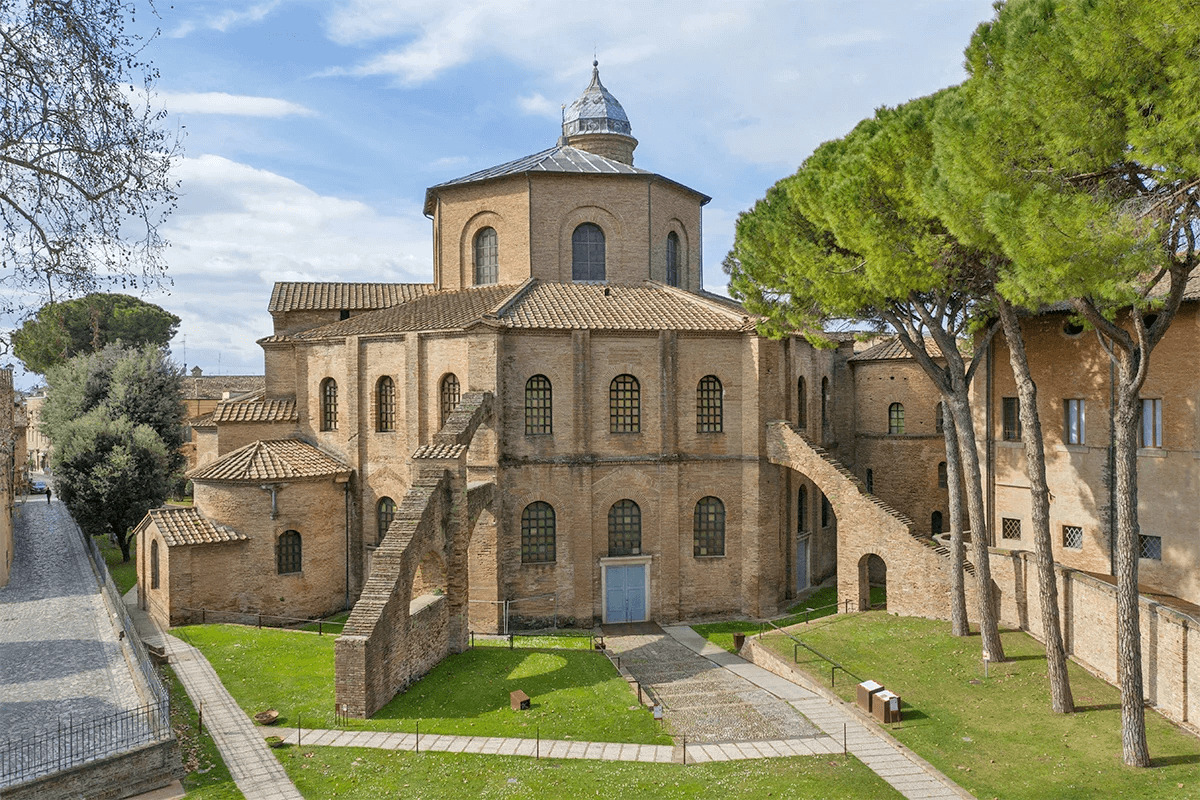
Basilica of San Vitale
Church in Ravenna, ItalyWikipedia
8
MENTIONS
6
EPISODES
6
PODCASTS
Search complete. 8 mentions across 6 episodes found for "Basilica of San Vitale".
Oct 21, 2026

Jonathan PageauHOST
Of course, it's not that these are represented always exactly the same.
Jonathan PageauHOST
It's a variation on a theme, right? And so in Ravenna, the Church of San Vitale, which is an amazing church.
Jonathan PageauHOST
If you've never been to Ravenna, go to Ravenna.
Jonathan PageauHOST
It's one of the most beautiful places in the world, especially because of how well it's been preserved.

Mike DHOST
If you ever get to Ravenna on Italy's Adriatic coast,
Mike DHOST
go see the Basilica of San Vitale.
Mike DHOST
It's an octagonal church consecrated in 547, and the inside glows with some of the finest mosaics to survive from the ancient world.
Mike DHOST
Now, a little context on Ravenna.

Michael WilcoxGUEST
There's a beautiful mosaic in Ravenna in Italy in an early, early Christian church.
Michael WilcoxGUEST
It's in San Vitale in Ravenna in the Apse.
Michael WilcoxGUEST
It shows Jesus beardless as a young youth, which is often the way they portray Jesus in early Christian art, young.
Michael WilcoxGUEST
And he's sitting on the earth.

Sue AndersonNARRATOR
The Goths had been vanquished and driven out of Italy.
Sue AndersonNARRATOR
The Byzantines under Belisarius and Narses had entered on possession, bringing with them a new splendor and new artistic feeling developed to their fullest extent in the decoration of the churches of San Michele in Afrisisco, San Vitale, and San Apollinaire in Classe, and of all the other churches of Ravenna which were completed between the years 540 and 547 by Julian the Treasurer.
Sue AndersonNARRATOR
The difference existing between the mosaic work of Ravenna under the rule of the late Western emperors and of the Goths and that executed after the re-establishment of the Eastern Empire and the institution of the exarchs is clearly seen when studied in their form, feeling, technique, and even in their material substance, and confirms what we are told by Cassiodorus and by other writers that Theodoric, partly from individual taste, partly from policy, employed Roman artists.
Sue AndersonNARRATOR
Direct inspection of the work itself is of more importance in this case than any other evidence, and it is surprising to find how long the obvious difference to which I refer has escaped the eyes of the historian and the art critic.

Waldemar JanuszczakNARRATOR
You'll know that it's mosaic heaven, where the Christian mosaic excelled itself.
Waldemar JanuszczakNARRATOR
How could anyone ever have thought any of this constituted a dark age? [birds chirping] [footsteps] This is the Church of San Vitale.
Waldemar JanuszczakNARRATOR
It's one of a group of churches in Ravenna that's filled with these stunning mosaics.
Waldemar JanuszczakNARRATOR
But the reason I brought you to this particular church is because of its shape.
Waldemar JanuszczakNARRATOR
These round churches of early Christianity have a particular effect on the visitor.
Waldemar JanuszczakNARRATOR
They offer a 360-degree experience, a sense of enclosure and centering.
Waldemar JanuszczakNARRATOR
The early Christians used round architecture particularly for churches devoted to the martyrs, like San Vitale up there, who'd stood up to Diocletian and died for his faith.
Waldemar JanuszczakNARRATOR
The basilicas were action spaces where you met and assembled and paraded, but these round churches, these are thinking spaces.

Sue AndersonNARRATOR
The Goths had been vanquished and driven out of Italy.
Sue AndersonNARRATOR
The Byzantines under Belisarius and Narses had entered on possession, bringing with them a new splendor and new artistic feeling developed to their fullest extent in the decoration of the churches of San Michele in Afrisico, San Vitale, and San Apollinaire in Classe, and of all the other churches of Ravenna, which were completed between the years 540 and 547 by Julian the Treasurer.
Sue AndersonNARRATOR
The difference existing between the mosaic work of Ravenna under the rule of the late Western emperors and of the Goths and that executed after the re-establishment of the Eastern Empire and the institution of the exarchs is clearly seen when studied in their form, feeling, technique, and even in their material substance, and confirms what we are told by Cassiodorus and by other writers that Theodoric, partly from individual taste, partly from policy, employed Roman artists.
Sue AndersonNARRATOR
Direct inspection of the work itself is of more importance in this case than any other evidence, and it is surprising to find how long the obvious difference to which I refer has escaped the eyes of the historian and the art critic.