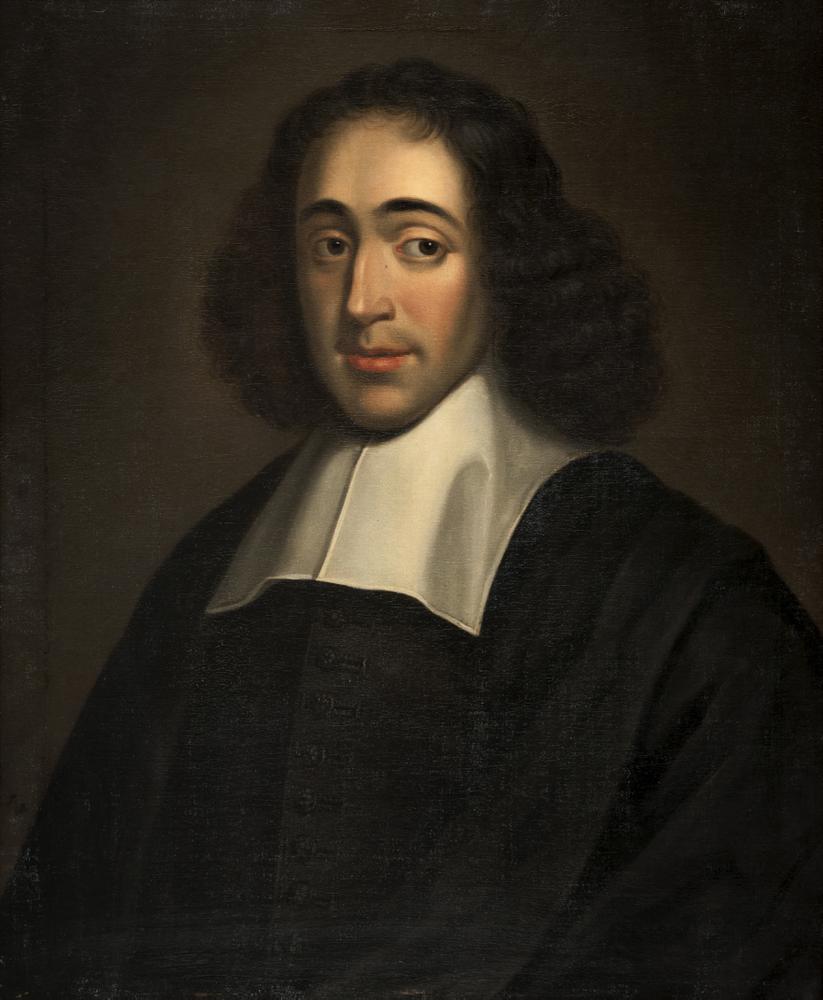
Baruch Spinoza
PhilosopherWikipedia
963
MENTIONS
222
EPISODES
188
PODCASTS
Search complete. 963 mentions across 222 episodes found for "Baruch Spinoza".
Oct 27, 2026

KeeganHOST
He was particularly interested in the Upanishads and the Vedas, and he would go on to become something of a pantheist, believing that there was ultimately no distinction between spirit and nature.
KeeganHOST
but rather that everything that comes into our experience in the phenomenal world could be called quote-unquote natural, which, you know, there's an obvious comparison to the philosophy of Spinoza, all things in God, si ve nature.
KeeganHOST
But Blackwood's interest in the supernatural colored these views, inspired by Eastern ideas like Advaita Vedanta, leading him to the conclusion that nature could not be understood as a reductive principle in the manner that, say, a scientific realist attempts to reduce everything strange or uncertain to a so-called naturalistic explanation.
KeeganHOST
Rather, what is contained within nature necessarily exceeds human understanding.

Nathan JacobsGUEST
So I just wanted to say here that I think Joe's actually quite right.
Nathan JacobsGUEST
So I think it's interesting that historically, somebody like Spinoza was branded an atheist.
Nathan JacobsGUEST
Now, of course, if you read Spinoza's Ethics, it begins with the ontological argument for the existence of God.
Nathan JacobsGUEST
But the difference is that Spinoza's God ends up being a base metaphysical principle of necessity, such that when we look around, well, whatever that necessity is that gives rise to all of this stuff... is what we call God.
Nathan JacobsGUEST
In some ways, it's almost taking Aquinas' conclusion, and this all men call God, and saying, well, that absolute necessity that's just there, as if you just told all the scientists who say, well, matter can't be created and destroyed, and it gives rise to all this, and then you say, ah, yes, and this all men call God.
Nathan JacobsGUEST
And that's essentially what you have, to oversimplify it, in somebody like Spinoza.
Nathan JacobsGUEST
And I think, on the one hand, there's...
Nathan JacobsGUEST
There's sort of two ways of looking at this.

speaker_1NARRATOR
In his Confessions, 397-400 CE, St. Augustine looks back on his devastation after a friend's death and diagnoses it as a spiritual mistake.
speaker_1NARRATOR
Why had that grief penetrated me so easily and so deeply, if not because I had poured out my soul onto the sand, loving someone who would die as if he never would? Baruch Spinoza, not religious in any conventional sense of the word, reached the same conclusion.
speaker_1NARRATOR
Sadness, he writes in his Ethics, 1677, is the mind's move to a lesser perfection, a loss of its power to act.
speaker_1NARRATOR
This means it can never be a good in itself, and its typical source is too much love for things that are impermanent.

Tom OvertonGUEST
It's something like, you know, at the height of her abilities she's speaking sort of more than six languages you know so kind of completely sort of you know kind of fluent to the level at which you can engage with philosophy at and so it's her who's I mean Walter Benjamin has a bit more of a profile particularly through Brecht because John knows about Brecht for I think first and that's partly through the seeing them the berliner ensemble and members meeting them through his sort of he sets up this thing in london uh called the the geneva club which is actually geneva it's confusing because he later lives in geneva but it's about the geneva accords which is about the sort of um the pre-american uh history of vietnam so it's a kind of anti it's a kind of anti-colonial um discussion group um and uh yeah it's Anya who all you know from the 60s to the 70s is the one who is um because she's working on alongside her sort of kind of day job at the UN in Geneva she's translating Lukács and Benjamin and all these because John um reads and speaks french uh but not not german which is strange because i often think he sounds quite germanic on recordings but um it's uh yeah it's andrew who's putting in front of him and i who is also kind of i suppose kind of passing it for him because he his i mean i'd be interested in your perspective on this but the set the sense in which he is a philosopher he's not in uh it's it's more on the sort of it often frustrates people certainly from an analytical philosophy tradition the way that he constitutes things but he's drawn far more to expressing it in the kind of the more mystical kind of poetic style of someone like Benjamin and he's the kind of the Kabbalistic dimensions of that also kind of have a there's a kind of Atalistic aspect of that because he knows his own
Omari EdwardsHOST
I think just to plug my own opinion, which obviously is far, far less educated on John, but I think it's really interesting that one i think the art criticism and the poetic language and this looking towards stories looking towards history is far more in line with a traditional view of continental philosophy more broadly which often uh you know the divide could be seen as a divide over uh logic and science versus uh you know a study of history and ideas obviously uh you know both sides uh would argue against this um but as broad strokes i think that's really interesting and i i will say um coming as trained as an analytic philosopher coming to john very much is like coming to someone like uh like benjamin like heidegger um in that categories are more fluid and his way of engaging I mean I think that I want to go on to talk about his relationship with Descartes and Spinoza because at the very least in interviews he says this is a touchstone throughout his life I don't know as the archivist whether or not that was true whether it was likely that he was reading Descartes and Spinoza um but um that it's very interesting you know this development against a sort of strict mechanical term turn rather um which i think someone like you know with and you're putting walter benjamin in front of him i think you know that that to me is like uh the debt could not be um undersold that you know that that sort of language is really powerful and really important for developing both his thought and the way that he goes on to discuss i think you know in terms at least of politics you can you can already see that you know this engagement both with anarchists and stalinists uh you'll you'll be able to get some of the social benefit but the philosophy that Ways of Seeing goes on to develop and perhaps we can talk about in more detail now is really thanks to Anya which is why I'm very happy to bring her up because it's really...
CharlesHOST
Yeah.
Omari EdwardsHOST
So in terms of, you know, turning more straightforwardly to, I think, obviously the novels G, the Booker Prize winning novel, should be somewhere that anyone who's not familiar with John goes to as an excellent read.
8 MINS LATER
Omari EdwardsHOST
It's, it's really a magnificent biography that really gets into all of the different periods.
Omari EdwardsHOST
But one of the things that I wanted to ask about is, you know, later in life, he, he, um, goes on to write, um, uh, Bento's sketchbook.
Omari EdwardsHOST
Um, he, he goes and I think does a BBC interview where he says he's turning away, uh, from Descartes towards Spinoza, uh, And I just wondered, as a broader philosophical question to you, and just thinking about how his thoughts, his ideas were being changed, whether being drawn to Spinoza was also connected with Spinoza is being cast out.
Omari EdwardsHOST
So Spinoza was cast out of his Amsterdam Jewish community in a similar way much earlier in his life.

Charlotte WilderHOST
Yeah.
Charlotte WilderHOST
Jewish philosopher Spinoza.
Charlotte WilderHOST
What is it? Famously said, like, right now.
Charlotte WilderHOST
Yeah.

TJ OnadiGUEST
She made a comparison between two, what on the surface sound very similar points of view.
TJ OnadiGUEST
One is, I think it dates back to Spinoza.
TJ OnadiGUEST
He called it under the aspect of eternity.
TJ OnadiGUEST
I forget the Latin.
TJ OnadiGUEST
another point of view, which, uh, she calls the Archimedean view, the view from the Archimedean point, this sort of hypothetical point outside of existence from where you can view existence.
TJ OnadiGUEST
And, uh, she said that is a false view, a false consciousness that it's, uh, sort of simulated and delusive.
TJ OnadiGUEST
Whereas, uh, Spinoza's, you know, um, I struggle with understanding exactly the distinction she was raising.
TJ OnadiGUEST
But one, Spinoza's exists in the universe as it is and is not accessible to human beings, right? It's only the pursuit of trying to get there that we're able to do.

Martin SolveigGUEST
But sometimes you catch this sentence and you're like, how powerful this idea is.
Martin SolveigGUEST
And so when you read this, typically, one of the recent book I read was this story about Spinoza.
Martin SolveigGUEST
You know, it's not the book by Spinoza, but it's more like his life and The Problem Spinoza or something like this, I think it's the title of the book.
Martin SolveigGUEST
The idea of reading philosophy books or thought, you know, all these things sort of brings us back to a certain reality that we are not much, you know.
Martin SolveigGUEST
And so I'm trying every day to do things right for, you know, for the others and feel that it's a good motto.

Joe BartolozziHOST
So yeah, I don't really know if I fucking covered this idea very well.
Joe BartolozziHOST
I could go into more philosophers like Hume and Spinoza and shit, but they all fucking say the same thing in different ways.
Joe BartolozziHOST
And sometimes they go into other, like Wittgenstein goes into like, I guess a more word-based argument.
Joe BartolozziHOST
It's very hard to explain what he's trying to say.

ClaireHOST
That is, I think, the most useful thing this episode has given me, and I did not expect to find it here.
ClaireHOST
Next week, we are covering Spinoza, the excommunicated lens grinder whose god was nature itself, substance, and necessity, and why Einstein said Spinoza's god was the only one he believed in.
ClaireHOST
It is one of the strangest and most serene philosophical systems we will cover this run.
SeanHOST
If this episode gave you a new way to think about your own work history, whether it looks like a single through line or a scattered set of odd jobs, share it with someone who might be questioning whether they are behind.

Boaz SoiferHOST
And they have this idea.
Boaz SoiferHOST
of God, or if you will, all consciousness, if you will, the substance, for Spinoza maybe, right, or whatever, that is that which is underlying everything.
Boaz SoiferHOST
is basically playing a game with itself where it breaks itself up into a million pieces or more than a million, a zillion, a zillion, a zillion.
Brian LeeHOST
More than a million.
212 more episodes mention Baruch Spinoza.
Create an account to see the whole feed, search across every transcript, and follow the entities you care about.