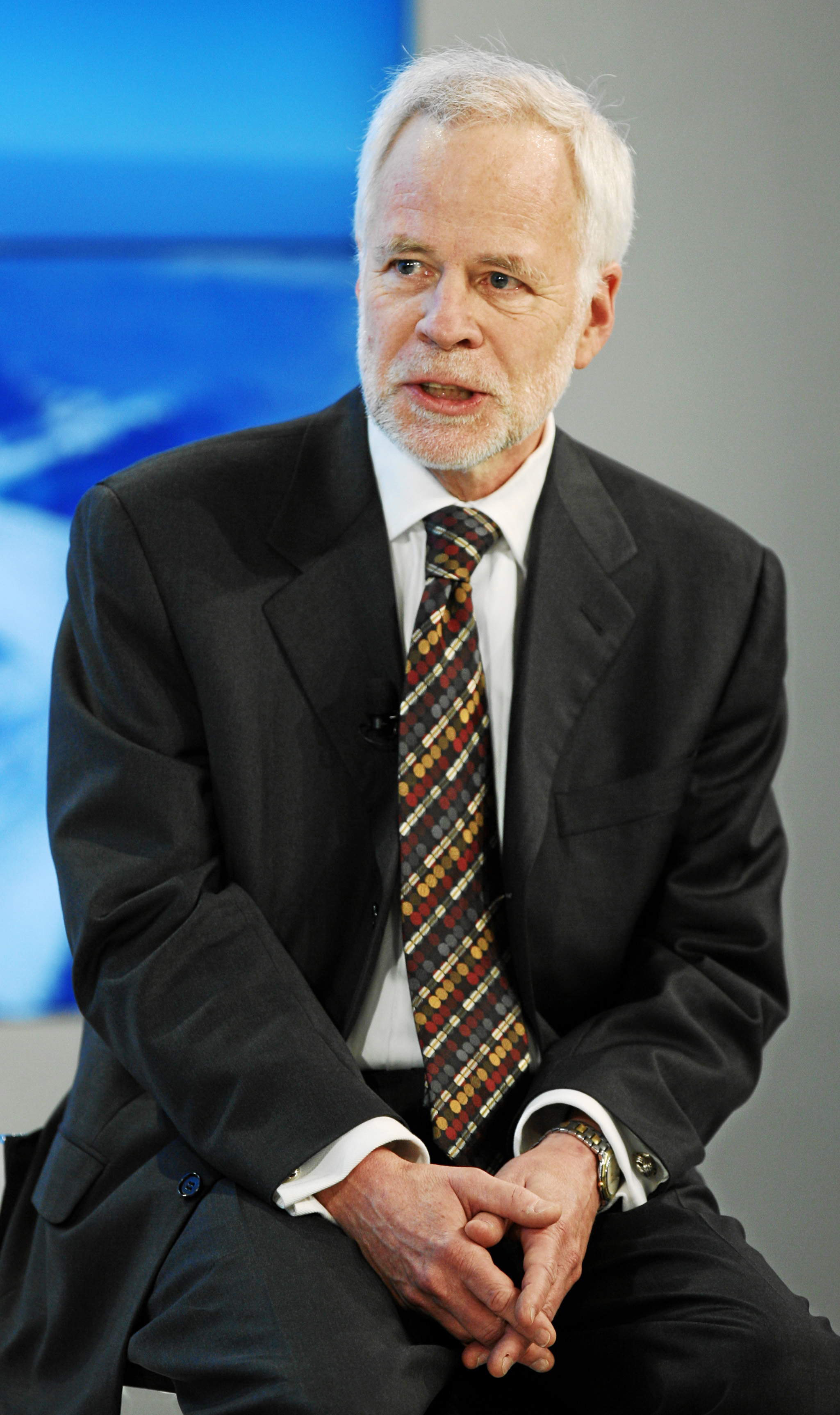
Barry Eichengreen
American economistWikipedia
19
MENTIONS
14
EPISODES
13
PODCASTS
Search complete. 19 mentions across 14 episodes found for "Barry Eichengreen".
Sep 18, 2026

Torsten SlokGUEST
And these tailwinds are really the critical reason why the economy continues to do so well.
Tom KeeneHOST
Are you modeling out a continued 5% nominal GDP, which clearly within Barry Eichengreen's financialization benefits the haves?
Torsten SlokGUEST
Absolutely, we expect still growth to be strong.
Torsten SlokGUEST
And what's really unique, as you also just spoke about a minute ago, is that when interest rates are high, it hurts the interest rate sensitive parts of the economy, which is housing and autos.

James RickardsGUEST
moving around and no real foreign exchange trading.
James RickardsGUEST
Barry Eichengreen, a scholar at Berkeley, University of California, Berkeley, has written on this and done some very good scholarly work on it.
James RickardsGUEST
So how long was Sterling's run? Well, you probably got to go back to the early 18th century.
James RickardsGUEST
Isaac Newton, by the way, he didn't just discover calculus and the laws of planetary motion.

AksharaHOST
So a big home loan at a low rate can come with a much smaller EMI than a much smaller loan at a high rate.
AksharaHOST
Now, in a recent paper, Barry Eichengreen, Maxime Menuet, and Gregory Dona looked at data for 12 advanced economies, including US data going back to 1800.
AksharaHOST
They focused on the primary balance, which in simple terms is the government's budget before interest.
AksharaHOST
So a primary surplus means taxes are enough to cover spending.

Jim SteelGUEST
Um, now in the last few years, the markets have been buying.
Jim SteelGUEST
And one of the things that, uh, Barry Eichengreen, who's a excellent gold economist, uh, at, uh, at Berkeley, uh, what he says is that the use of sanctions has reinvigorated central bank demand for gold in case you're in a country that could be put under sanctions.
Jim SteelGUEST
You'd rather have that, you'd want that gold.
Jim SteelGUEST
Now, that's in addition to all the other traditional things, which is I have a lot of dollars.

Cole SmeadHOST
And it's miraculous in some respects, isn't it?
Kenneth RogoffGUEST
Well, I'm, I'm not a Europhile like I say maybe Barry Eichengreen has been.
Cole SmeadHOST
Sure.
Kenneth RogoffGUEST
Uh, I've been watching from afar as a great skeptic of the whole thing.

James SteeleGUEST
Now, in the last few years, the markets have been buying.
James SteeleGUEST
And one of the things that Barry Eichengreen, who's an excellent gold economist at Berkeley, what he says is that the use of sanctions – has reinvigorated central bank demand for gold in case you're in a country that could be put under sanctions.
James SteeleGUEST
You'd rather have that.
James SteeleGUEST
You'd want that gold.

Patrick BoyleHOST
Within two weeks, the yen had surrendered about half of that, weakening back past 159.
Patrick BoyleHOST
Barry Eichengreen, writing in the Financial Times, pointed out that $88 billion is ultimately small potatoes against the sheer scale of the currency market.
Patrick BoyleHOST
In ordinary life, $88 billion is real money.
Patrick BoyleHOST
In the foreign exchange market, where trades worth trillions change hands every day, it is a rounding error.

Christopher MeissnerGUEST
So the 19th century, modern observers have looked back on it and tried to learn lessons about what created such stability.
Christopher MeissnerGUEST
How did it manage this great amount of stability? And maybe it's the next question, but I think the answer to that is, well, credibility and cooperation, as Barry Eichengreen has emphasized.
Christopher MeissnerGUEST
I'm going to talk about what credibility and cooperation mean in a second, but I would just highlight here that gold standard didn't work particularly well for countries on the so-called periphery the less developed countries the countries with economies with less well-developed financial systems their track record wasn't so great and so a lot of those countries had exchange rate crises balance of payment crises of the time and great amounts of instability so there's a lot to be learned there too so if you're in the 20th century and thinking the gold standard works all the time I think there's a lot of less developed countries that beg to differ.
Christopher MeissnerGUEST
Now, I'll just go ahead and talk about the foundation of stability.
14 MINS LATER
Christopher MeissnerGUEST
There were great incentives to rebuild the global economy, specialize along the lines of comparative advantage with the European coal and steel community and the European community eventually building the common market.
Christopher MeissnerGUEST
And domestically, labor had made peace with management, keeping investment high, wage growth moderate, and inflation low.
Christopher MeissnerGUEST
And the story that Barry Eichengreen tells about that is a fascinating one, but it's worth remembering.
Christopher MeissnerGUEST
And it's, I think, a very nice narrative about some of the general aspects of economic growth in Western Europe and how it was so successful.

Tom KeeneHOST
I, you know, I wanna synthesize in here your Wharton abilities, which is this linkage here that we have of our financial system into our politics, into our markets.
Tom KeeneHOST
Barry Eichengreen, with my book of the summer, talks about financialization.
Tom KeeneHOST
And I think that's maybe what we're all screaming about, including Mr. Druckenmiller and Mr. Bassett.
Tom KeeneHOST
With your wonderful perspective, Steve Sosnick, how financialized are we right now?

speaker_1ADVERTISER
Kitco News in Focus with Jeremy Safran.
Jeremy SzafronHOST
Now, Professor Barry Eichengreen, of course, joins me from Berkeley, and if you've never heard of him, I mean, this is the man central banks and the International Monetary Fund actually read on this subject.
Jeremy SzafronHOST
He wrote the standard history of how money moves between countries, and his new book is Money Beyond Borders.
Jeremy SzafronHOST
He also wrote a piece in May called Gold's Grim Message, and that's the reason I asked him here today.
56 MINS LATER
Barry EichengreenGUEST
What do you do, young man?" So I'll wait for the evidence.
Jeremy SzafronHOST
[laughs] I love it.
Jeremy SzafronHOST
All right, Professor Barry Eichengreen.
Jeremy SzafronHOST
Uh, the book is Money Beyond Borders, out now from Princeton.
4 more episodes mention Barry Eichengreen.
Create an account to see the whole feed, search across every transcript, and follow the entities you care about.