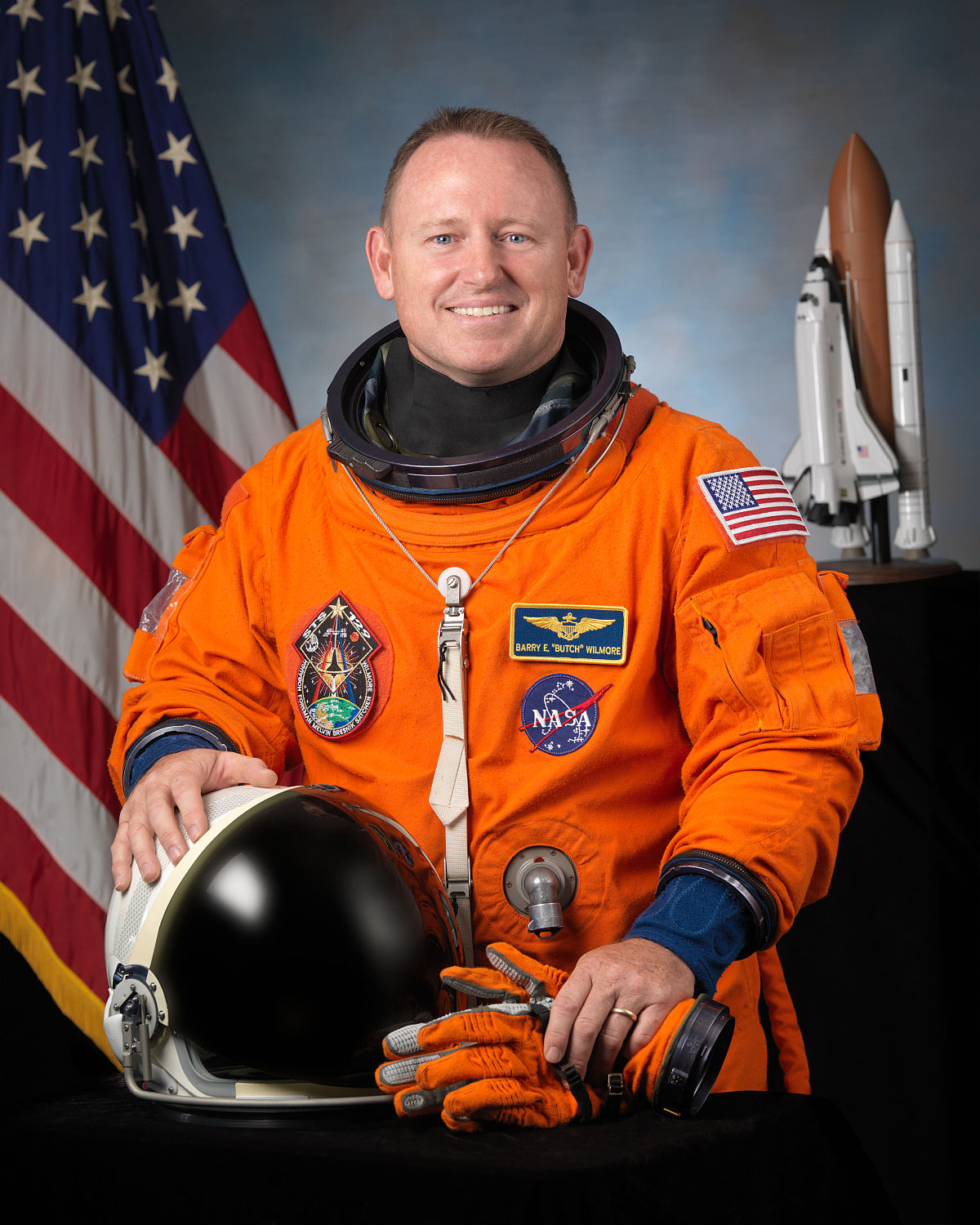
Barry Wilmore
American astronaut
15
APPEARANCES
15
PODCASTS
Aug 19, 2026

4:28
I, I didn't count them, but that's what I was told, so I just trust that they told me the truth.
4:32
Uh, but anyway, various missions supporting, uh, the goals of our nation in space, a dominance of space, and which includes the International Space Station right now, primarily for science.
4:42
And most of what we do, I, we over, almost 300 different science missions, uh, um, projects and, and other things that take place on the space station, um, while I was there for this last mission.
4:57
Um, how did I get stranded, stuck in space? So we have spacecraft, all of our spacecraft, maneuver in space with thrusters, right? There's no vacuum.
19 MINS LATER


Shannon BreamHOST
Give us a little context for how our space programs have really shaped this country and how that has in turn shaped the world because of our ingenuity.

Butch WilmoreGUEST
We went out and won our freedom on the battlefield and signed the Constitution 11 years later.

Shannon BreamHOST
From the earliest days of exploration, to the first steps on the Moon and the missions shaping our future, NASA represents the spirit of discovery that defines our nation." Um, give us a little context for how our space programs have really shaped this country and how that has in turn shaped the world because of our ingenuity.
Butch WilmoreGUEST
We went out and won our freedom on the battlefield and signed the Constitution 11 years later.
Butch WilmoreGUEST
Only 116 years after that, Orville and Wilbur White, Orville and Wilbur Wright took to the, took to the air.
Butch WilmoreGUEST
58 years after that, Alan Shepard breached the atmosphere into space, and eight years after that, uh, Aldrin and Armstrong were boots on the Moon.
Butch WilmoreGUEST
And now we are 26 years straight of human presence in space, and the future is bright.

Barry WilmoreGUEST
Get this, I was a linebacker on defense, a guard on offense, and the second-string quarterback.
Barry WilmoreGUEST
[laughs] That is a strange combination, but that's what you do in junior high.
15 MINS LATER
Lee WebbHOST
Tell us about what you're doing now and how the Lord is playing a role in, in your life.

TyrusHOST
Right.
Butch WilmoreGUEST
And it wasn't really until President Trump came back in that it got lit afire again to go back and pursue those capabilities to get back beyond low-Earth orbit and into the, you know, the lunar are- area of the moon, and that really started to stoke the fire again to go forward and make this happen again.
Butch WilmoreGUEST
So we took the, the architecture that we had, the spacecraft that we had and what we were building, kinda transformed a little bit to what we have now with the Artemis program.
Butch WilmoreGUEST
And, and b- be quite honest, uh, in the last couple years, the Artemis architecture, very challenging to do to get us to the surface of the moon.
Butch WilmoreGUEST
Everything, uh, together, how we were, the processes, we were gonna launch, and the mul- number of launches and in-space refueling of cryogenic, uh, fuels and all that, which, uh, the gory details are gory.
5 MINS LATER
TyrusHOST
Right.


speaker_4HOST
Let's begin with Butch's story.
Butch WilmoreGUEST
The progression of this life, my life, as far as how things transpired, it all started with my parents.
Butch WilmoreGUEST
They said, "You will go to college." It wasn't like if you might go or not go.
Butch WilmoreGUEST
"You're going." And so into college and always trying to do the best of what the Lord gave me, I went into electrical engineering and majored in that.
7 MINS LATER
speaker_5SOUNDBITE_SPEAKER
Butch and Suni have made their arrival.

12:14
And it takes balance, balancing all these other requirements out, and, and that was key.
12:23
Get- preparing for this mission, the rendezvous officer, that was Ray Biganez is his name, he's a volunteer fireman, and he'd say, "Butch, I'm coming off shift at 5:30 AM on Saturday morning.
12:40
And I'm like, "Roger that." Because the commitment for, for the role that I was given, all in, and the preparation has to ma- has to match that.
41 MINS LATER

Ken ColemanHOST
... and as a man of faith with a very unique, real perspective, what would you say to those people about what you've seen?


Butch WilmoreGUEST
So when, it was three months, we were on space station three months before the final decision was made not to return on the spacecraft.
Butch WilmoreGUEST
But about a month in, because of what I already knew, I told my family, I said, "Hey, the most likely scenario is, you know, we don't, we don't make it back until probably 2025." And this was July of 2024 at the time.
11 MINS LATER
speaker_2HOST
Certainly more than two.


Butch WilmoreGUEST
Uh, the process w- did not, you know, go long, long, long for me, for me or Sunny.
Butch WilmoreGUEST
Uh, w- we were in the spacecraft, obviously, when we had our problems, and, uh, we will go into the, maybe go into the problems in a little bit, but basically the situation we were in, we lost the ability to fully control the spacecraft, and I'm on the controls manually and, uh, doing my best to maintain control, trying to see if we could get in a process where we could dock.
Butch WilmoreGUEST
So the thought process was this: W- we have to dock because the situation we're in, I'm not sure we can get back to Earth.
Butch WilmoreGUEST
We dropped four thrusters, which a- affected our ability to fully control the spacecraft.
5 MINS LATER
speaker_6HOST
... for what's coming?

Barry WilmoreGUEST
Put them all together, that's six degrees of freedom, and we, we couldn't fully do that.
Barry WilmoreGUEST
So that led to the, you know, the situation where at least out in front of the space station, where we actually, we really needed to dock.
Barry WilmoreGUEST
We had to dock, um, because our options were limited if we weren't able to dock.

John SolomonHOST
Tell us a little bit about how this also becomes a personal spiritual journey for you.

speaker_7HOST
A lot.
Butch WilmoreGUEST
When I came back, I, I said it, I, I, I didn't see a lot of discussion about those issues from NASA or Boeing while I was in space, but when I got back, yeah, the, m- every press conference we had, we had several on orbit, and even getting back, I had four, four goals in mind when I spoke to the media and the, and the nation and the glo- and the world.
Butch WilmoreGUEST
I wanted to honor my, uh, our administration, that's our leadership of our nation, because this is a national endeavor.
Butch WilmoreGUEST
I wanted to honor NASA, my direct, you know, the, the ones that, that I'm, I'm a, I'm a slave to the...
1 HR 2 MINS LATER
speaker_9HOST
Damn.

Barry WilmoreGUEST
I actually initially started writing chapters for my daughters because my wife and I, we were in our 40s when we had them, and we'd lived a life before they were born.
Barry WilmoreGUEST
But the Starliner saga continued throughout the... 2024 and the first part of 2025, I continued to write some chapters while I was in space, trying to use my my time with intent.
Barry WilmoreGUEST
And as the story began to develop, it just seemed like a good story of hope in the now.
Barry WilmoreGUEST
And it also, you know, I believe in it doesn't matter what I believe, what matters is what's true.

Butch WilmoreGUEST
The structure of your skeletal structure, I think for most people, grab, you have to hold that up, and your muscles, especially your back muscles, are not used to that, so you have some tension in your back.
Butch WilmoreGUEST
I still feel a little bit right now, even though we've been back almost two weeks.

Anderson CooperHOST
Were you aware of the controversy that was stirred up after that interview, and, and how do you see it all now?
Butch WilmoreGUEST
Uh, uh, you know, I can't, I can't speak to all those comments that were made or things that were said.


Tom CostelloCORRESPONDENT
Did you ever feel abandoned up there? Did you ever feel that NASA, the White House, anybody had abandoned you?
Butch WilmoreGUEST
I understand the, the, the rhetoric that was taking place, I understand the reason for it.