Bantu peoples
Ethnolinguistic groupWikipedia
110
MENTIONS
49
EPISODES
46
PODCASTS
Search complete. 110 mentions across 49 episodes found for "Bantu peoples".
Oct 31, 2026

Troy LavalleeHOST
The outskirts.
Troy LavalleeHOST
English is widely spoken in Nairobi, which is good for you, though outside of the city, if you have to go out at all, and a few other towns, most black Africans speak little or no English, something you may want to keep in mind should you need to communicate with them, but luckily Hugo knows a little Bantu.
Troy LavalleeHOST
And if you speak Swahili, you can get by even when speaking with tribes who speak other dialects.
Troy LavalleeHOST
Which
Joe O'BrienHOST
is great.
Joe O'BrienHOST
Well, Bantu, Swahili is a
Troy LavalleeHOST
subsect, yeah.
Troy LavalleeHOST
So, I imagine you're going to want to sleep in.

Ben ReimanHOST
Where are they? Tell me a little bit about their story.
Heather Sauyaq Jean Kwamboka GordonGUEST
Yeah, the Kisi people are one of the 40 tribes in Kenya, and they are a Bantu-descended people, and they live in southwest Kenya.
Heather Sauyaq Jean Kwamboka GordonGUEST
They are a subsistence agriculture practice, more living in one place now, and they're specifically known for living in an area and growing the very small sweet bananas.
Heather Sauyaq Jean Kwamboka GordonGUEST
My mother-in-law loves her bananas, and the sweet bananas are specifically what the area is known for and connected to the people as well.

Stephen C. StearnsHOST
And we're going to see that in Europe the agriculture was spread out from the Middle East and squeezed the Celts into the Northwest.
Stephen C. StearnsHOST
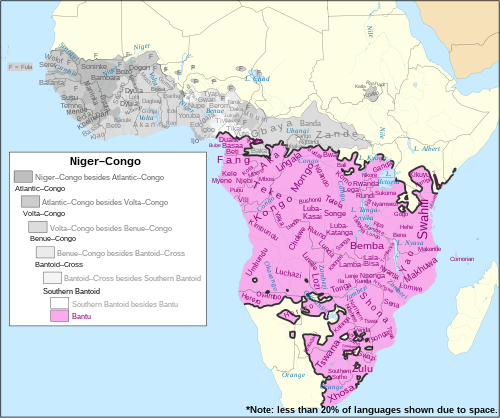
In Africa we're going to see the Bantu migration out of Cameroon, and how the Hottentots were squeezed into the Southwest of Africa.
Stephen C. StearnsHOST
And in Asia we'll see that agriculture was spread from both the Middle East and from China, and squeezed Siberians into the North.
Stephen C. StearnsHOST
So these things are laid out in a beautiful book by Cabelli Sforza, Paolo Manazzi, and another author, Alberto Piazza, I believe.
Stephen C. StearnsHOST
Interesting stuff.
Stephen C. StearnsHOST
If you look at Africa, What you can see is that there has been an invasion of Africa by Caucasoid northern Africans, and by sort of an Arab nilotic expansion, coming down this way.
Stephen C. StearnsHOST
The Bantu expansion out of Cameroon is what is coloring part of the continent pretty red.
Stephen C. StearnsHOST
And by the way, this migration got through here about 1,000 years ago.

Philip Ryan DealHOST
In Jamaica, they have a practice called obia, There are Congo-derived practices.
Philip Ryan DealHOST
Those are from the Bantu-speaking people of Central Africa.
Philip Ryan DealHOST
In Cuba, they call it Palo, Palo Mayombe, Palo Kimbisa, Palo Brionba.
Philip Ryan DealHOST
There are many different branches of Palo.

Gnaka LagokeGUEST
In Africa, we have more than 2,000 languages.
Gnaka LagokeGUEST
Ubuntu is a philosophy, a way of life of the Bantu people.
Gnaka LagokeGUEST
The Bantu people represent, out of the 2,000 languages in Africa, we have between 400 and 600 Bantu or Bantu languages.
Gnaka LagokeGUEST
In history, when we study the migration of the Bantu, you can see them like in different parts of Africa, in the southern parts, central, eastern, western, even like in the northern part of Africa.
Gnaka LagokeGUEST
So that it's a sense of community and collectivism.
Gnaka LagokeGUEST
The popular phrase of Ubuntu is that I am because we are.
Gnaka LagokeGUEST
And then as I'm going to end my answer talking about that point is that Cheikh Anta Diop from Senegal, he spoke about the cultural and the linguistic unity of Africa.
Gnaka LagokeGUEST
And in his books, he talks about how the ancient Egyptian civilization, a human being was called Nti, N-T-I.

Ivana HeijnenHOST
Infuyo.
Bernard NjathiGUEST
Infuyo, which means wealth or livestock in the Bantu language, mainly the Zulu language in South Africa.
Bernard NjathiGUEST
And Infuyo is a data and finance company in livestock value chain.
Bernard NjathiGUEST
But also wear a second hat.

speaker_0NARRATOR
A bone tool with a lump of quartz attached to it that is believed to have been created roughly 20,000 years ago, possibly as some kind of rudimentary mathematical tool.
speaker_0NARRATOR
Early hunter-gatherers in the area were eventually either replaced or absorbed into the Bantu tribes that began migrating southwards probably around the first millennium BC, and these Bantu kingdoms gradually evolved over the coming centuries.
speaker_0NARRATOR
things began to go just a bit apocalyptical when the belgium king leopold ii decided he wanted his own private slave plantation but in truth things had never been easy in this region the eastern area of what is today the drc saw frequent raids by the arab swahili slave traders who were bringing boats ashore on mainland africa to collect people without their consent long before europeans began doing the same but things quickly careened off a high cliff once king leopold envious of other european nations and their african colonies decided he wanted a slice of the pie for himself now this is important because while other nations had certainly marched into african regions and announced that those living there were now under the white rule of the king or queen living thousands of miles away it was always done so under the banner of a nation itself king leopold however have very different ideas in fact it's absolutely insane to think that in 1885 king leopold was able to claim such a massive piece of land not for belgium but for himself even more ludicrous considering what was to come he was able to convince other leaders at the berlin conference which began in 1884 to carve up the continent that he was a humanitarian and esteemed philanthropist and dear viewer i would like you to keep that particular sentence in mind when i begin to explain about what happened in the congo free state it began with a lot of bluster about suppressing the slave trade and the usual pompous crap about civilizing the natives and while thousands of slaves were liberated and the congolese were granted rights over their own lands it didn't take very long for that to go crashing down you see running a country is rather expensive and king leopold quickly ran up huge debts that even threatened his stake in the congo in response he set in motion a series of decrees that would push many to the brink and cause millions of deaths first came new land laws which essentially meant any piece of land without a dwelling or cultivation was automatically claimed by the state and this was followed by rules which forced the congolese to only sell their goods to the state which of course could set the prices at whatever they wanted them to be in 1992 leopold carved up the country and handed out huge parcels of land to private companies to create vast rubber plantations They were also given the freedom to police their land how they wished, which included detaining Africans who didn't work hard enough.
speaker_0NARRATOR
In return, the companies paid a hefty annual dividend which, you guessed it, found its way into Leopold's bulging wallet.

JeffAUDIENCE
So there's just like a walked path or you could have an actual patrol road because it's very clearly marked on the map.
JeffAUDIENCE
And because it takes place in East Africa, the names are already pretty applicable for a fantasy setting, assuming you're not, you know, a speaker of a Bantu language, right? Kilosa just sounds like a fantasy name, works perfectly.
JeffAUDIENCE
I mean, there's even a town called Sphinx Haven, that's a real place on the banks of the Lankan Lhasa.
JeffAUDIENCE
So this map was it all.

Kaila StoryGUEST
And it was this white woman with these little buns all over her hair.
Kaila StoryGUEST
And I'm like, you mean Bantu knots, which is a traditional African hairstyle.
Kaila StoryGUEST
They just they just did something.
Kaila StoryGUEST
I feel like in Elle or Vogue where they had Tracy Ellis Ross and they're like the cloud bob.

John David UlfertsHOST
This World Heritage Site has been called the Louvre of the Desert as its massive quartzite rock formations contain over 4,500 rock paintings dating back at least 100,000 years.
John David UlfertsHOST
The three prominent hills were thought to make up a trinity for the Bushmen and Bantu people.
John David UlfertsHOST
The largest was called the Male Hill, followed by the Female and Child Hills.
John David UlfertsHOST
The Sedillo Hills were holy to both the Bushmen and the Bantu, who believed the hills to be the birthplace of all life.
John David UlfertsHOST
The first humans were thought to have descended from the heavens atop these hills.
John David UlfertsHOST
The spirits of the deceased were also thought to occupy the hills.
39 more episodes mention Bantu peoples.
Create an account to see the whole feed, search across every transcript, and follow the entities you care about.