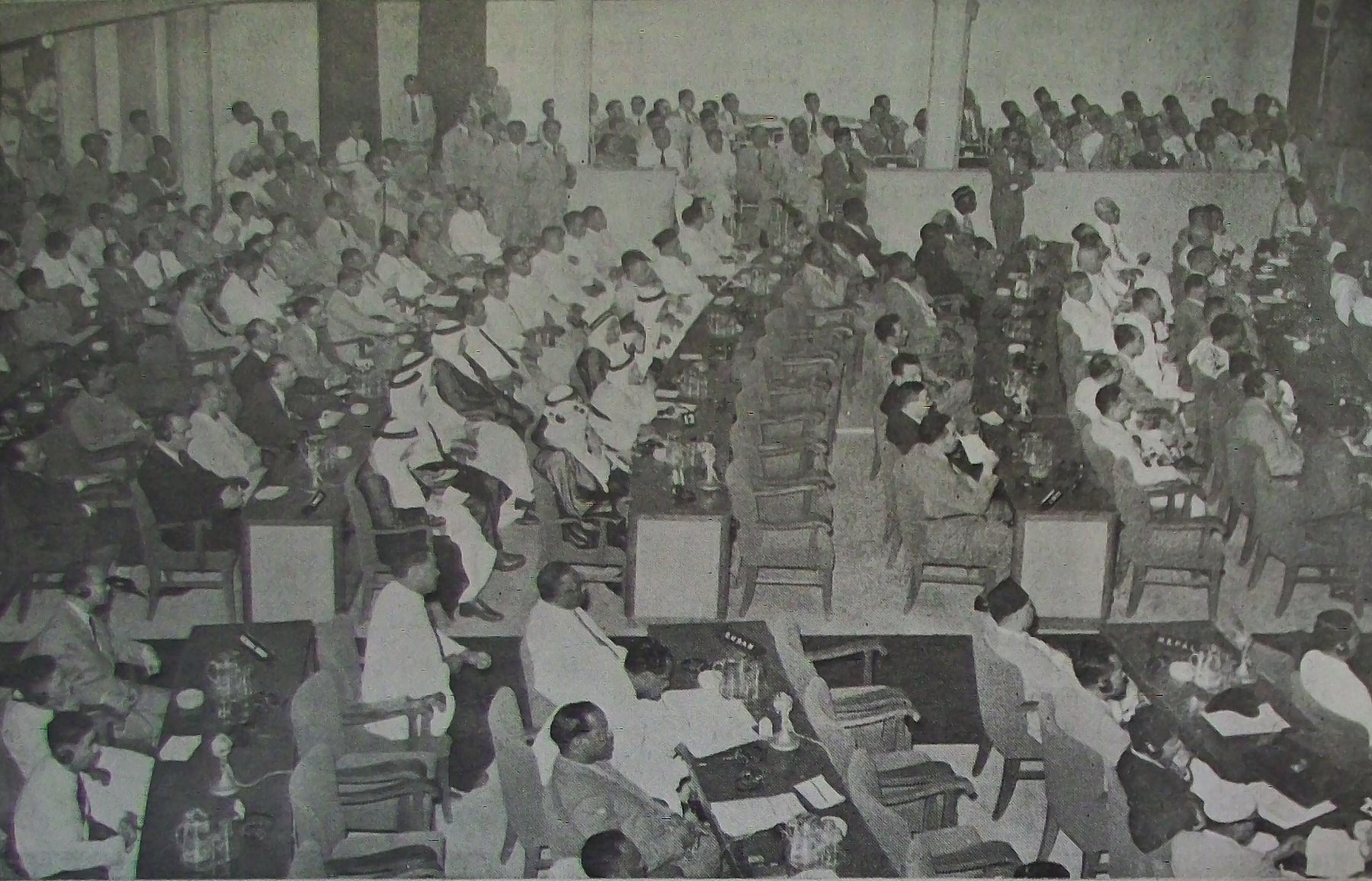
Bandung Conference
11
MENTIONS
10
EPISODES
10
PODCASTS
Search complete. 11 mentions across 10 episodes found for "Bandung Conference".
Oct 14, 2026

Dan BanikHOST
I use it in my lectures, in my published work, and on this podcast.
Dan BanikHOST
Indeed, it is certainly being used much more today than at any point since the historic Bandung Conference of 1955.
Dan BanikHOST
Many countries are comfortable using it, even though there are some, especially I would argue in the global north, who question whether the global south is any better than similar terms we've used in the past, such as low-income countries, developing countries, etc., But although I am increasingly using the phrase, I am doing so with a sense of unease, because I am, like perhaps many of you, well aware of the numerous contradictions the term entails.
Dan BanikHOST
Indeed, the Global South is sometimes used to signify a bloc in the sense of a group of countries that are acting together, often because they have a common set of grievances and claims against the Global North.

Dashran YohanHOST
It's about uniting different groups of people on a particular land to develop and grow and come together and modernize together.
Dashran YohanHOST
I think that was the spirit of, you know, Bandung Conference, um, you know, which had folks like Sukarno and Nehru and, and so on and so forth.
Azif AzudinGUEST
Yeah, it's interesting that you say that because you're saying that there is a pushback against imperialism, right? Which we, which we saw in the '70s and '80s.
Azif AzudinGUEST
But if you look at the Malaysian version, the Malaysian narrative of the far right, they are essentially saying that they're essentially blending those two together, that you can still be exclusionary.

Hans van de VenGUEST
Um, they have stood up to Japan and all of that.
Hans van de VenGUEST
Uh, but what are they going-- what is, what is China going to do w- vis-à-vis these Chinese populations? How are they going-- do they want to extend their influence? And in 1955, at the Bandung Conference, Zhou Enlai's offer is act-- is simply, no, we're going to recognize all you new independent countries.
Hans van de VenGUEST
We want settlements with them.
Hans van de VenGUEST
We will-- we want nationality laws, and that's all fine.

Rebecca ChristieHOST
Before I hand it over to Alicia, do you wanna speak a little more definitively about, like, is this a good group? Is this a useful thing? You've talked about 9/11, you've talked about sort of the history and the World Bank, but I didn't feel like you clearly said, "This is good," or, "This is an issue and we're gonna come back to that."
Suman BeryGUEST
Well, India, you know, has always seen itself from the 1955 Bandung Conference as an aspirant leader of the Global South.
Suman BeryGUEST
And I cannot recall where the idea originated from, but I do think what is very important are two points, uh, Rebecca.
Suman BeryGUEST
One is that that was a moment where the economic distance between India and China was not very great, and where the, perhaps as a consequence, the geopolitical relationship was stable and even.

Julian FeeldHOST
or less.
Julian FeeldHOST
But Sukarno was very involved in the third worldist movement and he organized the Bandung Conference, which is like a famous third world conference at the time.
Julian FeeldHOST
where the nations independently met without any fucking imperial nations present and discussed their own independence and their own sovereignty in the future.
Jon GabrusHOST
Oh, cool.

AshwinHOST
India was a strong proponent of the non-aligned movement.
AshwinHOST
It was, you know, part of the Bandung Conference, the Afro-Asian Conference, you know, in the 1950s.
AshwinHOST
It was kind of a...
AshwinHOST
After, you know, 200-something years of colonialism, it was, you know... attempting to carry this mantle of the global south, of the decolonizing world, et cetera.

Fernando PazGUEST
Libya is not a pro-Soviet country, but it is a very strongly anti-North American country, anti-imperialist at the time.
Fernando PazGUEST
And it is also one of the leaders of the non-aligned group that comes from the Bandung Conference of the year 55.
Fernando PazGUEST
Muammar Gaddafi is one of the great anti-North American leaders of the world, although he is not pro-Soviet.
Fernando PazGUEST
We have Algeria, which is also strongly pro-Soviet.

Richard RJ EskowHOST
And then you talk about what's going on in the Global South with some cautionary notes in there.
Richard RJ EskowHOST
And you talk about, you contrast the Global South today with, for example, I guess I would say the Bandung Conference in the mid-1950s, I think it was, and And then, of course, the revolutionary socialist movements of that era in the 1960s.
Richard RJ EskowHOST
And you conclude by saying, I was intrigued by this, and I'm sure it was a work of collective authorship, but saying of these countries, their projects are fragile and appear in ways that are not necessarily progressive.
Richard RJ EskowHOST
And yet the quantity of areas that seek to break from the current world order is not widespread or powerful enough to change the quality of the world order.

Anuradha ChenoyGUEST
It says it very clearly.
Anuradha ChenoyGUEST
And, of course, from earlier the Kazan meeting of BRICS, the Rio de Janeiro meeting of BRICS, so it draws a line that historicity of the Bandung Conference has come out for the first time.
Anuradha ChenoyGUEST
And that was clearly, you know, that was a foundational kind of arch of non-alignment.
Pascal LottazHOST
And this is clearly the Indian hand, right? I think it's the Chinese.

Stanly JohnyGUEST
I, I can argue, I can make two arguments.
Stanly JohnyGUEST
One, uh, one interesting point I noticed in the Delhi Declaration was that there is a clear reference to the 1955 Bandung Conference.
Sharmada VenkatasubramanianHOST
Right.
Stanly JohnyGUEST
And the Indians were a critical component of the Bandung Conference, the Indians and the Chinese.
Stanly JohnyGUEST
I mean, it was, um, basically this was the Afro-Asian Solidarity Conference.
Stanly JohnyGUEST
And BRICS statement says that we are actually driven by the spirit of Bandung.