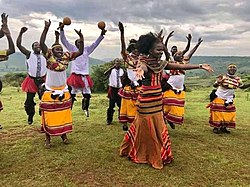
Baganda
Ethnic groupWikipedia
106
MENTIONS
15
EPISODES
13
PODCASTS
Search complete. 106 mentions across 15 episodes found for "Baganda".
Sep 16, 2026

Dawudi KagwaHOST
Ekyo Katonda ky'agamba.
Dawudi KagwaHOST
Kaabe taata wo, kaabe maama wo, kaabe muganda wo, kaabe mwannyoko, amiina, kaabe pulezidenti, kaaba ani, kasita aba ng'atambula bubi naye nga, eeh, omuntu okwegamba y'akukulembera tateekeddwa kuba wa musaayi.
Dawudi KagwaHOST
Bala ideally tuleme okukoppakoppa oba okugobera amakubo g'abantu agatari malungi.
Dawudi KagwaHOST
Eyo y'ensonga esooka.
20 MINS LATER
Dawudi KagwaHOST
Naye a-atugaana okwegatta nabo mu kukola obubi.
Dawudi KagwaHOST
Ekyo kye natandise nakyo.
Dawudi KagwaHOST
Amina? Sigenda ku kya watata wange, sigenda ku kya bwa maama wange, sigenda ku kya bumuganda wange, kubanga takkiriza kye nzikiriza.
Dawudi KagwaHOST
Ekyo Katonda si kyatuyitidde okukola.

Andrew MwendaGUEST
Our princes ran and lived in exile in Buganda.
Andrew MwendaGUEST
So when Captain Lugard came, the Baganda said, "We have a prince here whose land has ... country has been occupied by Kabalega." So it's the British and the Baganda forces who came and restored the independence of Toro.
Andrew MwendaGUEST
So for us, uh, the coming of the British was the restoration of our independence.
Andrew MwendaGUEST
For the rest of Uganda, it was colonialism.
Robert KabushengaHOST
No. Toro
Andrew MwendaGUEST
...
Andrew MwendaGUEST
but Bu- Bunyoro and Toro have been hostile kingdoms, so we were allied to Buganda in order to preserve our independence, the Baganda and the British.
Robert KabushengaHOST
Ah.

Nahlah AyedHOST
Mm-hmm.
Nakanyike MusisiGUEST
So the Baganda, who for centuries have had their monarchy, y- they only think about the king to rule them, to have their king in power.
Derek PetersonGUEST
We should explain perhaps at the start before we go further into this, Buganda the kingdom is different from Uganda the colony.
Derek PetersonGUEST
Buganda is an ancestral kingdom whose history goes back to the distant mists of time.
Derek PetersonGUEST
It was favored as a political society under British rule.
Derek PetersonGUEST
The British adopted Buganda as a kind of model, what do we call it, agent of British colonialism in the 1900s.
Derek PetersonGUEST
Baganda became very well educated.
Derek PetersonGUEST
They were, they were largely Protestant Christians, and they were sent around the rest of Uganda, the colony, to govern on behalf of the British Crown.

Laura GibbsNARRATOR
I am again indebted to Sir Apollo Kagwa, KCMG, MBE, for some of the stories from his Ngaro Zatbaganda.
Laura GibbsNARRATOR
It is impossible to acknowledge by name all my Baganda friends to whom I owe the rest, but each story recalls to my memory a vivid Uganda scene, a shady banana garden, a smoky kitchen, the bedside of a sick woman in a stuffy hut, or a campfire beneath a star-spangled sky, all gentle, soft-voiced people who allowed me to share their lives for a little while and tried in their simple way to be kind to me.
Laura GibbsNARRATOR
My thanks are due to Miss Muriel Robertson for allowing me to use her Uganda songs, and to the Westminster Gazette for permission to reprint them.
Laura GibbsNARRATOR
section

Jim MoraHOST
Uganda, okay.
Jim MoraHOST
And what does the name Uganda mean? It's the home of whom? So is it the home of the Ganda people? It is the home of the Ganda people, the largest Bantu ethnic group in Uganda, many of whom are small farmers growing what?
Jack Whaley-CohenGUEST
In Uganda, coffee or tea? Chocolate.
Jack Whaley-CohenGUEST
Yes, actually

GinaHOST
Then you also have the Kikongo language.
GinaHOST
the Ba'ateke language, the Lari language, the Aka, the Bembe, the Kongo, the Likuba, the Baganda.
GinaHOST
Several languages spoken by smaller ethnicities are facing extinction.
GinaHOST
So languages like the Babule, the Bokiba, Ngom.

Aubrey MasangoHOST
Somebody said to me, Aubrey, how come we are not hearing that that is xenophobic violence.
Aubrey MasangoHOST
We've seen similar things happening in Uganda, running battles between Somalis and so forth, and Baganda.
Aubrey MasangoHOST
And similar questions were raised as to why we are not hearing that that is xenophobic.
Aubrey MasangoHOST
Why is it that the South African situation has been called xenophobic? And I'm happy to have that conversation with you if you want.

speaker_22NARRATOR
The great spirit or god of Uganda was supposed to be living within this wizard, and for this reason he was greatly feared.
speaker_22NARRATOR
many other less powerful spirits or gods were worshipped by the waganda when the people were anxious about their crops they went to the god of food when threatened by famine they went to the god of famine in time of war offerings were made to the god of war on other occasions it was the god of the earthquake or the god of the plague or the god of the small-pox which was most worshipped here and there along the roadside under some tree or in the private courtyards of the chiefs were to be seen the tiny huts already described which were sacred to one or another of these gods in some of them dwelt the wizards and witches in whom the spirits or gods were supposed to live very plainly were these strange folk dressed usually in simple robes of goatskins only and they carried clubs or crooked wood decorated with iron knobs and bells now and then a wizard assuming a high falsetto voice would rave like a lunatic the people thinking that the spirit within him was angry would bring him cows and chickens and goats as gifts and even a great many pots of beer that the spirits were supposed to need very much to drink When offering such gifts, the Waganda would be praying the best kind of prayers they knew, while the wizard would make them think more prayers were needed.
speaker_22NARRATOR
These men and women of magic also made a great many trinkets, sometimes simply from bunches of grass, or again from the teeth of animals, or from odd-shaped stones.
speaker_22NARRATOR
After mumbling mysterious words over these trifles, the sacred men sold the trinkets to the people as charms.
speaker_22NARRATOR
When worn about the neck or ankles, or when placed above the doorways of the homes, or hung about the tiny huts where they made their offerings, the Waganda thought these charms a protection against the numerous evils over which the gods had control.
speaker_22NARRATOR
Of all these spirits, the greatest was the god of the lake.
speaker_22NARRATOR
If a chief wished to learn what this god could tell him of the chances for success in some war shortly to be entered upon, he would go to the god's island home in the lake.
40 MINS LATER
MarianneNARRATOR
He himself used to be a follower of the wizards, but now he no longer believed his old superstitions.

Charles OpiyoHOST
They decide how things function.
Susan OpiyoHOST
So when you talk about the Baganda kingdom in East Africa, you're saying that when you come to the Baganda kingdom, there's a way they live.
Susan OpiyoHOST
But who sets the rules? The king of that place.
Susan OpiyoHOST
Who has authority? The king of that place.
Susan OpiyoHOST
So when they come and tell you, here we live like this, you don't argue.
Susan OpiyoHOST
You're in the kingdom of the
Charles OpiyoHOST
Bagandas.
Charles OpiyoHOST
That's important.

Laura GibbsNARRATOR
THE FLAME TREE AND OTHER FOLKLORE STORIES FROM UGANDA BY ROSETTA BASKERVILLE PREFACE I am again indebted to Sir Apollo Kagwa, KCMG, MBE, for some of the stories from his Ngaro Zatbaganda.
Laura GibbsNARRATOR
It is impossible to acknowledge by name all my Baganda friends to whom I owe the rest, but each story recalls to my memory a vivid Uganda scene, a shady banana garden, a smoky kitchen, the bedside of a sick woman in a stuffy hut, or a campfire beneath a star-spangled sky, all gentle, soft-voiced people who allowed me to share their lives for a little while and tried in their simple way to be kind to me.
Laura GibbsNARRATOR
My thanks are due to Miss Muriel Robertson for allowing me to use her Uganda songs, and to the Westminster Gazette for permission to reprint them.
Laura GibbsNARRATOR
section i of the flame
5 more episodes mention Baganda.
Create an account to see the whole feed, search across every transcript, and follow the entities you care about.