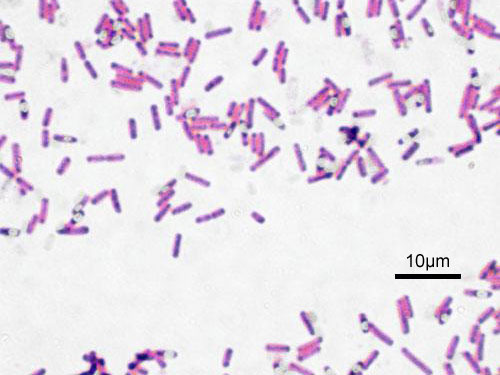
Bacillus
BacteriaWikipedia
30
MENTIONS
11
EPISODES
11
PODCASTS
Search complete. 30 mentions across 11 episodes found for "Bacillus".
Oct 29, 2026

Michael MehlmanHOST
Okay.
Michael MehlmanHOST
And then for motility, that could refer to bacillus cereus.
Michael MehlmanHOST
And then for also the Clostridia, Bacillus, fuck my saying.
Michael MehlmanHOST
For the Clostridia would be C. difficile, tetany, and botulinum.
Michael MehlmanHOST
Okay, so Clostridium perfringens is immotile, and Bacillus anthracis, immotile.
Michael MehlmanHOST
Regardless, wrong fucking answer.

Jared St. ClairHOST
These studies used different branded strains as opposed to just kind of generic strains of these probiotics.
Jared St. ClairHOST
But let's start with one of the big guys, Bacillus subtilis.
Jared St. ClairHOST
In 2015, a randomized double-blind placebo-controlled study in France gave 100 healthy senior citizens, 60 to 74 years old, all with a history of getting sick in the winter, a strain of bacillus subtilis, in on and off courses over four months of cold and flu season.
Jared St. ClairHOST
In the group they tested biologically, secretory AIGA went up significantly in both their stool and their saliva compared to the placebo group.
Jared St. ClairHOST
And when symptoms did show up, things like hoarseness, headache, and fatigue, they didn't last as long.
Jared St. ClairHOST
The researchers tied those results to measurable changes in immune signaling proteins specifically in their blood.
Jared St. ClairHOST
Then Bacillus clausii.
Jared St. ClairHOST
In 2007, researchers at the University of Pavia in Italy gave Bacillus clausus spores for three months to children who kept getting respiratory infections over and over.

Leighton MorrisonHOST
Oh,
Maurice DiazGUEST
is it Bacillus thuringiensis that's eating the eggs?
Leighton MorrisonHOST
yeah i think i uh yeah something like that yeah that's mixed with the boron but there's also a whole bunch of um bacteria that in the compost products that i make are also doing the same thing is is they're they're consuming the ant eggs because they don't have like there probably are some chitin degraders in in the material as well but i've noticed that when i'm applying that extract It's not just the ants coming out.
Leighton MorrisonHOST
It's the ants with the eggs.

Jake AllenHOST
Biologicals and new entrants pressed into crop protection this week.
Jake AllenHOST
Koppert launched Maycan in Brazil, a Bacillus velezensis foliar fungicide for soybean, corn, and sugarcane registered for thirteen disease targets.
Jake AllenHOST
Lubrizol entered crop care with its Xyra formulation range.
Jake AllenHOST
On the data side, Proba released N-Tree in Amsterdam in the Netherlands.

Paul ZornerGUEST
We talked about it's not who's there, it's what function do they provide.
Paul ZornerGUEST
And so it's a matter of getting organisms that will liberate micronutrients like magnesium and zinc and iron and those things that the plant needs.
Paul ZornerGUEST
You have free-living microbes that will fix nitrogen, azotobacter, agrobacteria.
Paul ZornerGUEST
We all know about rhizobium and its interaction with legume crops.
8 MINS LATER
Paul ZornerGUEST
But if you leave out, especially if you leave out the French horns, but also the violins, it's just not going to be the same thing.
Paul ZornerGUEST
Nobody's going to perform as well.
Paul ZornerGUEST
And so I think what happens with those organisms that we have found work well as microbial soil amendments is, are acting to improve everybody around them.
Paul ZornerGUEST
They're acting to a certain extent as quorum sensors that will actually cause that whole ecosystem now to bloom a little bit more prolifically and get everybody involved in creating that functionality you want to create the optimal environment for that crop to grow.

Betsy RedmondGUEST
So there's certain, you know, bacteria that we know make it.
Betsy RedmondGUEST
So Bacillus makes it, you know, Bacteroides fragilis, Clostridia, Ruminococcus.
Betsy RedmondGUEST
There's certain bacteria we know make it and there's probably more.
Betsy RedmondGUEST
But so, you know, you can go in and look for that.

Brandon DilanHOST
It is a profound risk that most people are entirely unaware of.
Brandon DilanHOST
Uncooked rice frequently harbors spores of a bacterium called Bacillus cirrus.
speaker_1HOST
Okay.
Brandon DilanHOST
These endospores act like tiny biological bunkers.

Pippa ChapmanHOST
... and, uh, multiply massively and let mosquitoes all over your garden.
Zoe EdwardsHOST
Bacillus.
Pippa ChapmanHOST
But I would say, yes, there are-
Zoe EdwardsHOST
I just wanted to see if it was as fun to say as it is to listen to you say it.
Zoe EdwardsHOST
Nice
Pippa ChapmanHOST
... um, than, than trying to, uh-
Zoe EdwardsHOST
Bacillus.
Zoe EdwardsHOST
[laughs]

Don SchaffnerHOST
Yep.
Ben ChapmanHOST
If it's not meat, I think you could make a case for Bacillus cereus.
Don SchaffnerHOST
Agreed.
Ben ChapmanHOST
And so the microwaving part of this, of getting it to 165.
Ben ChapmanHOST
He got it up to 190, 195.
Ben ChapmanHOST
I still don't think that that's gonna be enough to denature the heat-stable toxins if they were present.
Don SchaffnerHOST
No, but Bacillus, Bacillus toxin is famously very heat stable.
Ben ChapmanHOST
Yeah.

Nicholas James BridgewaterNARRATOR
It was in the year 1889 that Professor Loeffler, while experimenting with mice in his laboratory at Griefswald, discovered a microorganism which was extremely fatal to all kinds of mice.
Nicholas James BridgewaterNARRATOR
The happy idea occurred to the professor that this lethal little microbe, which he christened Bacillus typhi murium, might be turned to excellent account in combating plagues of field mice in grain fields, where the devastation committed by these voracious rodents had become in parts of Greece and Russia a serious source of loss to agriculturists.
Nicholas James BridgewaterNARRATOR
Experiments were accordingly made on a small scale to test the efficiency of this bacterial poisoner in destroying field mice, and so successful were the results that Loeffler confidently announced the possibility of keeping down these pests by distributing food material infected with these bacteria over the fields which were invaded by them.
Nicholas James BridgewaterNARRATOR
The Greek government took up the question, and Loeffler's method was applied with brilliant results.
2 HRS 40 MINS LATER
Nicholas James BridgewaterNARRATOR
In each of these instances, the milk secured with greater care remained sweet over twenty-four hours longer than the ordinary milk.
Nicholas James BridgewaterNARRATOR
Unquote.
Nicholas James BridgewaterNARRATOR
An organism which has exceptional opportunities for finding its way into cow's milk is the Bacillus coli communis, normally present in the feces of all animals.
Nicholas James BridgewaterNARRATOR
This microbe is a very undesirable adjunct to milk, and may greatly interfere with the souring process by multiplying extensively, and so producing a change in the milk which renders it impossible for the particular souring bacteria to carry on their work, resulting in their collapse and ultimate extinction.
1 more episode mentions Bacillus.
Create an account to see the whole feed, search across every transcript, and follow the entities you care about.