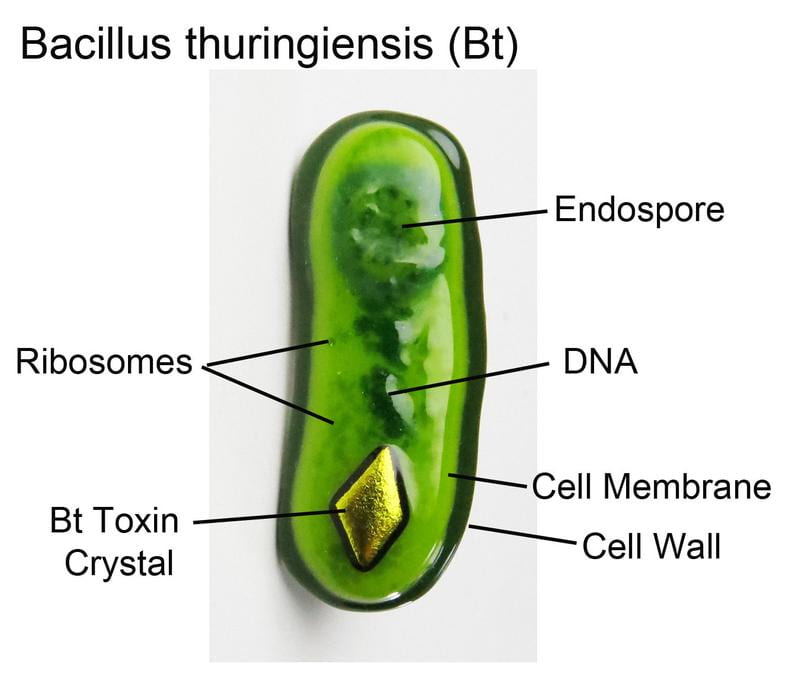
Bacillus thuringiensis
BacteriaWikipedia
18
MENTIONS
9
EPISODES
9
PODCASTS
Search complete. 18 mentions across 9 episodes found for "Bacillus thuringiensis".
Sep 14, 2026

Sherri HarrahHOST
And Bt, for all of y'all that are listening that don't know what Bt is, Bt is-
Anita NelsonGUEST
Bacillus thuringiensis.
Sherri HarrahHOST
Yes.
Sherri HarrahHOST
It is, it is a, uh, targeted, it only, it only attacks caterpillars.

Robert Vincent SimsHOST
Then they get caterpillars, and they chew the leaves.
Robert Vincent SimsHOST
For that, you use Liquid 7, or you could use Bacillus thuringiensis, also known as BT.
Robert Vincent SimsHOST
That's all natural, too.
Robert Vincent SimsHOST
And the third one is something that seems to be worse this year.

Jamie EllisHOST
And I know maybe you wanted, well, can I put this treatment in the hive? There aren't really things available in that context.
Jamie EllisHOST
Now, there is a product that's based on Bacillus thuringiensis, BT, that you can spray on cones.
Jamie EllisHOST
But even that works better in the stored cone situation and not really in the hive situation.
Jamie EllisHOST
So really the best defense against wax moths is controlling all those other problems that bees get.
Jamie EllisHOST
Well, of course, that's going to make that cavity less attractive to the bees.
Jamie EllisHOST
I'm going to circle back to this in a moment.
Jamie EllisHOST
Option number two is that BT treatment that I mentioned earlier, the one that's based on bacillus thuringiensis.
Jamie EllisHOST
This is a perfect scenario for it.

Joseph ReynoldsGUEST
if you do have standing water, if you have to have standing water, you can even create a trap for the mosquitoes.
Joseph ReynoldsGUEST
You can take a bucket and put some organic matter in it so that way it's producing some of these methylates that are attracting the mosquitoes, and then you can add in pellets that contain a product called Bacillus thuringiensis, or Bt, which is a natural occurring bacteria that actually parasitizes mosquito larvae.
Joseph ReynoldsGUEST
Adding that in to wherever it is that mosquitoes might be breeding on your property can help cut the life cycle down, and it keeps that one adult mosquito from becoming 200 adult mosquitoes in a matter of a couple weeks.
Jen LardasHOST
Wow.

David MartinGUEST
So, so Mike, if we add one little extra bulge on the already bursting aneurysm that you just identified, what we would do is we'd look at nutrition the same way.
David MartinGUEST
Remember that in 1904, the Japanese determined that, that Bacillus thuringiensis toxin was toxic to mammalian gut tissue, which explains perfectly why genetically modified seed crops started using Bacillus thuringiensis to make sure every seed crop, our, our nutritional food chain, is contaminated with a toxin that in 1904 was established to be the cause of leaky gut syndrome and every form of destruction of the natural biome of the human gut.
David MartinGUEST
Now, why on earth would we pick something where in 1904, the empirical evidence showed that this toxin beyond any reasonable doubt was harmful and fatal to the human condition and we simultaneously bring the drug companies, think all of the gastrointestinal drugs we've had over the last 100 years, together with industrial agriculture, which is now using Monsanto for what? BT-adjusted crops.
Mike AdamsHOST
[laughs] Yes.
David MartinGUEST
Now, BT-ad- a- adjusted crops is in fact Bacillus thuringiensis.
David MartinGUEST
If we actually acknowledged that the thing we're using to genetically modify our food is a toxin produced by something that by 1904 we knew was going to kill people, we would have a different view of that.
David MartinGUEST
But once again, the patents on seed crops, the patents on Monsanto, the patents on glyphosate that was the precursor for Roundup, all of these things are part of exactly the same Bayer, Hoechst, Wellcome, Glaxo, SmithKline, Beecham.

Karen ConstableHOST
Bacillus species are used as agricultural biocontrol agents, including on agricultural produce.
Karen ConstableHOST
The EFSA considered the safety of such species in the context of a recent outbreak linked to Bacillus velizensis and a 2012 outbreak linked to Bacillus thuringiensis and discussed whether their use as biocontrol agents could potentially lead to enterotoxigenic residues on agricultural produce.
Karen ConstableHOST
It concluded that since biocontrol agents are authorised at a strain level, not a species level, more information is needed about strain-specific toxigenicity.
Karen ConstableHOST
Klebsiella species are serious pathogens in healthcare settings, and an important contributor to multidrug-resistant infections in people.

speaker_1HOST
Bs.
speaker_1HOST
Bt.
speaker_1HOST
It has a very long, storied history in agriculture, and currently stands as the most commercially successful biopesticide on the global market.
speaker_0HOST
Okay.
speaker_0HOST
So we talked about the caterpillar melting from the inside out in the intro.
speaker_0HOST
That was Bt, right?
speaker_1HOST
[laughs] That was Bt.
speaker_0HOST
Let's break down the actual biology of how a single bacterium takes down an insect that is millions of times its size.

Jeff WickmanHOST
Raymond, where do we stand on bagworm activity right now? We're really beyond the spraying point?
Raymond CloydGUEST
Yeah, Jeff, I, at this point, the usual products we recommend are around like, uh, spinosad or Btk, which is the Bacillus thuringiensis kurstaki bacteria.
Raymond CloydGUEST
Those are really gonna be not effective because the caterpillars in the bags are getting larger, and they're less susceptible to those materials.
Raymond CloydGUEST
So right now, uh, we're getting close where the caterpillars will start, uh, forming a cap on the bag and thinking about reproduction.

Colin BellGUEST
And not all microbes can be registered.
Colin BellGUEST
Uh, Canada's a very tough country, as an example, where Bacillus thuringiensis isn't even allowed in the, in the, in the country.
Colin BellGUEST
And so you have to make sure that it's registerable, and that's the guidelines we followed.
Colin BellGUEST
And also, we tested the, the microbes for an array of potential to make sure that that wasn't the case.