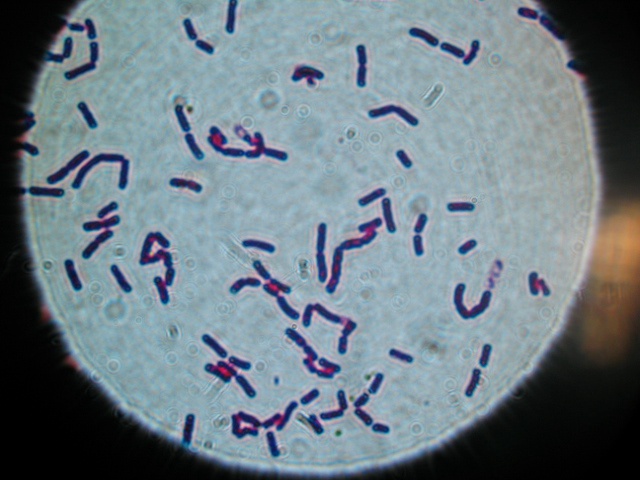
Bacillus cereus
BacteriaWikipedia
6
MENTIONS
6
EPISODES
5
PODCASTS
Search complete. 6 mentions across 6 episodes found for "Bacillus cereus".
Oct 29, 2026

Ryan ShieldsGUEST
But I want to take a step back because metallobetalactamases have really been around for a long time, and they can kind of first be divided as chromosomally encoded betalactamases versus plasmid mediated.
Ryan ShieldsGUEST
And so some examples of organisms that have chromosomally encoded metallobetalactamases might be like Bacillus cereus, or maybe your audience might be familiar with Stenotrophomonas multifilia, which has an L1 betalactamase on its chromosome that is a metallobetalactamase.
Ryan ShieldsGUEST
So I'm going to, for a second, just differentiate those chromosomally encoded enzymes with the ones you had mentioned, which we often associate as being plasmid mediated, meaning they're transferred on mobile genetic elements.
Ryan ShieldsGUEST
And the three most common ones that we talk about are IM or imipenemase, VIM, which stands for Verona, integron-encoded metallobetalactamase, and NDM, or New Delhi metallobetalactamase.

speaker_7HOST
really is.
speaker_6HOST
Uncooked rice contains spores of a bacteria called Bacillus cereus that actually survive the boiling process.
speaker_6HOST
So if you leave that cooked rice sitting out at room temperature, it basically turns into an incubator for those spores.
speaker_6HOST
Cool it fast.

speaker_2HOST
They were eating and producing waste.
speaker_2HOST
And as part of their life cycle, specific bacteria like Staphylococcus aureus and Bacillus cereus produce waste products called enterotoxins.
DonHOST
Enterotoxins.
speaker_2HOST
So it's like a biological byproduct.

Joe SchwarczGUEST
Right.
Joe SchwarczGUEST
Well, no, rice actually has... a tendency to harbor bacteria of the Bacillus cereus type.
Joe SchwarczGUEST
And that's the one that has spores.
Joe SchwarczGUEST
Now, spores are inactive bacteria.
Joe SchwarczGUEST
Right.
Joe SchwarczGUEST
Well, no, rice actually has a tendency to harbor bacteria of the Bacillus cereus type.
Joe SchwarczGUEST
Ooh, ooh.
Joe SchwarczGUEST
And that's the one that has spores.