B-cell
66
MENTIONS
5
EPISODES
5
PODCASTS
Search complete. 66 mentions across 5 episodes found for "B-cell".
Oct 6, 2026

speaker_1HOST
Her plasma is constantly patrolling for anything that looks like a B antigen.
speaker_0HOST
So if we look at the inventory, if a nurse accidentally hung a bag of AB-negative blood and transfused it into Leilani, her anti-B antibodies would instantly recognize the B antigen on those donor cells as a foreign invading threat.
speaker_1HOST
The immune response would be catastrophic.
speaker_1HOST
The IgM antibodies would latch onto the donor red blood cells, activating the complement cascade.
speaker_1HOST
Leilani is negative.
speaker_1HOST
She lacks the D antigen.
speaker_0HOST
Now, with the ABO system, she naturally had anti-B antibodies circulating just from environmental exposure.
speaker_0HOST
Does she naturally have anti-D antibodies circulating because she is Rh-negative?

Larissa ThackerayHOST
On September 25th, 2026, we talked with Dr. Chris Risley, a postdoctoral fellow in the Lund and Worthy Labs at the University of Alabama in Birmingham.
Larissa ThackerayHOST
Dr. Risley also received his PhD from UAB, where his work examined the regulation of a unique population of effector memory B cells following influenza infection.
Larissa ThackerayHOST
His current research focuses on the regulation of local B cell responses to influenza infection in the airways, including the role of tertiary lymphoid tissues in protective immunity.
Larissa ThackerayHOST
Thanks for talking with us today.
7 MINS LATER
Chris RisleyGUEST
But I think at the lab's core, at my core, I am a B cell immunologist.
Chris RisleyGUEST
That is how I would choose to define my research.
Chris RisleyGUEST
And I'm very interested in how B cells respond to antigens.
Chris RisleyGUEST
And we use flu as a model, which I think is awesome.

Barbara WillekensGUEST
Nevertheless, those CAR T-cell therapies can also have severe side effects, so that's maybe something we need to discuss later.
Barbara WillekensGUEST
But the prospect of these CAR T-cells having such profound effects on patients who were previously actually given up on, has also made people think, can you use those cell therapies maybe for other diseases where the same types of cells, B cells, that are targeted.
Barbara WillekensGUEST
So B cells are immune cells in your body that produce antibodies.
Krissy DilgerHOST
And
Barbara WillekensGUEST
in blood cancers, they multiply abnormally in abnormal amounts.
Barbara WillekensGUEST
But those B cells also play a role in autoimmune diseases.
Barbara WillekensGUEST
And in autoimmune diseases, they produce autoantibodies that are directed towards your own body.
Barbara WillekensGUEST
And that's actually something you don't want.

Mark SaltzmanHOST
I'll say more about that in a minute.
Mark SaltzmanHOST
The humoral immune response involves antibody production and antibodies are made by a subset of cells called B cells.
Mark SaltzmanHOST
B cells.
Mark SaltzmanHOST
The other part of the adaptive immune system is the cell mediated immune system.
Mark SaltzmanHOST
This is an immune system that doesn't involve antibodies but involves cells that are activated in response to a foreign antigen and that utilize cellular means to get rid of it.
Mark SaltzmanHOST
The main effector cells in cell-mediated immunity, the cells that do the main business are called T cells.
Mark SaltzmanHOST
Now, T cells are also involved in humoral immunity but they're not the end result.
Mark SaltzmanHOST
The end result in humoral immunity is B cells producing antibodies.

Hank GreenHOST
An antigen is anything that causes your immune system to ID a pathogen and then create an antibody against it.
Hank GreenHOST
Now antibodies aren't cells, they're highly specialized proteins produced by B cells to recognize and help lay the smack down on intruders.
Hank GreenHOST
But antibodies can't kill invaders themselves, they're just little proteins after all.
Hank GreenHOST
The best that they can do by themselves is sort of just swarm all over the invader, making it harder for it to move and to excrete toxins or otherwise infiltrate healthy cells.
Hank GreenHOST
But more often antibodies serve as tags, attaching themselves to the scumbags and then releasing chemical signals to nearby phagocytes, alerting them that it's dinner time.
Hank GreenHOST
Your acquired immune system also has its own type of white blood cells, not phagocytes, which go after everything that looks a little bit sketchy, but lymphocytes, which go after specific things that they already know about.
Hank GreenHOST
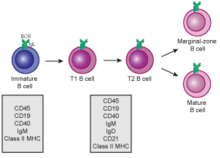
There are two major types of lymphocytes, the T cells, which form in your bone marrow and then migrate and mature in the thymus gland right behind your breastbone, and the B cells, which originate and mature in the bone marrow.
Hank GreenHOST
What T and B actually stand for is a long story, but if it helps you to remember, T's mature in the thymus, B's in the bone marrow.