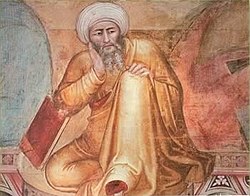
Averroes
JuristWikipedia
55
MENTIONS
28
EPISODES
24
PODCASTS
Search complete. 55 mentions across 28 episodes found for "Averroes".
Oct 26, 2026

C. Derick VarnHOST
I have the Protestants ruin everything theory of life, but Protestants are part of why we have this weird historiography about Plato, because this is also attacking Catholic commentary traditions, which themselves go back to ancient commentary traditions, which you can find in...
C. Derick VarnHOST
Maimonides and Averroes and Avicenna and Al-Kindi and Al-Arabi and blah, blah.
C. Derick VarnHOST
I can go on and on and on.
C. Derick VarnHOST
And I mean, some of these people ruled against the philosophers, but they were familiar with them.

Abdullah Hakim QuickGUEST
They changed the names of our scientists.
Abdullah Hakim QuickGUEST
Ibn Rushd, they said his name Averros.
Abdullah Hakim QuickGUEST
Ibn Zuhar, Avanzoa.
Abdullah Hakim QuickGUEST
Ibn Sina, Al-Bitruji, Al-Petrajius, Al-Haytham, Ibn Al-Haytham, Al-Hazan, Al-Kindi, they said Al-Kindi, Abul-Qasas, they said was Al-Zahrawi, Al-Khwarizmi, Al-Agrismas, Al-Battani, Al-Batajanus, Al-Razi, they said Rasis, Jabir ibn Hayyan, they used the word Jabir.

Alex PriouGUEST
for philosophic doctrine.
Alex PriouGUEST
So Averroes, about 800 years or so before, argued that the true teaching of the Quran is basically Aristotle and Plato, and they agree.
Alex PriouGUEST
And therefore, we're totally inoffensive.
Alex PriouGUEST
Why are you guys mad at us? He tried to do that.

Bill FedererGUEST
He's writing philosophy, medicine, and math.
Bill FedererGUEST
Another is Averroes, and he's writing on physics and music.
Bill FedererGUEST
And if you would have taken a snapshot of the world, you would have thought that Islam was about to experience the Renaissance.
Bill FedererGUEST
But it all gets slapped down by Ghazali.

Justin SledgeSOUNDBITE_SPEAKER
So in many ways, the early adopters in Western philosophy were largely Platonists.
Justin SledgeSOUNDBITE_SPEAKER
What ultimately ends up happening is that Boethius ultimately takes control of this situation and led by people like Abelard and eventually the inheritance of Averroes and mostly Ockham.
Justin SledgeSOUNDBITE_SPEAKER
William of Ockham, famous for his razor, which is ironically one of the most systematically misquoted ideas ever.
Justin SledgeSOUNDBITE_SPEAKER
Ockham never said that the simplest answer is most correct because that's patently wrong.

SamHOST
Another influence on Michael Servetus is Islam.
SamHOST
Michael Servetus read a lot about Islam, although he could not read Arabic himself, but there were a lot of Latin translations of Arabic works, including the Quran and other famous Islamic philosophers like Avicenna and Averroes.
SamHOST
But it's not like he does use some Islamic ideas that some Islamic arguments against the Trinity he will adopt.
SamHOST
But I think some people go too far in calling him a syncretist or something like that.

NoraHOST
One is one of idealism and abstract idealism, and the other one is of, of a mechanical materialism.
NoraHOST
And so he wants to talk about the agency of matter, and he takes Ibn Sina as being, and later Ibn Rushd, as being two specific figures that were able because of the role of Islam and also merchant capital in their time.
AnattarraHOST
Yeah.
NoraHOST
They had an ability to speak about philosophy as expressing something about reason, and so he's able to find in Ibn Sina and Ibn Rushd an insistence on the capacity for reason, amongst other reasons.
NoraHOST
There's a, a, a democratization of intellect, of the capacity to reason, which is also stated in the introduction as Ibn Sina already going further than, and Ibn Rushd going further than Aristotle, who did not allow the enslaved to have the capacity to reason the same way that, that citizens had.
AnattarraHOST
Yes.
NoraHOST
And so with Ibn Sina and Ibn Rushd, the unity of the intellect, you get a universal capacity to reason.
NoraHOST
This is one of the findings that already sets them not only apart from Christian thinkers but presents an advancement over Aristotle's conception of hylomorphism.

Justin SledgeHOST
He notes that the planets must be intelligent in some sense and just leaves it at such.
Justin SledgeHOST
And yet just a chapter before that, before that repeats the famous position of Averroes with the traditional association of Saturn, Jupiter, Mars, the Sun, Venus and Mercury and the Moon of course with the angels Cassiel, Sachiel, Samael, Michael, Aniel, Raphael, Gabriel respectively.
Justin SledgeHOST
You know, wink wink, nudge nudge.
Justin SledgeHOST
it's astral necromancy.

speaker_1NARRATOR
La corte di Federico II, costantemente in movimento tra la Puglia, la Sicilia e la Campania, fu un polo di attrazione intellettuale in cui conversero studiosi ebrei, traduttori arabi, astronomi greci e filosofi latini.
speaker_1NARRATOR
Il sovrano promosse la traduzione dei testi scientifici di Aristotele, Averroè e Avicenna, intrattenendo fitti scambi epistolari di natura matematica con Leonardo Fibonacci e commissionando al celebre scienziato Michele Scoto studi avanzati di ottica, astrologia e biologia comparata.
speaker_1NARRATOR
Questa visione pragmatica e antidogmatica culminò nella stesura personale del trattato De arte venandi cum avibus, un testo monumentale di ornitologia e falconeria che anticipò di secoli il metodo scientifico galileiano.
speaker_1NARRATOR
Nel trattato, Federico II respinse espressamente le credenze popolari e le favole tramandate nei bestiari medievali, affermando che lo scopo dell'opera era manifestare le cose che sono così come sono, basando ogni descrizione anatomica e comportamentale unicamente sulla verifica oculare e su esperimenti controllati condotti sul campo con pazienza meticolosa.
18 more episodes mention Averroes.
Create an account to see the whole feed, search across every transcript, and follow the entities you care about.