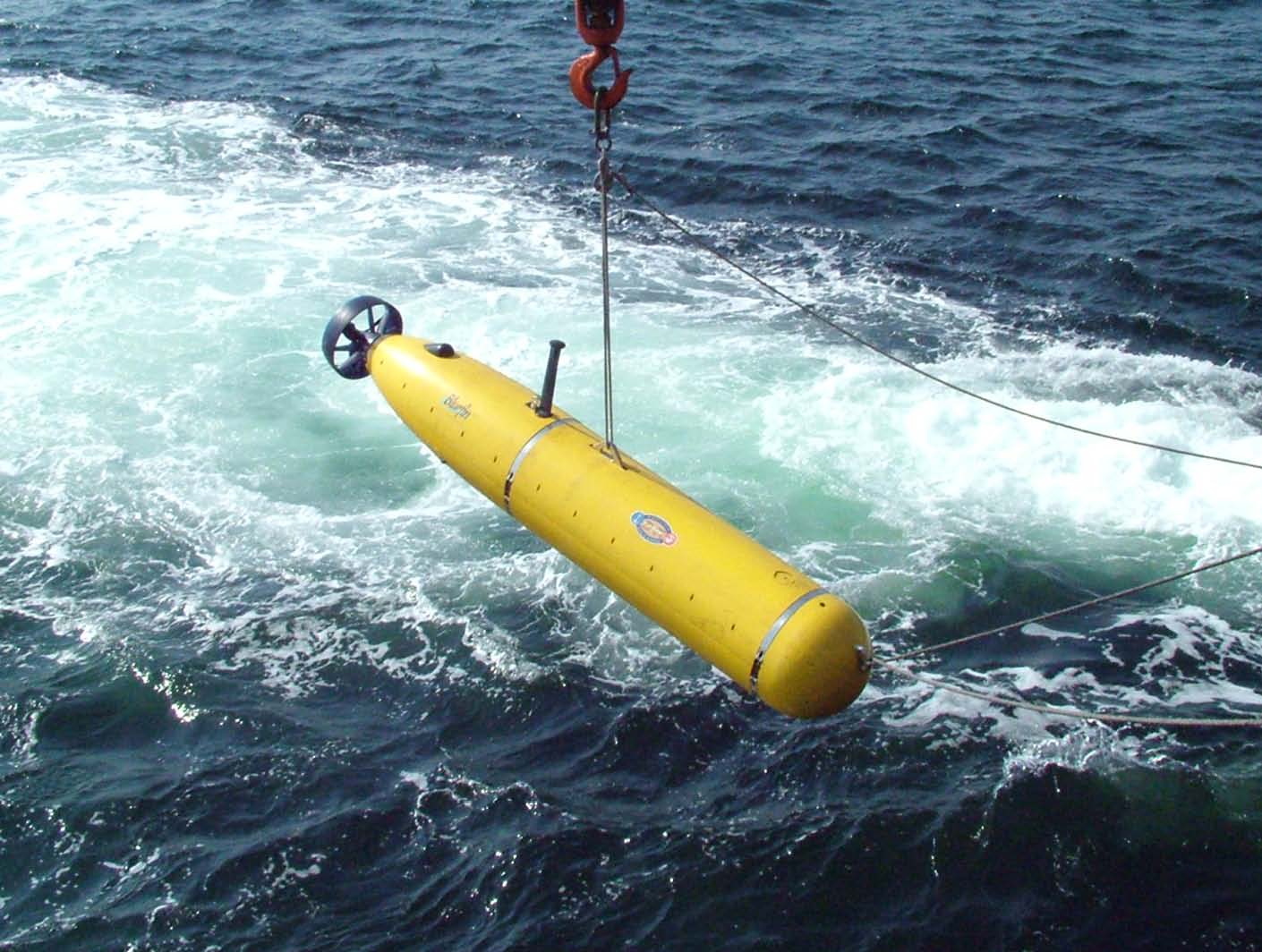
Autonomous underwater vehicle
29
MENTIONS
12
EPISODES
12
PODCASTS
Search complete. 29 mentions across 12 episodes found for "Autonomous underwater vehicle".
Oct 28, 2026

Matt TirmanGUEST
It is comms denied.
Matt TirmanGUEST
Uh, and so what, you know, what bedrock has done, you know, building out this, you know, autonomous intelligence stack, building the, uh, the AUVs and the hardware around that.
Matt TirmanGUEST
Um, and frankly, what others are doing as well, too.
Matt TirmanGUEST
I mean, this is a, This is a new evolution of how we are going to compete and open up the multi trillion dollar ocean economy, which is already the backbone of the global economy.
Matt TirmanGUEST
We were doing Earth observation from above.
Matt TirmanGUEST
So there's a lot of different similarities as to how the customer sets think about the problems, but they're unique, right? In the subsea, you do not have the advantage of perspective, right? It is a dark and denied environment, right? And Bedrock, we want to create this ability to do ubiquitous sensing.
Matt TirmanGUEST
And That's going from where we're at now, which is being able to fly and deploy anywhere in the world, 24 hours deploying our AUVs, to not having to do that, to having motherships strategically located to serve offshore energy, to serve defense, to provide on-demand tasking.
Matt TirmanGUEST
That is the autonomy goal that we're working toward over the next, call it 24 months here.

Jake PalmerGUEST
I see us doing a lot more work now and in the future in the offshore energy markets where those – uh, markets are also making the change to unmanned uncrewed vessels.
Jake PalmerGUEST
Uh, a lot of with the offer energy, a lot of their work with those vessels are submersible, um, AUVs or UUVs.
Jake PalmerGUEST
Uh, but they also have surface vessels, unmanned surface vessels that can carry and deploy those assets.
Jake PalmerGUEST
And that's where right now we would be a great fit for in the future.

Tomasz NadrowskiGUEST
These are ROVs, so remotely operated vehicles.
Tomasz NadrowskiGUEST
These are AUVs, autonomous underwater vehicles.
Tomasz NadrowskiGUEST
These are surface vessels that are also autonomous.
Tomasz NadrowskiGUEST
Mines, various agents for anti-submarine warfare.

speaker_0NARRATOR
A cable links the ships to the ROVs.
speaker_0NARRATOR
Autonomous underwater vehicles or AUVs have no cable, but they must be pre-programmed.
speaker_0NARRATOR
Hybrid vehicles called HROVs combine some of the features of both ROVs and AUVs.
speaker_0NARRATOR
The oceans are becoming increasingly exploited for their resources.
speaker_0NARRATOR
Human effects now reach the farthest corners and depths of ocean ecosystems.

Matt TirmanGUEST
Yeah, so Bedrock uniquely, we started out building the autonomy first, right? We built the autonomy stack and the software.
Matt TirmanGUEST
First, we went out to market, we looked at other AUVs, other UUVs available, played with a few, nothing really quite fit the needs of the company because we wanted to create something truly adaptable and truly modular.
Matt TirmanGUEST
Because we have customers that come to us with different fishing packages, right? Be it mine countermeasure, or we have customers in the North Sea that say, look, we have thousands of wells that we need decommissioned over the next 10 years.
Matt TirmanGUEST
That's a different sensor package.
Matt TirmanGUEST
And it takes ages to actually get the data from the subsea back to the user.
Matt TirmanGUEST
And ages, I mean weeks and months.
Matt TirmanGUEST
where the benefit that we can bring, we can fly and deploy off of any vessel of opportunity, drop our AUVs in, our people from back in the States or sitting anywhere can remotely plan a mission and off the AUV go to map and monitor.
Matt TirmanGUEST
Critically, the customers want, they want that data as soon as possible, right? It goes back to the days of Earth observation and reduce the latency in that time to action from space down to the analyst.

TonyHOST
The lack of sonar detections does pose a challenge for any hypothesis that involved a solid object entering water, since sonar would likely pick up disturbances or a foreign body if it were large enough.
TonyHOST
If we consider the possibility of a submersible test craft, perhaps an experimental autonomous underwater vehicle, AUV, such platforms can operate at high speeds and depths without producing strong acoustic signatures until they breach surface waves.
TonyHOST
However, AUVs are usually designed for stealth from sonar rather than infrared, making their surface presence unlikely to register as a bright sphere in thermal imaging.
TonyHOST
When the Navy later released an official briefing transcript, they noted that crew members received additional training on identifying potential foreign drones after the incident, implying the military did not rule out human technology entirely.
TonyHOST
That training reflects a precautionary stance.

Claire AsherHOST
Hello everyone! I'm excited to share this special bonus episode of the podcast.
Claire AsherHOST
Last month, I was invited to host a panel discussion at the AUV Symposium in Southampton titled Marine Autonomy's Journey Overlooked or Overhyped Through Different Lenses.
Claire AsherHOST
AUV 2026 was hosted by the University of Southampton and the National Oceanography Centre and sponsored by the IEEE Oceanic Engineering Society with support from Cellular Robotics and Sonodyne International.
Claire AsherHOST
I had a fantastic conversation with Gwyn Griffiths, Daniel Hook, Emma Curtis, Sarah Aldahari and Edith Clare Hall about how progress in marine autonomy resonates with different audiences.
Claire AsherHOST
Here's the recording from the event.
Claire AsherHOST
Daniel Hook is CEO of Rad Propulsion, a sustainable marine technology company aiming to cut carbon emissions in the maritime industry.
Claire AsherHOST
He was previously a non-executive director of the National Oceanography Center, CTO of Ocean Infinity, and one of the founders of ASV Limited.
Claire AsherHOST
Emma Curtis is a research fellow in the Maritime Engineering Department at the University of Southampton, where she helps to deploy AUVs in the field, as well as managing and interpreting the data collected by AUVs and other marine imaging platforms.

David Nino RodriguezHOST
And their latest project is advancing at a terrifying pace, folks, with experts warning that the lethal unmanned vessels could be roaming European waters in just under two years.
David Nino RodriguezHOST
Last week, a Colombian Navy report estimated cartel underwater vehicles, AUVs, could have crossed the Atlantic and the Pacific by 2035 in droves.
David Nino RodriguezHOST
But undersea defense expert Benia Cordiano told The Sun that these deadly vessels will be ready for deployment much, much sooner, in as little as a year.
David Nino RodriguezHOST
Wow! And they're self-detonating.

Jeff NosanovHOST
Okay
Gilly ElorGUEST
... experience with caving ourselves, and also Stone Aerospace has a lot of experience with, uh, autonomous, uh, underwater vehicles, AUVs-
Jeff NosanovHOST
Mm
Gilly ElorGUEST
... that go and explore water-filled caves.

Boris DorschelGUEST
When I started my job here, one of my first statements that I keep repeating ever since is if you want to go somewhere you need a map i mean we all used to google maps and you check out the city before you do your trip there and on the seafloor it's it's in no way different if you want to operate somewhere and want to send equipment down i want to take samples you want to know how it looks like down It just helps with the planning and the coordination.
Boris DorschelGUEST
I mean, if you have an RV or an AUV, you sink millions of millions of euros into the water.
Boris DorschelGUEST
And you want to know what you're facing.
Boris DorschelGUEST
And we provide this information.
15 MINS LATER
Boris DorschelGUEST
But I've never heard of it.
Boris DorschelGUEST
To my knowledge, there's none, but that's unconclusive.
Steve HallHOST
yeah sure okay no brings back memories of uh you ever come across the theseus mission uh this is north of canada yeah years ago where they they laid the fiber optics under ice using a very large autonomous underwater vehicle because exactly that is you couldn't easily lay the cable with a conventional cable ship so they basically built a large AUV where the whole space was full of a massive optical fiber spool and laid the cable along the seabed that way.
Steve HallHOST
So I suppose you could do that again.
2 more episodes mention Autonomous underwater vehicle.
Create an account to see the whole feed, search across every transcript, and follow the entities you care about.