autoimmune thrombocytopenic purpura
DisorderWikipedia
82
MENTIONS
19
EPISODES
17
PODCASTS
Search complete. 82 mentions across 19 episodes found for "autoimmune thrombocytopenic purpura".
Sep 29, 2026

BasharHOST
Occasionally, someone might present with an infection due to suppressed immunity or funny immune phenomena like exaggerated mosquito bite reactions, but those last few are quite rare and sometimes related to a T cell problem instead.
BasharHOST
To list them out though, some of the classic complications of CLL that a patient might present with are an immune-mediated ITP, immune thrombocytopenia, or autoimmune hemolytic anemia, possibly pure reticel aplasia, and possibly hypogammaglobulinemia, which would cause infection.
KaleHOST
Then the signs of CLL on exam might include lymphadenopathy, which is most common.
KaleHOST
And I mean, this can be generalized or localized to individual groups.
29 MINS LATER
NickHOST
Therapy might include continuous BTK inhibitors, such as these are ibrutinib, acalabrutinib, or xanabrutinib, or fixed-generation venetoclax and CD20 antibodies, or fixed-generation BTK plus venetoclax combinations, which are great if you need an oral treatment in a regional setting.
NickHOST
Mm-hmm.
NickHOST
Key complications include autoimmune hemolytic anemias, or ITP, secondary to the clone, even if the actual clone itself is not particularly big, recurrent infection secondary to hypogammagobular anemia, and the dreaded Richter's transformation.
KaleHOST
And

Sam MazurHOST
And the younger kid, what about the toddler? You know, the kid that's, th- that we're always worried.
Sam MazurHOST
These are the kids, again, we did an episode before on ITP.
Sam MazurHOST
We were talking about-
Hope WilsonGUEST
Mm-hmm
25 MINS LATER
Hope WilsonGUEST
[laughs]
Chris ChiuHOST
[laughs] Well, this one's only in four parts then.
Chris ChiuHOST
But, um, going back to what you said initially, you know, I know like in ITP where we used to admit just 'cause of the convenience of being able to start treatment.
Hope WilsonGUEST
Mm-hmm.

Paolo GhiaGUEST
And most doctors probably will be confident to watch and wait the patient until the patient gets below 50,000.
Paolo GhiaGUEST
And I hear other doctors that are even considering to go to 30,000, 20,000, again, because we are experienced with ITP, for example, and it's exactly the same.
Paolo GhiaGUEST
So patients typically don't bleed, even with this low level of platelets.
Lydia ScarfoGUEST
Yeah, thank you so much.

Keith BatemanGUEST
Baseball was always a passion for him, but he was a kid that kind of played whatever sport was in that season.
Keith BatemanGUEST
I think the biggest challenge he ever had baseball wise was when he was seven or eight years old, he had ITP, which is a blood deal.
Keith BatemanGUEST
So he wouldn't clot up.
Keith BatemanGUEST
He'd get bruised.

Marge LauberNARRATOR
My question is, would my spleen be the culprit behind my low platelet count? And Dr.
Marge LauberNARRATOR
Roach says, low platelet counts are common, and one common reason for them is a condition called idiopathic thrombosulpinia, it's ITP, and a large spleen isn't common with ITP, even though removing the spleen is one treatment.
Marge LauberNARRATOR
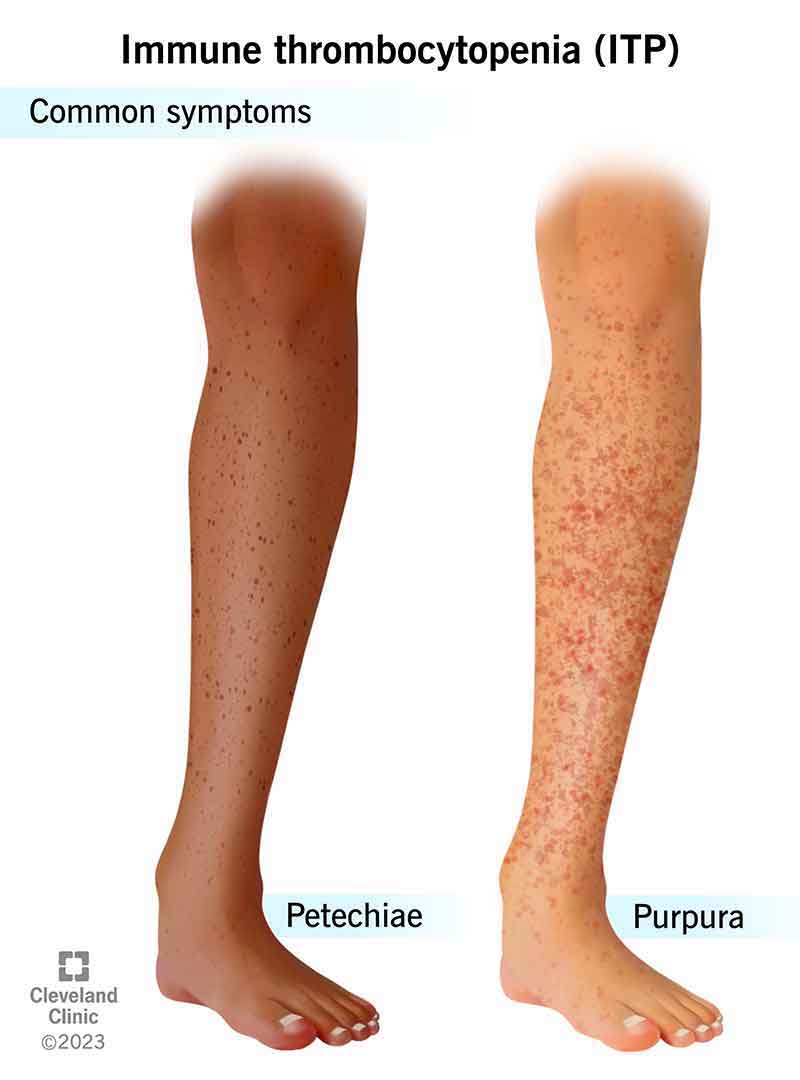
The red dots on your chest might be Pytacella, which are small areas where red blood cells leak through small blood vessels.
Marge LauberNARRATOR
They can happen due to low platelets from any cause, but usually happen with much lower levels of platelets than you report typically.
Marge LauberNARRATOR
It has been seen with platelet counts lower than 20,000 or even 10,000.
Marge LauberNARRATOR
So if the splint is enlarged as new, this could be a red flag that something in your bone marrow is new and different, since people with ITP are at substantial increased risk for leukemia.
Marge LauberNARRATOR
Wow.
Marge LauberNARRATOR
So there was an ex-youth detention center counselor who faced a sexual assault trial in New Hampshire.

Isaac EliazGUEST
It is very effective for antibody-related diseases, for autoimmune diseases.
Isaac EliazGUEST
Very effective, graft versus host, ITP, Guillain-Barré, multiple sclerosis, very effective.
Isaac EliazGUEST
It removes the bad antibodies.
Isaac EliazGUEST
and takes down the inflammation.

MaddieHOST
And before kind of nerding out about the buckets that I'll kind of go over, you have to, like, cross-- think through all those three things.
MaddieHOST
Um, I find it helpful to, um, think of thrombocytopenia in kind of three-- a three bucket approach, that being is it an underproduction issue related to kind of bone marrow issues? Is it a peripheral destruction? And what I mean by that, is there a consumptive process such as, um, a MAHA picture, or is there a kind of destructive process, um, like in kind of ITP where you have, like, antibodies, um, targeting the, the platelets for, for destruction.
MaddieHOST
So underproduction, peripheral destruction, and then sequestration is a really important bucket to think of.
MaddieHOST
So this is in folks who have, um, portal hypertension and splenomegaly, platelets can be sequestered.
8 MINS LATER
MaddieHOST
Youssef, what, what did this information do for you?
YusufHOST
Yeah.
YusufHOST
I, I think one thing that I'm thinking of is like, what is the mechanism of thrombocytopenia? So this is an infection, and did the infection invade the marrow, and is there underproduction because of that? Or is this an ITP triggered by an infection? 'Cause these will be like two very separate etiologies.
YusufHOST
'Cause if I tell you invading the marrow, then you worry about TB, while if I tell you it's induced ITP, then maybe you might worry about the flu or EBV.

ShelleyHOST
My question is, would my spleen be the culprit behind my low platelet count? Written by R.H.
ShelleyHOST
And Dr. Roach's answer: Low platelet counts are common, and one reason for them is called a, is a condition called idiopathic thrombocytopenia, or ITP.
ShelleyHOST
An enlarged spleen isn't common with ITP, even though removing the spleen is one treatment.
ShelleyHOST
If the spleen's enlargement is new, this would be a red flag that something in your bone marrow is new and different.
ShelleyHOST
Because people with ITP are substantially increased risk for leukemia, or eight times the average risk, leukemia is definitely a concern.
ShelleyHOST
Spleen enlargement is universal with some types of leukemia and common with many others.
ShelleyHOST
Because your doctor said that they think you have leukemia, I'm worried there may be something very abnormal with your blood count.
ShelleyHOST
A lumbar puncture or spinal tap is certainly done for most cases of acute leukemia, but the diagnosis of leukemia, acute or chronic, is made through an examination of your bone marrow, which should be done before a lumbar pu- puncture.
9 more episodes mention autoimmune thrombocytopenic purpura.
Create an account to see the whole feed, search across every transcript, and follow the entities you care about.