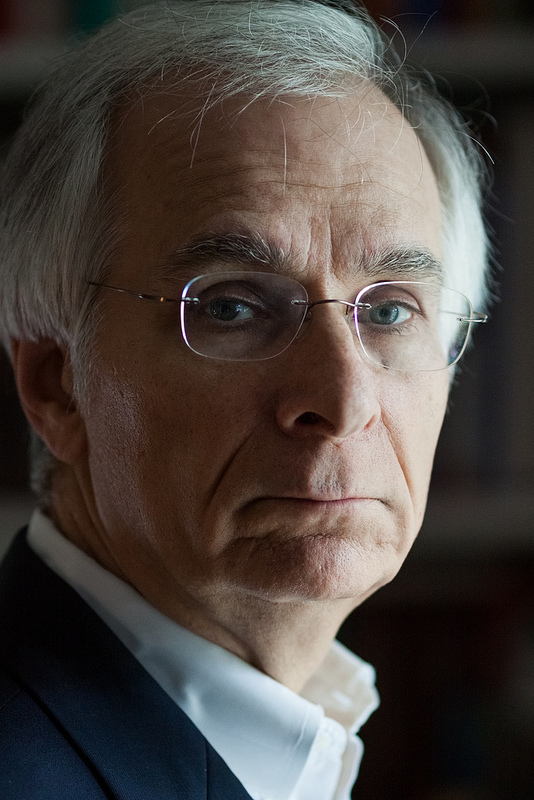
Austin Sarat
American political scientistWikipedia
47
MENTIONS
21
EPISODES
18
PODCASTS
Search complete. 47 mentions across 21 episodes found for "Austin Sarat".
Oct 20, 2026

Rod CabralHOST
That's pretty extraordinary.
Rod CabralHOST
Livestreaming will not educate, it will terrorize, and is beneath the dignity that we owe to anyone, even those who committed horrific crime such as Hassan's, said Austin Sarat, a legal expert in the death penalty at Amherst College, Massachusetts, told the iPaper.
Rod CabralHOST
The decision to livestream the execution is unprecedented in the modern area, And on uncertain legal terrain, John Mills, the lawyer who works with inmates sentenced to death, told the BBC, the live stream may face a legal challenge because federal regulations forbid the visual or audio recording of an execution without a specific judicial order.
Rod CabralHOST
From the topic, the economy headline.

Darren MarlarHOST
"Around each picture is looped the noose in which the criminal died.
Darren MarlarHOST
Last week, prison attendants added a 17th picture and a 17th rope, thereby memorializing the picture of Mrs. Eva Dugan, 52, first woman executed in Arizona." "Her hanging made national news and set off public outrage in Arizona," Austin Sarat writes, and he credits it with pushing the state to change its method of execution.
Darren MarlarHOST
In 1933, the 11th Legislature passed House Joint Resolution 4, which sent the voters a constitutional amendment two sentences long.
Darren MarlarHOST
"The judgment of death shall be inflicted by administering lethal gas.

Shane ClaiborneHOST
Um, and all of these different ways that we've devised to kill people.
Shane ClaiborneHOST
Um, Austin Sarat, uh, he's got a book on botched executions called Gruesome Spectacles: Botched Executions and America's Death Penalty.
Shane ClaiborneHOST
Powerful book.
Shane ClaiborneHOST
Um, I mean, it's really just sickening as he...

Shane HewittHOST
Great opportunity to meet somebody new who studies this, and that's where we're going.
Shane HewittHOST
Professor at Amherst College, Massachusetts, and author of Life After Death: Surviving the Execution, Austin Sarat is here.
Shane HewittHOST
Um, unprecedented times, Austin? Or is it just standard fare, but it's in the public now?
Austin SaratGUEST
Well, first of all, thanks for having me, and I look forward to the conversation.
8 MINS LATER
Shane HewittHOST
I don't know when you wake up from that if it's a good day or a bad day.
Shane HewittHOST
That's the part that I can't figure out, and it's gonna take an awful lot of time spent sitting with it, um, to see if I can even come to any conclusion on that.
Shane HewittHOST
Austin Sarat, the book, uh, is Life After Death: Surviving Execution.
Shane HewittHOST
He's a professor at Amherst College, Massachusetts.
Shane HewittHOST
And so we wanted to dig into that with an expert who's written a book on it.
Shane HewittHOST
His name is Austin Sarat.
Shane HewittHOST
He's gonna be, uh, with us later tonight and help us understand whether the notion of capital punishment is going up or down around the world, and, uh, it might surprise you.
Shane HewittHOST
Plus, our conspiracy guy's gonna be here, Dr. Lee Kunla.

Chas LicciardelloHOST
They certainly are, and we're gonna tell you why and so much more on Planet America's Fireside Chat podcast on the ABC Listen app or wherever you get your podcasts.
Samantha HawleyHOST
[upbeat music] We know by now that Donald Trump loves a spectacle, but live streaming an execution by firing squad, will he agree to that? And will Australians be able to watch it? Today, law and capital punishment expert Austin Sarat on the proposed public execution of a former US Army major, botched execution of Christa Pike, and whether Americans still support the death penalty.
Samantha HawleyHOST
I'm Sam Hawley on Gadigal land in Sydney.
Samantha HawleyHOST
This is ABC NewsDaily.
14 MINS LATER
Austin SaratGUEST
But I think that Donald Trump notwithstanding, that the United States will, if not in my lifetime, certainly in the lifetime of my children, end up joining the European Union or Australia, New Zealand, and other democracies in ending the death penalty.
Austin SaratGUEST
[gentle music]
Samantha HawleyHOST
Austin Sarat is a professor of law and politics at Amherst College, and the author of Life After Death: What Happens When Someone Survives an Execution.
Samantha HawleyHOST
This episode was produced by Ilaria Brophey and Louise Milen.

Doug BeckerHOST
We will consider the general human rights questions of capital punishment, and we'll try to understand what's next, not just for Christa Pike, but for capital punishment generally in the country.
Doug BeckerHOST
Our panel today is Austin Sarat.
Doug BeckerHOST
He is William Nelson Cromwell Professor of Jurisprudence and Political Science at Amherst College.
Doug BeckerHOST
He is the author of Lethal Injection and the False Promise of Humane Execution, and he has a forthcoming book due out next spring entitled, Life After Death: Surviving Execution.
Sandra BabcockGUEST
There are a lot of unknown questions that we don't have answers to at this point.
Doug BeckerHOST
I imagine the only thing that will help with those answers is time, that we're gonna have to see how things develop.
Doug BeckerHOST
Now, Austin Sarat, you've been doing research on this specific question of when the state fails in an execution, sort of what then are the next steps.
Doug BeckerHOST
And so I guess, first off, since you've been looking at this question, you know, in a number of cases, how common is it that the state attempts an execution and fails? Is this really an, an outlier, or does it happen fairly frequently?

Tony BrueskiHOST
They knew he'd testified under oath that he lacked the skills, and then sent him in again.
Tony BrueskiHOST
According to data published by the Death Penalty Information Center, drawn from legal scholar Austin Sarat's research covering eighteen ninety to twenty ten, lethal injection has a botch rate of seven point one two percent, the highest of any execution method in the dataset.
Tony BrueskiHOST
The electronic chair.
Tony BrueskiHOST
[laughs] Doesn't that sound nice? The electronic chair.

Tony BrueskiHOST
They knew he'd testified under oath that he lacked the skills, and then sent him in again.
Tony BrueskiHOST
According to data published by the Death Penalty Information Center, drawn from legal scholar Austin Sarat's research covering 1890 to 2010, lethal injection has a botch rate of seven point one two percent, the highest of any execution method in the dataset.
Tony BrueskiHOST
The electronic chair, [laughs] doesn't that sound nice? The electronic chair.
Tony BrueskiHOST
Maybe it's more like, you know, Ol' Sparky.
11 more episodes mention Austin Sarat.
Create an account to see the whole feed, search across every transcript, and follow the entities you care about.