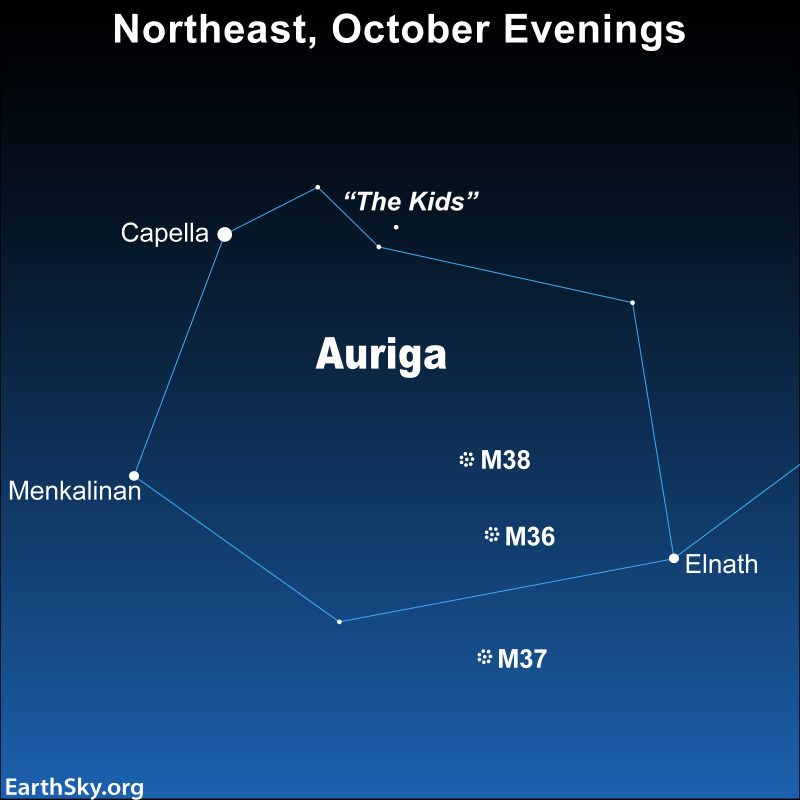
Auriga
ConstellationWikipedia
16
MENTIONS
13
EPISODES
12
PODCASTS
Search complete. 16 mentions across 13 episodes found for "Auriga".
Sep 9, 2026

Marty LeedsGUEST
So going off what Mario was saying is, like, he's, they're not, like, moving forward, and that says a lot because it's like that's telling you right there that that is a figure in the heavens because it le- when, when you think about the cosmology and how it actually works, it's waters above and waters below.
Marty LeedsGUEST
And so when you get into, you know, looking up in the stars and we realize that this is a constellation, Auriga is the constellation, and in this sense, like what he's saying, the unmoved mover, well, it doesn't move.
Marty LeedsGUEST
It's absolutely that pattern.
Marty LeedsGUEST
It just, boom, just stamped onto the firmament, and then the firmament moves, but that pattern is always the same.
Marty LeedsGUEST
So his wheels are in the waters of heaven.
Marty LeedsGUEST
And Auriga is absolutely in, uh, the charioteer.
Marty LeedsGUEST
Auriga's the charioteer.
Marty LeedsGUEST
He's also known as, like, a shepherd and that sort of stuff, but he's actually in the Milky Way.

Chris BeckettHOST
Uh, on the twentieth of September, you can try following Capella, unaided eye, into the, uh, daylight sky that week.
Chris BeckettHOST
And that, that's kind of a, a neat one to try as well 'cause Capella, it's the brightest star in Auriga, and, uh, you'll be able to see that, uh, coming up in the morning sky.
Chris BeckettHOST
And then a- as you're, as you're watching it, um, you know, you can sort of watch your clock, make sure you're careful not to look anywhere towards the sun and see if you can follow that into the daylight sky.
Shane LudtkeHOST
Mm-hmm.

Chuck WilliamsonNARRATOR
Capella! Billy had drawn a star chart to her side.
Chuck WilliamsonNARRATOR
Where is that located? In Auriga, about halfway from Orion to the Pole Star.
Chuck WilliamsonNARRATOR
She's a big yellow sun.
Chuck WilliamsonNARRATOR
At any rate, the Venusians say that this particular planet of Capella's has people almost exactly the same as those of the Earth, except, speaking very clearly, except that they have had about one century more civilization.

ChrisHOST
On the 20th of September, you can try following Capella, a needed eye, into the daylight sky that week.
ChrisHOST
And that's kind of a neat one to try as well, because Capella, it's the brightest star in Auriga.
ChrisHOST
And you'll be able to see that coming up in the morning sky.
ChrisHOST
And then as you're watching it, you can sort of watch your clock.

Stuart GaryHOST
The Aurigids provide up to five swift and bright meteors an hour, with its peak just before dawn on September the first.
Stuart GaryHOST
It's best viewed from the Northern Hemisphere as its radiant, that is, the direction the meteors appear to be coming from, lies in the northern sky constellation of central Auriga.
Stuart GaryHOST
A second meteor shower in the month of September is the Epsilon Perseids, which run from September the fifth to the twenty-first.
Stuart GaryHOST
Although they're called the Epsilon Perseids, the radiant actually lies closer to the star Beta Perseus or Algol.

Adrian WealeNARRATOR
Camille Flammarion, the famous French astronomer, wrote a fantastic little book called Lumen, which tells of a man who died in 1864.
Adrian WealeNARRATOR
His soul flew straight to its heaven, which was one of the planets of Capella, the largest star in the constellation Auriga.
Adrian WealeNARRATOR
Here he found the benevolent inhabitants of that sphere, who were endowed with superhuman powers of sight, watching with great distress the bloody scenes of the French Revolution of 1793, and wondering how it would come out.
Adrian WealeNARRATOR
To the visitor from the earth this was an old story.
Adrian WealeNARRATOR
To the people of Alpha Aurigae it was a present spectacle, for the distance of the star was such that it took light seventy-two years to travel from the earth, so they were seventy-two years belated in their observation of current events on our planet.
Adrian WealeNARRATOR
The spirit of the defunct Parisian, having the power of flying through empty space at any speed he chose, found that he had thereby also acquired control of time, and could hasten, retard, stop, or reverse the course of events at will by simply varying his speed.
Adrian WealeNARRATOR
If he remained stationary, scenes on the earth would unfold at their normal rate and in regular order.

Russell RaphaelHOST
The appearance of a star, first magnitude, of exceeding brilliancy, dominating by night and day a new luminous sun generated by the collision and amalgamation and in, in incandescence of two nonluminous exsuns about the period of the birth of William Shakespeare over Delta in the recumbent neversetting constellation of Cassiopeia, and of a star, second magnitude, of similar or- origin but lesser brilliancy which had appeared in and disappeared from the constellation of Corona Septentrionalis about the period of the birth of Leopold Bloom.
Russell RaphaelHOST
And of other stars of presumably similar origin which had effectively or presumably appeared in and disappeared from the cos- constellation of Andromeda about the period of the birth of Stephen Dedalus, and in and from the constellation of the Auriga some years after the birth and death of Rudolph Bloom Junior, and in and from other constellations some years before or after the birth or death of other persons.
Russell RaphaelHOST
The attendant phenomena of eclipses, solar and lunar, from immersion to immersion: abatement of wind, transit of shadow, taciturnity of winged creatures, emergence of nocturnal or crepuscular animals, persistence of infernal light, obscurity of terrestrial waters, pallor of human beings.
Russell RaphaelHOST
His, Bloom's, logical conclusion, having weighed the matter and allowing for possible error: that it was not a heaven tree, not a heaven grot, not a heaven beast, not a heaven man.

JesseHOST
Super not great at labyrinths.
JesseHOST
The last thought Auriga has as she bleeds out.
JesseHOST
Yes.
JesseHOST
Well, okay.

speaker_3NARRATOR
It is not a constellation, but a pattern formed by six bright stars from different constellations.
speaker_3NARRATOR
Rigel from Orion, Aldebaran from Taurus, Capella from Auriga, Pollux from Gemini, Procyon from Canis Minor, and Sirius from Canis Major.
speaker_3NARRATOR
These stars form a rough, hexagonal shape that dominates the winter sky.
speaker_3NARRATOR
Inside this hexagon lies Betelgeuse, the red giant star in Orion.
3 more episodes mention Auriga.
Create an account to see the whole feed, search across every transcript, and follow the entities you care about.