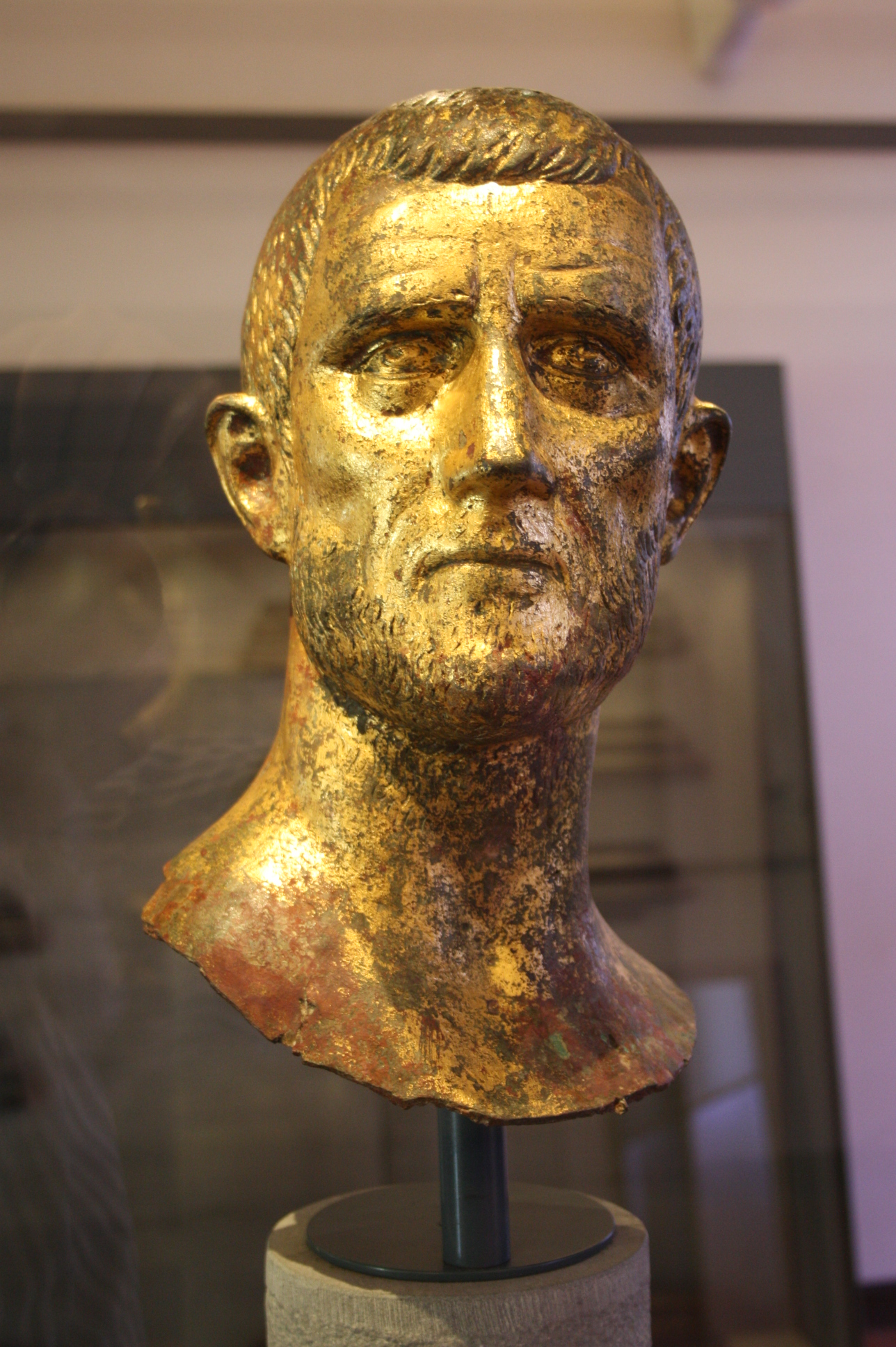
Aurelian
Former Roman emperorWikipedia
67
MENTIONS
34
EPISODES
32
PODCASTS
Search complete. 67 mentions across 34 episodes found for "Aurelian".
Oct 13, 2026

Mike RitlandHOST
Man, that's fascinating.
Jeremy Ryan SlateGUEST
Now here is, not too far after, this is Aurelian, and he has the nickname Restutor Orbis or Restorer of the World.
Jeremy Ryan SlateGUEST
And because Rome had broken into three pieces after Valerian died, and over a 15-year period he reunites them.
Jeremy Ryan SlateGUEST
He tries to fix the currency at that point in time, which has been slowly collapsing.
Jeremy Ryan SlateGUEST
It would've had, like, a silver coating on top of it, which is already not there anymore.
Mike RitlandHOST
Wow.
Jeremy Ryan SlateGUEST
And then here's Probus, which is right after Valerian, or right after, uh, Aurelian.
Mike RitlandHOST
So this is the 5% silver maybe.

John TrevithickNARRATOR
The circuit of the bench frontage of the Circus Maximus was very nearly a mile in length, and the Romans of imperial times certainly used 10 times as much water as the modern Romans.
John TrevithickNARRATOR
But, on the other hand, habits change, and Rome, as it is defined by lines drawn at the times of its greatest ascendancy, the city that is, enclosed by the walls of Aurelian, and including all the regiones of Augustus, an enclosure from which there could have been no reason for excluding half or more of its population, could have scarcely contained a million.
John TrevithickNARRATOR
It would have packed very comfortably within the circle of the Grand Boulevard of Paris, the Paris that is, of Louis XIV, with a population of 560,000.
John TrevithickNARRATOR
And the Rome of to-day were the houses that spread so densely over the once vacant Campus Martius, distributed in the now deserted spaces in the south and east, and the Vatican suburb replaced within the ancient walls would quite fill the ancient limits in spite of the fact that the population is under 500,000.

Amelia ChesleyNARRATOR
From that time the treatise has often been printed, edited, translated, but opinion still floats undecided about its origin and period.
Amelia ChesleyNARRATOR
Does it belong to the age of Augustus or to the age of Aurelian? Is the author the historical Longinus, the friend of Plotinus, the tutor of Porphyry, the victim of Aurelian? Or have we here a work by an unknown hand more than two centuries earlier? Manuscripts and traditions are here of little service.
Amelia ChesleyNARRATOR
The oldest manuscript, that of Paris, is regarded as the parent of the rest.
Amelia ChesleyNARRATOR
It is a small quarto of 414 pages, whereof 335 are occupied by the problems of Aristotle.
5 MINS LATER
Amelia ChesleyNARRATOR
Now, the historical Longinus was a friend of the Neoplatonist teacher, not writer, Ammonius Saccas.
Amelia ChesleyNARRATOR
If we could be sure that the Ammonius of the treatise was this Ammonius, the question would be settled in favor of the late date.
Amelia ChesleyNARRATOR
Our author would be that Longinus who inspired Zenobia to resist Aurelian, and who perished under his revenge but ammonius is not a very uncommon name and we have no reason to suppose that the neo-platonist ammonius busied himself with the literary criticism of homer and plato there was among others an egyptian ammonius the tutor of plutarch these are the mass of the arguments on both sides M. Egger sums them up thus.
Amelia ChesleyNARRATOR
After carefully examining the tradition of the manuscripts, and the one very late testimony in favor of Longinus, I hesitated for long as to the date of this precious work.

John TrevithickNARRATOR
The circuit of the bench frontage of the Circus Maximus was very nearly a mile in length, and the Romans of imperial times certainly used ten times as much water as the modern Romans.
John TrevithickNARRATOR
But on the other hand, habits change, and Rome, as it is defined by lines drawn at the times of its greatest ascendancy, the city that is, enclosed by the walls of Aurelian, and including all the regiones of Augustus, an enclosure from which there could have been no reason for excluding half or more of its population, could have scarcely contained a million.
John TrevithickNARRATOR
It would have packed very comfortably within the circle of the Grand Boulevard of Paris, the Paris that is, of Louis XIV, with a population of five hundred and sixty thousand.
John TrevithickNARRATOR
And the Rome of today, were the houses that spread so densely over the once vacant Campus Martius, distributed in the now deserted spaces in the south and east, and the Vatican suburb replaced within the ancient walls, would quite fill the ancient limits, in spite of the fact that the population is under five hundred thousand.

DuneHOST
Um-
TitusHOST
I don't think Aurelian did.
TitusHOST
He was too busy.
DuneHOST
No, but like of the Julio-Claudians.

Jeremy Ryan SlateGUEST
It's two." So you have an attempt to fix currency there because people were losing faith in currency.
Jeremy Ryan SlateGUEST
You go down the road toward the end of the Third Century Crisis, around 275, Aurelian, who's ba- the, the empire had broken up at that point in time, where you have kind of the hollowed out center.
Jeremy Ryan SlateGUEST
You have the West breaks off and forms what's called the Gallic Empire.
Jeremy Ryan SlateGUEST
The East breaks off and forms the Palmyren Empire.
Jeremy Ryan SlateGUEST
Because you have a crisis of confidence in kind of the, the central part of the Roman Empire, right? Where people are pulling further away from being involved in the state because it's not really benefiting them.
Jeremy Ryan SlateGUEST
So Christianity's actually a really key part of that, because now people are brought into kind of one world view again, right? Because Rome is interesting, where you had your 12 traditional Roman gods, but you could bring in gods from different places.
Jeremy Ryan SlateGUEST
You might have, uh, Sol Invictus, which is, uh, a god that Aurelian worshiped and Constantine earlier in his life worshiped, which is from North Africa.
Jeremy Ryan SlateGUEST
You might worship, um, Isis from Egypt or Apollo from, uh, Greece, and a lot of these things were acceptable.

MithaHOST
The Greeks sacrificed it to Demeter.
MithaHOST
The emperor Aurelian put free pork on Rome's public dole.
MithaHOST
Every medieval cottager who could fatten a pig on acorns and scraps had a winter's meat that owed no lord anything." and it earns its place now.
MithaHOST
Pork is the richest source of thiamine in the butcher's window, close to 10 times what the same weight of beef carries.

Pamela NagamiNARRATOR
A Roman emperor, Decius, was defeated and slain by them.
Pamela NagamiNARRATOR
During the whole of the third century the confederacy then known as that of the Alamani was putting to the severest strain the efforts of emperors like Maximin, Claudius, Aurelian, and Probus to keep them from the Upper Rhine, and they ended by establishing themselves there in spite of the victories in the following century of Julian and Gratian.
Pamela NagamiNARRATOR
In the year 240 the Germans of the Lower Rhine, no more known as the Chatti, Camavi, Buchtari, and only in rhetoric as the Gaembrians, appear for the first time as the Franks, more furious, more enterprising, and more terrible in their ravages in Gaul than even the Alamani.
Pamela NagamiNARRATOR
And the Burgundians, once settled between the Oder and the Vistula, then in their migrations driven westward before the Goths, pushed themselves in between the Alamani and the Franks.

MatthewHOST
In dire circumstances, we have seen great leaders that had a knack for spotting talent.
MatthewHOST
Like we talked about Gallienus, Aurelian, Aetius, Majorian, all these guys, right? And I think Heraclius had that knack as well.
MatthewHOST
And then there's the boy heir, Heraclius Constantine, a teenager.
MatthewHOST
Maybe he's like 14 years old at this point.
24 more episodes mention Aurelian.
Create an account to see the whole feed, search across every transcript, and follow the entities you care about.