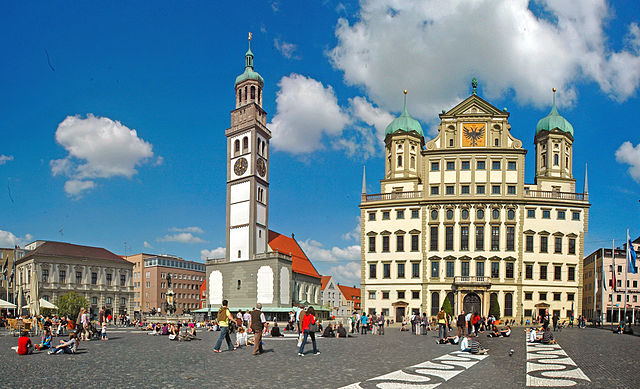
Augsburg
City in GermanyWikipedia
267
MENTIONS
78
EPISODES
66
PODCASTS
Search complete. 267 mentions across 78 episodes found for "Augsburg".
Sep 18, 2026

Jürgen OverhoffGUEST
It was a mess.
Jürgen OverhoffGUEST
But then we have the Treaty of Augsburg in 1555, and this is really a milestone in the history of tolerance.
Jürgen OverhoffGUEST
Because people eventually found out that it is not the best thing to engage in fights and killing each other on a daily basis.
Jürgen OverhoffGUEST
But we have to find if we think differently.
Jürgen OverhoffGUEST
And they had found out by that time that they could not convince each other by weapons and warfare.
Jürgen OverhoffGUEST
So they thought differently about theology and how to live their lives.
Jürgen OverhoffGUEST
So we have to come together and find a way to coexist so in 1555 they came up with the treaty the Protestants and the Catholics I mean Germany came up with this treaty the peace treaty of Augsburg and they said well we live in a federal system We have different states.
Jürgen OverhoffGUEST
Now, what we can do is Bavaria is Catholic.

Simon GuillebaudHOST
Johannes is a German Catholic theologian, philosopher, author, speaker.
Simon GuillebaudHOST
Studied German literature and philosophy before completing a doctorate in Catholic theology in Munich, and he's best known, I can't wait to hear this story, about starting founding the Gebetshaus Augsburg, which is the Augsburg House of Prayer, this beautiful ecumenical movement established in 2005 with his wife, Jutta.
Simon GuillebaudHOST
Married to four kids.
Simon GuillebaudHOST
They host the Mehr, Mehr in German, for More Conference that I think beginning of this year had 11,000 attendees.
13 MINS LATER
Simon GuillebaudHOST
So God brings you Jutta.
Simon GuillebaudHOST
You can't be a, a monk or a hermit.
Simon GuillebaudHOST
And tell us about the journey to founding Gebetshaus Augsburg.
Johannes HartlGUEST
I think it's very good that I didn't become a monk.

Markus FjørtoftHOST
Finn Daman.
Markus FjørtoftHOST
Ferdinand Augsburg goalkeeper as well.
Markus FjørtoftHOST
I think it's been a bit under the radar in terms of him not being...
Markus FjørtoftHOST
Yeah.
Jan Åge FjørtoftHOST
Okay.
Jan Åge FjørtoftHOST
Yeah.
Jan Åge FjørtoftHOST
And then he, of course, saved his sixth penalty in consecutive penalties which is a record in Germany unbelievable hopefully Frankfurt have solved their goalkeeping problem okay then we have Hannes Behrens Augsburg as well Augsburg fullback
Markus FjørtoftHOST
so younger around 21

Pamela NagamiNARRATOR
The death of Henry V in 1125 gave prominence to two factions whose names are intimately associated with the internal wars of Italy.
Pamela NagamiNARRATOR
The Salian or Franconian emperors, the descendants of Conrad, were also known by the name of Waiblingen, from a castle which they occupied in the diocese of Augsburg.
Pamela NagamiNARRATOR
The house of Bavaria, having had many princes of the name of Wulf, came to be generally known by this appellation.
Pamela NagamiNARRATOR
The two words were Italianized into Ghibellino and Guelfo, and as the later Salic emperors had been enemies of the Church, the two parties ranged themselves respectively on the sides of the Empire and the Papacy.
6 HRS 24 MINS LATER
Pamela NagamiNARRATOR
He was therefore all the more anxious to begin his expedition to Italy as soon as possible in order that the Pope might crown him at Rome and thus give his power a stability which it did not now possess.
Pamela NagamiNARRATOR
Rupert sent envoys to the Florentines describing himself as the deadly enemy of John Galeazzo who had surpassed the enormity of his other crimes by bribing Rupert's physician to poison him at Vienna.
Pamela NagamiNARRATOR
The imperial army mustered at Augsburg in September 1401.
Pamela NagamiNARRATOR
The Florentines promised a sum of 200,000 florins on the condition that the independence of their town should be respected.

Greg SteinmetzGUEST
He was born in the right place at the right time.
Greg SteinmetzGUEST
Augsburg, let's say maybe it's sort of a distant suburb of Munich, takes a- an hour from train, by train to get there.
Greg SteinmetzGUEST
At the time, it was at a, a great place.
Greg SteinmetzGUEST
It was at the crossroads between Venice, which handled all that Silk Road business, and the rest of Europe.
Greg SteinmetzGUEST
It was fairly close to the, uh, the passes you needed to get over the Alps, but you could also access, uh, get access up to the north, up to the Netherlands, Belgium.
Greg SteinmetzGUEST
So that was a good place to be.
Greg SteinmetzGUEST
Um, Augsburg had carved out a niche as a textile center.
Greg SteinmetzGUEST
That put Augsburg in a good place to build, um, industry, and from that, we had banking.

Pamela NagamiNARRATOR
Yet it can hardly be doubted that a really national parliament would have adopted Lutheranism.
Pamela NagamiNARRATOR
more or less modified as the religion of the nation before protestantism was fifty years old in spite of all difficulties ninety per cent of the population of germany were protestant in default of national action in favour of protestantism it was adopted and supported by most of the lay princes and electors a new principle of disintegration was thus introduced into germany as those princes were forced to act in opposition to the views adopted by the diet if the diet was unlikely to play the part of an english parliament neither was the emperor likely to play the part of henry the eighth for the interests of germany charles the fifth who had been elected in fifteen nineteen was weak where he ought to have been strong and strong where he ought to have been weak as emperor he was nothing as feudal sovereign and national ruler he was very little but he was also a prince of the empire and as such he ruled over the austrian duchies and tyrol further than this he was one of the most powerful sovereigns of europe he was king of spain and of the indies with all their mines in italy he disposed of naples and the milanese sicily and sardinia were his and under various titles he ruled over the fragments of the old burgundian inheritance franche-comte and the seventeen provinces of the netherlands such a man would influence the progress of affairs in germany with a weight out of all proportion to his position in the german constitution and unhappily with the power of a foreign sovereign he brought the mind of a foreigner his mother's spanish blood beat in his veins and he had the instinctive aversion of a spaniard to anything which savoured of opposition to the doctrines of the church that man he said when he caught sight of luther for the first time shall never make me a heretic of this antagonism between the minority of the princes backed by the majority of the nation and the majority of the princes backed by an emperor who was also a foreign sovereign civil war was the natural result in the end the triumph of the protestants was so far secured that they forced their opponents in fifteen fifty two to yield to the convention of passau by which it was arranged that a diet should be held as soon as possible for a general pacification that diet which was assembled at augsburg in fifteen fifty five met under remarkably favourable circumstances charles the fifth baffled and disappointed had retired from the scene and had left behind him as his representative his more conciliatory brother ferdinand who was already king of hungary and bohemia and was his destined successor in the german possessions of the house of austria both he and the leading men on either side were anxious for peace and were jealous of the influence which philip the son of charles the fifth and his successor in spain italy and the netherlands might gain by a continuance of the war there was little difficulty in arranging that the protestant princes who before the date of the convention of passau had seized ecclesiastical property within their own territories either for their own purposes or for the support of protestant worship should no longer be subject to the law or authority of the catholic clergy the real problem arose in providing for the future with protestantism as a growing religion the princes might be inclined to proceed further with the secularization of the church property still left untouched within their own territories and besides this it was possible that even bishops or abbots themselves being princes of the empire might be inclined to abandon their religion and to adopt protestantism the first of these difficulties was left by the treaty in some obscurity but from the stress laid on the abandonment by the catholics of the lands secularized before the convention of passau it would seem that they might fairly urge that they had never abandoned their claims to lands which at that date had not been secularized the second difficulty led to long discussions the protestants wished that any bishop or abbot who pleased might be allowed to turn protestant and might then establish protestantism as the religion of his subjects the catholics insisted that any bishop or abbot who changed his religion should be compelled to vacate his post and this view of the case prevailed under the name of the ecclesiastical reservation it was further agreed that the peace should apply to the lutheran church alone no other confession having been as yet adopted by any of the princes such a peace acceptable as it was at the time was pregnant with future evil owing its origin to a diet in which everything was arranged by the princes and electors it settled all questions as if nobody but princes and electors had any interest in the matter and besides this there was a most unstatesmanlike want of provision for future change The year 1552 was to give the line by which the religious institutions of Germany were to be measured for all time.
Pamela NagamiNARRATOR
There was nothing elastic about such legislation.
Pamela NagamiNARRATOR
It did not, on the one hand, adopt the religion of the vast majority as the established religion of the empire.
6 HRS 41 MINS LATER
Pamela NagamiNARRATOR
It was not an agreement which anyone was likely to be enthusiastic about.
Pamela NagamiNARRATOR
The ties which bound Ferdinand to his Protestant subjects had been rudely broken, and the solemn promise to forget and forgive could not weld the nation into that unity of heart and spirit which was needed to resist the foreigner.
Pamela NagamiNARRATOR
A Protestant of the North might reasonably come to the conclusion that the price to be paid to the Swede and the Frenchman for the vindication of the rights of the Southern Protestants was too high to make it prudent for him to continue the struggle against the emperor but it was hardly likely that he would be inclined to fight very vigorously for the emperor on such terms if the treaty gave no great encouragement to anyone who was comprehended by it it threw still further into the arms of the enemy those who were excepted from its benefits the leading members of the league of heilbrunn were excepted from the general amnesty though hopes of better treatment were held out to them if they made their submission the landgrave of hesse cassel was shut out as a calvinist besides such as nourished legitimate grievances there were others who like bernard were bent upon carving out a fortune for themselves or who had so blended in their own minds consideration for the public good as to lose all sense of any distinction between the two there was no lack here of materials for a long and terrible struggle but there was no longer any noble aim in view on either side the ideal of ferdinand and maximilian was gone the church was not to recover its lost property the empire was not to recover its lost dignity the ideal of gustavus of a protestant political body was equally gone even the ideal of wallenstein that unity might be founded on an army had vanished from henceforth french and swedes on the one side austrians and spaniards on the other were busily engaged in writhing at the corpse of the dead empire the great quarrel of principle had merged into a mere quarrel between the houses of austria and bourbon in which the shred of principle which still remained in the question of the rights of the southern protestants was almost entirely disregarded horrible as the war had been from its commencement it was every day assuming a more horrible character on both sides all traces of discipline had vanished in the dealings of the armies with the inhabitants of the countries in which they were quartered soldiers treated men and women as none but the vilest of mankind would now treat brute beasts he who had money says a contemporary was their enemy he who had none was tortured because he had it not outrages of unspeakable atrocity were committed everywhere human beings were driven naked into the streets their flesh pierced with needles or cut to the bone with saws others were scalded with boiling water or hunted with fierce dogs the horrors of a town taken by storm were repeated every day in the open country even apart from its excesses the war itself was terrible enough when augsburg was besieged by the imperialists after their victory at nirdlingen it contained an industrious population of seventy thousand souls after a siege of seven months ten thousand living beings wan and haggard with famine remained to open the gates to the conquerors and the great commercial city of the fuggers dwindled down into a country town how is it possible to bring such scenes before our eyes in their ghastly reality let us turn for the moment to some notes taken by the companion of an english ambassador who passed through the country in sixteen thirty six as the party were towed up the rhine from cologne on the track so well known to the modern tourist they passed by many villages pillaged and shot down further on a french garrison was in ehrenbreitstein firing down upon koblenz which had just been taken by the imperialists they in the town if they do but look out of their windows have a bullet presently presented at their head more to the south things grew worse at bacherach the poor people are found dead with grass in their mouths at rudesheim many persons were praying where dead bones were in a little old house and here his excellency gave some relief to the poor which were almost starved as it appeared by the violence they used to get it from one another at menz the ambassador was obliged to remain on shipboard for there was nothing to relieve us since it was taken by the king of sweden and miserably battered here likewise the poor people were almost starved and those that could relieve others before now humbly begged to be relieved and after supper all had relief sent from the ship ashore at the sight of which they strove so violently that some of them fell into the rhine and were like to have been drowned up the mine again all the towns villages and castles be battered pillaged or burnt after leaving wurzburg the ambassador's train came to plundered villages and then to neustadt which hath been a fair city though now pillaged and burnt miserably poor children were sitting at their doors almost starved to death his excellency giving them food and leaving money with their parents to help them if but for a time in the upper palatinate they passed by churches demolished to the ground and through woods in danger understanding that the croats were lying hereabout further on they stayed for dinner at a poor little village which hath been pillaged eight and twenty times in two years and twice in one day and so on and so on The corner of the veil is lifted up in the pages of the old book, and the rest is left to the imagination to picture forth as best it may the misery behind.
Pamela NagamiNARRATOR
After reading the sober narrative, we shall perhaps not be inclined to be so very hard upon the Elector of Saxony for making peace at Prague.

Maria KasperNARRATOR
They returned to the house of the Senator Kimberker, where they were all lodging, and taking Kimberker, who was a Lutheran, into their confidence, they held a council of war.
Maria KasperNARRATOR
It was decided that Stanislaus must have gone to Augsburg.
Maria KasperNARRATOR
Paul recalled something that Stanislaus had said to him only the day before, when he had threatened plainly to run away.
Maria KasperNARRATOR
And they had heard him say another time that at Augsburg was Peter Canisius, the provincial of the German Jesuits.
Maria KasperNARRATOR
Of course they were going to follow him and bring him back.
Maria KasperNARRATOR
But night had come on before their inquiries and deliberations were finished.
Maria KasperNARRATOR
They must wait till the next day.
Maria KasperNARRATOR
Accordingly, bright and early the following morning, all three, with one of the Kostka's servants, drove out in a carriage over the Augsburg road.
Pamela NagamiNARRATOR
He was a strong reformer of vigorous intellect, competent learning, and irreproachable morals.
Pamela NagamiNARRATOR
About Whitsuntide 1058, envoys were dispatched to the imperial court at Augsburg, who obtained the ready assent of the empress to Gerhard's appointment.
Pamela NagamiNARRATOR
Near the end of the year, Duke Godfrey had raised the men, and Hildebrand had raised the money deemed sufficient to ensure success.
Pamela NagamiNARRATOR
The scattered cardinals and their clergy reassembled at Siena and elected Gerhard there on December 28th.
29 MINS LATER
Pamela NagamiNARRATOR
Anno of Kulm, not highborn but not less ambitious, was involved in similar strife with the Palgrave Henry, but succeeded in defeating him.
Pamela NagamiNARRATOR
The Palgrave died mad and his son was made a vassal of the sea.
Pamela NagamiNARRATOR
The prelate who had by far the greatest influence with the Empress was Henry, Bishop of Augsburg, and he consequently incurred peculiar hatred.
Pamela NagamiNARRATOR
Base slanders respecting their intimacy were circulated, which however groundless served the turn of the malicious.

Philip GouldNARRATOR
With these he marched against the King of France, who, at the head of near 100,000 men, had begun the war.
Philip GouldNARRATOR
The Duke attacked the King near Augsburg, and after a desperate and bloody battle, defeated him.
Philip GouldNARRATOR
Footnote, September 14th, 1917.
Philip GouldNARRATOR
End footnote.

ThomasGUEST
That's real war.
ThomasGUEST
Um, that same month, um, at, uh, In Augsburg, the Royal Army Fraction bombed a police station, specifically targeting the Bavarian State Criminal Investigation Agency.
ThomasGUEST
Five police officers were wounded.
ThomasGUEST
For the first time, there was a formal acceptance of responsibility.
68 more episodes mention Augsburg.
Create an account to see the whole feed, search across every transcript, and follow the entities you care about.