Atoms for Peace
SpeechWikipedia
11
MENTIONS
7
EPISODES
7
PODCASTS
Search complete. 11 mentions across 7 episodes found for "Atoms for Peace".
Oct 1, 2026

Ilan BermanHOST
No, that makes a lot of sense to me, but, but also it's a little bit of a technocratic answer in the sense that, you know, it is, it is an ongoing process.
Ilan BermanHOST
The most compelling arguments I've heard against this, w- one is historical and one is strategic, right? The historical one is that regimes aren't forever, and we run the risk of repeating the error that we made with Iran when the Eisenhower administration actually was the grantor of an Iranian civilian enrichment capability b- uh, as part of the Atoms for Peace program.
Ilan BermanHOST
Uh, and that all went well until it didn't go well.
Ilan BermanHOST
So there, there's that, that fear.

AdamHOST
It's a, at this point in time, the cold war, everybody's freaking out about nuclear.
AdamHOST
They're freaking out about bombs and being in this cold war, uh, While trying to start to pass on this new form of energy, this zero emission atomic energy, you have to start trying to push them in a – hey, atoms for peace, not atoms for war.
AdamHOST
We're going to try to push this agenda a little bit differently.
ChrisHOST
You have to rebrand it.
ChrisHOST
Yeah, it's an invisible killer.
ChrisHOST
It's a long-term invisible – form of death instead of just a quick one with an explosion.
AdamHOST
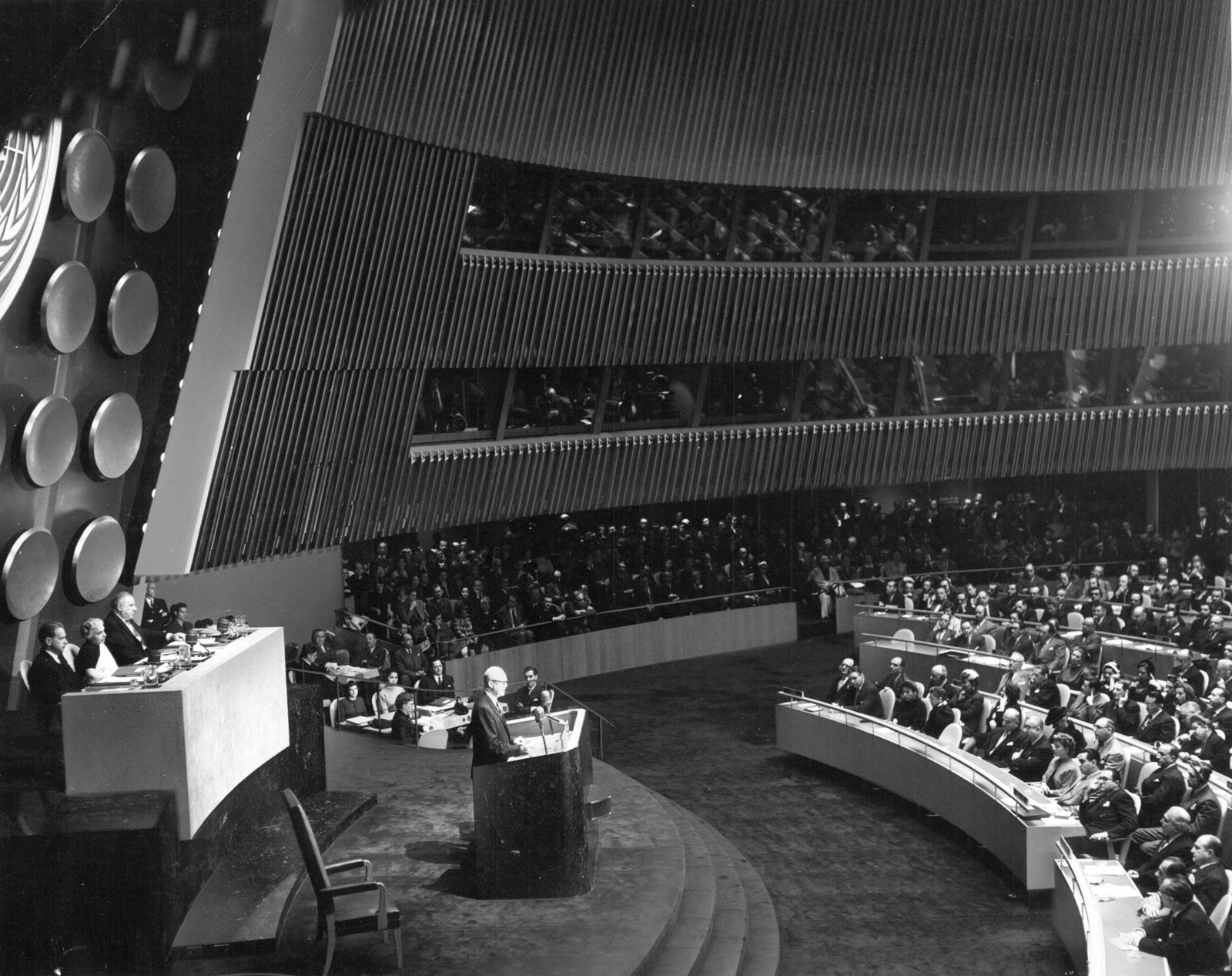
When you're trying to do that, Eisenhower, a guy who was such a military force coming out as president with this Atoms for Peace address where he frames atomic energy as something that should serve the needs rather than the fears of mankind.
AdamHOST
Brilliant line.

Shane SmithGUEST
America gave them their first reactor.
Shane SmithGUEST
We gave them their nuclear program under Atoms for Peace.
Shane SmithGUEST
And you know, they s- then they said, "Look, we're a member of the Nonpr- Proliferation, uh, Pact.
Shane SmithGUEST
We can't do it." And the Grand Ayatollah Khomeini, uh, said, in- issued a fatwa that i- is irrevocable saying that you cannot develop weapons of mass destruction.

BenjaminGUEST
Well, that's a great question.
BenjaminGUEST
And I think what access to nuclear technology, when the international commitment to provide nuclear technology to countries developing nations at the time this began in the 1950s under american president dwight eisenhower under a program known as atoms for peace and it was meant to suggest that all nations should have a right to access nuclear technology for civilian use for medical for energy and that if they agreed by certain guidelines and operated under certain conditions through the nuclear non-proliferation treaty that they would receive this access the idea being that this would help countries emerge uh the countries that were either challenging to develop their own energy infrastructure or we're looking for alternatives or more and so i think the spirit of that still remains the issue then becomes is once you do this once you give a country access to that technology can you develop safeguards to prevent it from going beyond the limits imposed under that agreement That is where we run into problems.
BenjaminGUEST
I think the idea that Saudi Arabia and other non-nuclear states should have access to this under an umbrella system, in theory, in spirit, is a very good one.
BenjaminGUEST
And it is meant to provide the Saudis with not just a pathway towards alternative energy away from oil, because we've seen the disruption that can result on the over-reliance on one natural resource, for energy use and for state revenue.

Cory HughesHOST
It is not known to this researcher to what extent Secretary Strauss aided the fledgling Permindex, either promoting or protecting, only that he was in the right place in the right time and used the same language, permanent exhibitions.
Cory HughesHOST
In his presentations on nuclear trade in Atoms for Peace, the peaceful U.S. conferencees in Geneva were selling their floor model reactors right out of their shiny showrooms.
Cory HughesHOST
The Atomic Energy Act, as amended in 1954, mandated a role to the US Department of Commerce to assume oversight of nuclear facilities.
Cory HughesHOST
The processing and utilization of source, byproduct, and special nuclear material affects interstate and foreign commerce and must be regulated.
5 MINS LATER
Cory HughesHOST
In 1955, our classification policies were revised to open up large areas of reactor information.
Cory HughesHOST
As of today, 1962, in the field of reactors, only data primarily of importance to reactor systems for military applications remain classified.
Cory HughesHOST
The feature of our international cooperation on Atoms for Peace program, which distinguished it most completely from enterprises by other nations, is that we were both able and willing to allocate quantities of reactor fuel.
Cory HughesHOST
In 1958, there was a total allocation for peaceful uses of 100,000 kilograms of uranium-235, designated half for the Atoms for Peace program.

Joe CalnanHOST
Yeah.
Michelle LeslieGUEST
Atoms for Peace.
Joe CalnanHOST
She's the author of a recent paper for us at CJI titled Canada's Nuclear Export Moment.
Joe CalnanHOST
And we'll link this in the show notes.
14 MINS LATER
Joe CalnanHOST
That's always a concern for these sorts of technologies.
Joe CalnanHOST
But yeah, sorry.
Michelle LeslieGUEST
And a lot of, no, no, no, I don't mean to, and a lot of people, you know, may or may not know about the IAEA, right? So the International Atomic Energy Agency, the signatory, the Atoms for Peace, right? And so it's, It's interesting in today's context how much of our energy is tied to security.
Michelle LeslieGUEST
And then when you start looking at the supply chain all the way down to the raw materials, and the security around offtakes and what does it mean for a country's stability and an economic future.

Josh ThierengelGUEST
They were aligned with different countries.
Josh ThierengelGUEST
And so what Eisenhower did in the Atoms for Peace speech was talk about the fact that we better get together and figure out how to regulate around this thing that is not widely understood, but that is inherently dangerous and shared equally by a number of countries.
Josh ThierengelGUEST
Right.
Josh ThierengelGUEST
And so right now, we don't have any national regime that's forcing these companies to the table.