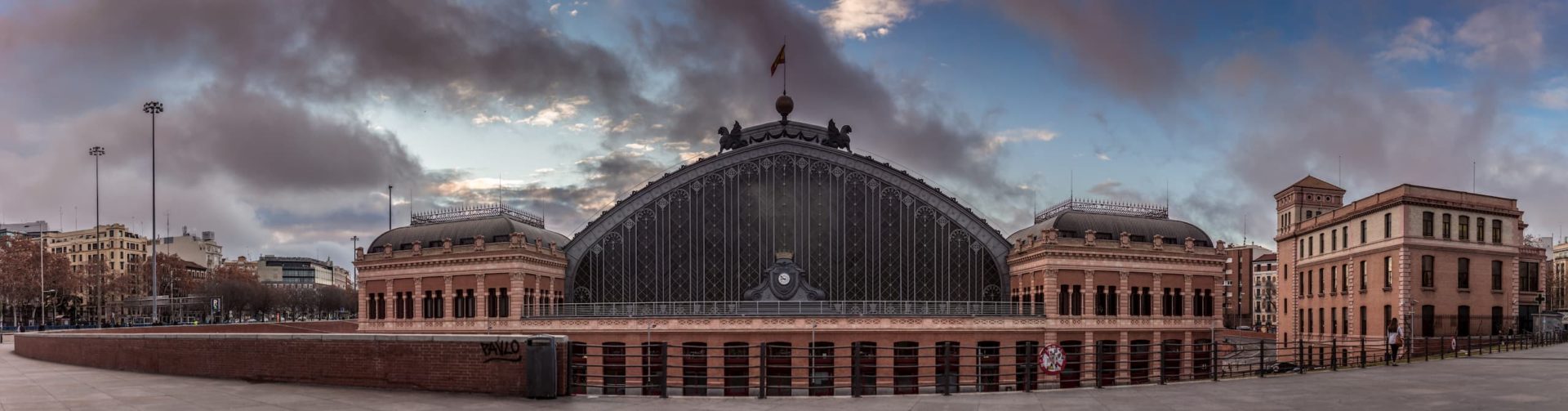
Atocha Railway Station
Train station in Madrid, SpainWikipedia
42
MENTIONS
20
EPISODES
18
PODCASTS
Search complete. 42 mentions across 20 episodes found for "Atocha Railway Station".
Nov 3, 2026

Giles BrownHOST
Because the air traffic guy is like, okay, you can, you know, Delta 3-5, you can land on flight path number two, and it's all very calm and organised and things.
Giles BrownHOST
And if you listen to the audio of this poor guy in Madrid, in Atocha, in the centre, and you listen to the poor, the train operator, the train operator is going, well, do I go on, do I not? And then you hear the guy in the control tower in Atocha going, hang on a second, momento, momento, and you can see him going...
Andres GallardoPANELIST
And
Giles BrownHOST
it's

Damien WilleyHOST
The investigation must also identify the people responsible for the conditions of this particular case.
Damien WilleyHOST
On the 29th, the CGT Railway Department, in response to public concern over the Atocha train station controller, demanded a general review of the organisation, staffing, scheduling and traffic conditions.
Damien WilleyHOST
The reaction of the workers, which was extended to a planned safety strike, was also the subject of this report concerning CEMAF, the train drivers' union, and the decision taken to continue the strike on October 29th.
speaker_5SOUNDBITE_SPEAKER
The Spanish Union of Train Drivers and Assistance is maintaining the strike called for this October 29th in defense of rail safety, as well as the fulfillment of commitments to achieve a structural change in safety.

Mary EnglishHOST
So it says on there, on the 28th of October, 26, at 8.54am, an AVE high-speed train collided end-on with a stationary IRO high-speed train in Los Yebenes, Toledo, on the Madrid-Cevil high-speed rail line, killing at least 69 people.
Mary EnglishHOST
Both trains involved in the crash were travelling from Atocha station in Madrid to Santa Justa station in Seville.
Mary EnglishHOST
Government sources gave the likely cause of the crash as human error in the manual operation of signalling after an automated system had failed.
Mary EnglishHOST
So it tells us about what time the train left and how many people were on board.
Mary EnglishHOST
So the Independent Authority for Technical Investigation of Accidents and Incidents, the AITAT, is responsible for investigating railway accidents in Spain.
Mary EnglishHOST
A recording of the communications between the ADIF Control Centre and the trains was leaked to the media.
Mary EnglishHOST
Oscar Puente, the Minister of Transport and Sustainable Mobility, went to ADIF's Control Centre in Atocha to learn the details of the incident.
Mary EnglishHOST
He described it as inexplicable that ADIF's control centre authorised the AVE high-speed train to resume normal operation when the IRYO train was still stationary in front of it.

EnriqueHOST
Luego veremos también cómo fue exactamente el accidente y os lo voy a mostrar con, eh, un mapa para que veáis exactamente cómo ocurrió.
EnriqueHOST
Bien, entre ambos trenes viajaban un total de quinientos treinta pasajeros, ciento cuarenta y siete personas a bordo del Iryo, que había partido a las siete y cincuenta y cuatro horas de Madrid-Atocha.
EnriqueHOST
Trescientos setenta y ocho pasajeros a bordo del AVE de Renfe, con salida a las ocho horas desde la misma estación.
EnriqueHOST
El impacto fue de una vil violencia descomunal.

Victoriano Martín YobelSOUNDBITE_SPEAKER
During rush hour, we have a train every 15 minutes in the morning.
speaker_0NARRATOR
The anchor point for the rail system is Atocha Station in the capital city of Madrid.
speaker_0NARRATOR
Built back in the 1800s, Atocha Station is Madrid's busiest rail hub with over 20 million people travelling through it every year.
speaker_0NARRATOR
Upgrading to handle high-speed trains required new platforms and training a new generation of drivers like Jamie Arroyo.
Jamie ArroyoSOUNDBITE_SPEAKER
You're the driver.
speaker_0NARRATOR
March 11, 2004.
speaker_0NARRATOR
Terrorists set off 10 bombs on four separate commuter trains.
speaker_0NARRATOR
The explosives were smuggled on board in backpacks and detonated as the trains pulled into Atocha Station.

speaker_23SOUNDBITE_SPEAKER
Sometimes you have these like mental images in your head that you can't get out and it definitely was need to find a way to process that
Ken BrownCORRESPONDENT
so how did this happen first the lzb rail security system went down at around 8 30 a.m halting at least half a dozen trains including the italian irio train traveling from madrid to seville that stopped near urda toledo Command of the trains passed to the control center in Atocha, Madrid, and a second train, a national carrier Renfe train, also bound for Seville on the same track, was given the green light to restart its journey at full speed, potentially reaching over 200 kilometers an hour.
Ken BrownCORRESPONDENT
When the Erio train failed to restart with its 147 passengers stranded, the Renfe train carrying 397 people had around 20 minutes to build up speed, eventually slamming into the back of the Erio train, causing this catastrophic collision.
Ken BrownCORRESPONDENT
So that is what the government is pointing out right now, a human error that caused this terrible tragedy, the second rail fatal accident in Spain this year.

Paul FullerNARRATOR
Transport Minister Oscar Puente said that at 8.30 a.m., a computer failure knocked out the old LZB safety system on a 63-kilometer stretch, automatically halting trains there.
Paul FullerNARRATOR
At 8.36, he said, an operator at ADEF's control center in Madrid's Atocha station told the AVE driver to resume normal running, despite a red signal, even though the Erio train had told Atocha it was still motionless on the track.
Paul FullerNARRATOR
Puente called this inexplicable, and the government leaked control room recordings to the press, trying to substantiate its accusations against the operator.
Paul FullerNARRATOR
Blaming the disaster on human error is a fraud, however, whether or not human error in fact occurred.
Paul FullerNARRATOR
In 2024, the Rail Accident Investigation Commission, CIAF, examined an incident at Cuenca.
Paul FullerNARRATOR
It warned that replacing automatic systems with human verification is susceptible to failing and recommended switching from outdated systems to a modern ERTMS level two security system.
Paul FullerNARRATOR
As for the Atocha operator, the CSIF union warned in September that out-of-staff were working shifts of up to 12 hours, five nights in a row.
Paul FullerNARRATOR
Exhaustion and understaffing and the accidents that come with them were decided upon by management.

Ken BrownCORRESPONDENT
That stopped near Urda Toledo.
Ken BrownCORRESPONDENT
Command of the trains passed to the control center in Atocha, Madrid, and a second train...
Ken BrownCORRESPONDENT
A national carrier Renfe train, also bound for Seville on the same track, was given the green light to restart its journey at full speed, potentially reaching over 200 km an hour.
Ken BrownCORRESPONDENT
When the Erio train failed to restart with its 147 passengers stranded, the Renfe train, carrying 397 people, had around 20 minutes to build up speed, eventually slamming into the back of the Erio train, causing this catastrophic collision.
Stephen RitsonHOST
But then you've got these private ones coming on board as well, some of which are high speed as well.
Stephen RitsonHOST
The Irio train set off from Atocha train station.
Stephen RitsonHOST
The two main train stations in Madrid, Atocha, centre south, and Chamartín, centre north.
Stephen RitsonHOST
They connect to each other.
Stephen RitsonHOST
If you're going from Alicante to Santander, for example, you'd go through, you'd go through Atocha.
Stephen RitsonHOST
If you're going to Santander, you stay on the train.
Stephen RitsonHOST
You go underground, basically under the Castellana, that north-south road, Recoletos, Paseo del Prado.
Stephen RitsonHOST
You go under that all the way, Chamartín, you come back out, and then you carry on overground until the north, for example.

Sean LayHOST
In all, there have been three fatal rail accidents this year.
Sean LayHOST
SEMAF, the union, criticised how audio from the control centre at Madrid's Atocha station had been leaked to Spanish media, arguing that the recordings gave only a partial picture.
Sean LayHOST
An inquiry is underway to establish the full facts, but we're going to hear now from our correspondent, Guy Hedgcoe.
Guy HedgecoeCORRESPONDENT
Emergency workers have continued today to sift through the wreckage of the two trains that crashed with the help of cranes that have been lifting up carriages so that the workers can examine them and see if there are more bodies within the wreckage still.
10 more episodes mention Atocha Railway Station.
Create an account to see the whole feed, search across every transcript, and follow the entities you care about.