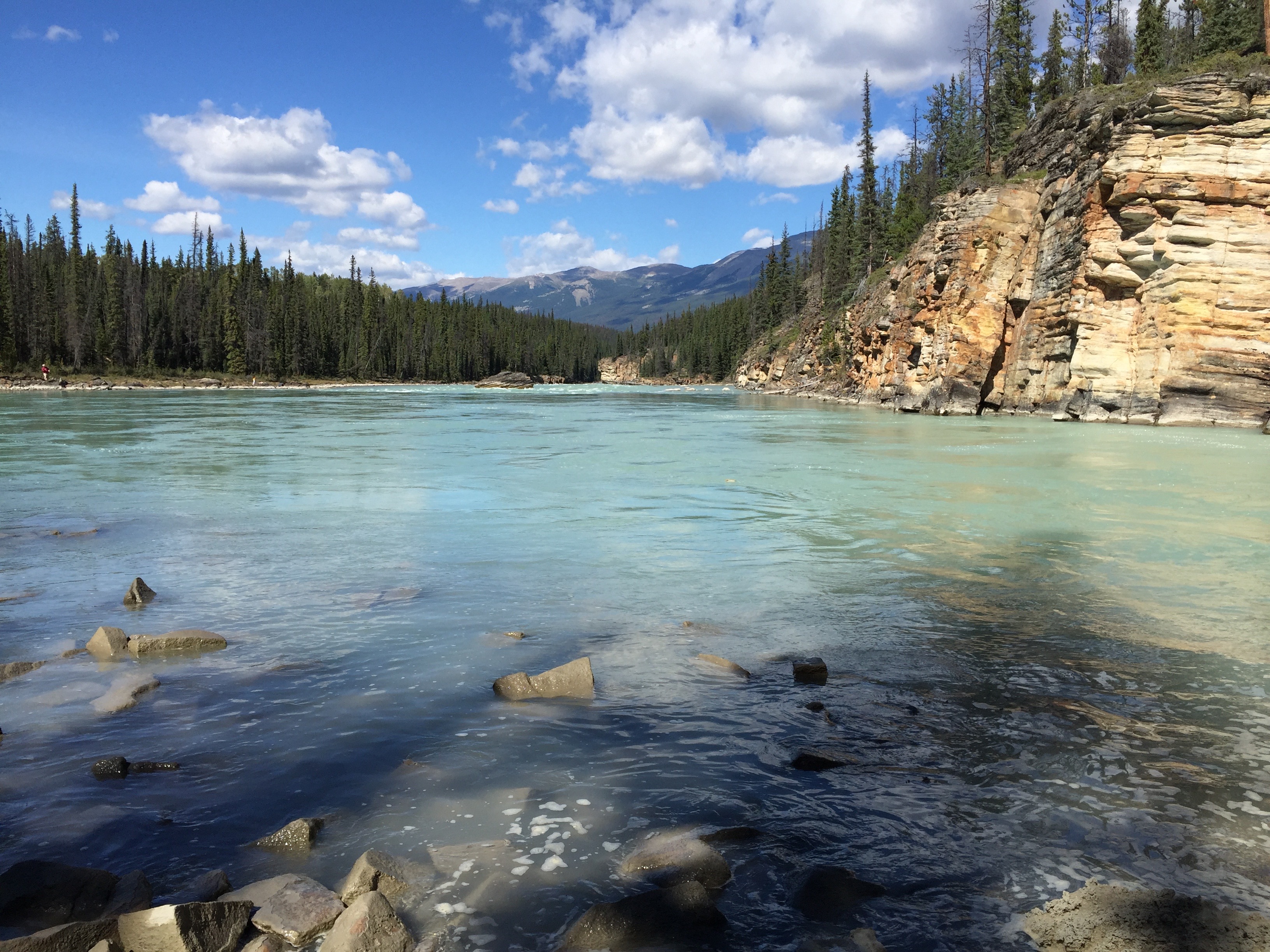
Athabasca River
River in Alberta, CanadaWikipedia
26
MENTIONS
12
EPISODES
9
PODCASTS
Search complete. 26 mentions across 12 episodes found for "Athabasca River".
Oct 11, 2026

Scott SunderwaldHOST
I think I'd also retain the electricity because we've got so much good water here.
Scott SunderwaldHOST
We've got the Athabasca River, Happy Creek.
Scott SunderwaldHOST
I've got running water up my backyard, so I'm not hurting.
Scott SunderwaldHOST
And then snowpack and...

Mark CarneySOUNDBITE_SPEAKER
This community's overcome many challenges over the years, including a devastating forest fire a decade ago, and it has always emerged stronger.
Mark CarneySOUNDBITE_SPEAKER
Carved out of the wilderness at the meetings of the Athabasca, Clearwater, and Hangingstone Rivers, this region holds the fourth-largest oil reserve in the world.
Mark CarneySOUNDBITE_SPEAKER
There's more than three and a half million barrels of oil that leave here every day to markets around the world, bringing home more than $40 billion to the Canadian economy every year.
Mark CarneySOUNDBITE_SPEAKER
There are literally hundreds of, hundreds of thousands of people who wake up and go to work every day because of what Fort McMurray has built.

speaker_0NARRATOR
As they reached the southern shore, the jumble of rocks and hills and stunted trees of the barren north was left behind, and the travelers entered a fine level country over which wandered great herds of buffalo and moose.
speaker_0NARRATOR
For about 40 miles, they ascended the course of the Athabasca River, finding themselves among splendid woods with tall pines and poplars such as Hearne had never seen.
speaker_0NARRATOR
From the Athabasca, they struck eastward, plunging into so dense a forest that at times the axes had to be used to clear the way.
speaker_0NARRATOR
For two months, January and February of 1772, they made their way through the northern forest.

John VaillantGUEST
I'm not a climate person.
John VaillantGUEST
I'm really a journalist and a citizen who saw Fort McMurray burning, was terrified and horrified by it, and wanted to understand, how could this happen in May, which is, you know, just this side of winter in, in, uh, Alberta, when there were still frozen lakes and car-sized blocks of ice on the Athabasca River? How could you have, uh, you know, temperatures in the 30 degree Celsius and flames 100 meters tall sweeping over one of the most able, well-equipped cities in North America and driving every citizen out of there in an afternoon, you know? And they were masters of their universe right up until May 3rd, and suddenly it was all they could do to get out of there with their cat, and that is a message to all of us.
John VaillantGUEST
And so, you know, my journey over the past decade has just been trying to understand that.
John VaillantGUEST
And basically, you know, we are living in a world that is growing steadily warmer, and we have continued burning fossil fuels unabated for about 250 years.

Brian EngelmanHOST
Wood Buffalo.
Brian EngelmanHOST
On the Athabasca River.
Brian EngelmanHOST
And it is the main service center for the Athabasca oil sands.
Brian EngelmanHOST
Okay.

Joe DesjardinsHOST
Um,
Chris GibbsHOST
you know, I, I did the, uh, bear two, two, two, um, the one that was, you know, uh, in during the fires, she hung her down with her, with her cubs or whatever and survived the wildfires around the Athabasca river.
Chris GibbsHOST
Um, they had GPS tracking, so they were able to, to follow her.
Chris GibbsHOST
saw her so she was there her and her cubs were running around the golf course but didn't get to see them but um oh really so two

Randall CarlsonGUEST
It's a meta type of meta quartzite rock whose origin, there's two mountains, Mount Robeson and Mount Edith Cavell that have that same type of rock.
Randall CarlsonGUEST
Now this Okotoks is part of what's known as the Foothills Erratics Train because it reaches for 500 miles from the mouth of the Athabasca River down into Montana.
Randall CarlsonGUEST
Okotoks is the biggest one of the, there's thousands of them, but Okotoks is the biggest, most impressive one.
Randall CarlsonGUEST
But the really bizarre thing about this, and when you're standing there looking at this massive boulder and thinking about the forces that could move it, appreciate the fact that its origin was on the western side of the continental divide.

Ted LinhartNARRATOR
On the Isaac Todd also went Macdonald of Garth.
Ted LinhartNARRATOR
The overland expedition was to thread that labyrinth of waterways connecting Lake Superior and the Saskatchewan, thence across the plains to Athabasca, over the northern Rockies, past Jasper House, through Yellowhead Pass, and down half the length of the Columbia through Kootenay Plains to Astoria.
Ted LinhartNARRATOR
One has only to recall the roaring canyons of the northern Rockies, with their sheer cataracts and bottomless precipices, to realize how much more hazardous this route was than that followed by Hunt from St. Louis to Astoria.
Ted LinhartNARRATOR
Hunt had to cross only the plains and the width of the Rockies.
10 MINS LATER
Ted LinhartNARRATOR
Here, at the great bend, we left canoes and began a mountain pass, Yellowhead Pass.
Ted LinhartNARRATOR
The river meanders much, and we cut across, holding by one another's hands, wading to the hips in water, dashing in, frozen at one point, thawed at the next, frozen before we dashed in, our men carrying blankets and provisions on their heads.
Ted LinhartNARRATOR
Four days hard work before we got to Jasper House at the source of the Athabasca, sometimes camping on snow twenty feet deep, so that the fires we made in the evening were fifteen or twenty feet below us in the morning." End quote.
Ted LinhartNARRATOR
They had now crossed the mountains, and taking to canoes again paddled downstream to the portage between Athabasca River and the Saskatchewan.
Randall CarlsonGUEST
Well, yes, it could be.
Randall CarlsonGUEST
You'll see on the map here, Mount Edith Cavell is the type of metachorsite rock that forms the erratics train, okay? So the pathway out from here is up the Athabasca River, through here.
Randall CarlsonGUEST
So those rocks would have been conveyed up through this here.
Randall CarlsonGUEST
Once it gets out onto the Alberta prairie here, it runs right up against a wall of ice, which is the westernmost wall of the Laurentide, the giant Laurentide ice sheet.
GeorgeHOST
Hey, are we going to go fishing in the river today too? I don't know.
GeorgeHOST
What do you think? We might be able to convince Casey to come down and try to catch a grayling or two out of the Athabasca.
Jeff CGUEST
Yeah.
GeorgeHOST
Oh wow, look at this view.
2 more episodes mention Athabasca River.
Create an account to see the whole feed, search across every transcript, and follow the entities you care about.