Astronomical unit
Unit of lengthWikipedia
76
MENTIONS
7
EPISODES
6
PODCASTS
Search complete. 76 mentions across 7 episodes found for "Astronomical unit".
Oct 19, 2026

John WilliamsHOST
Got you.
John WilliamsHOST
All right, so after this, we're going to astronomical units, correct?
VeronicaHOST
That's correct.
John WilliamsHOST
We've
VeronicaHOST
reached the point where we transition to astronomical units of measurement.
John WilliamsHOST
Okay, before we get into that, I want to give a little dissertation here.
John WilliamsHOST
Once we start talking about astronomical units, you're going to see that we're going to slowly move away from miles because the distances are so great.
John WilliamsHOST
The speed of light is 186,000 miles per second.

GorgorodHOST
Right.
GorgorodHOST
Now, just to establish the scale for everyone listening, Neptune sits at about 30 astronomical units or AU from the sun.
speaker_1HOST
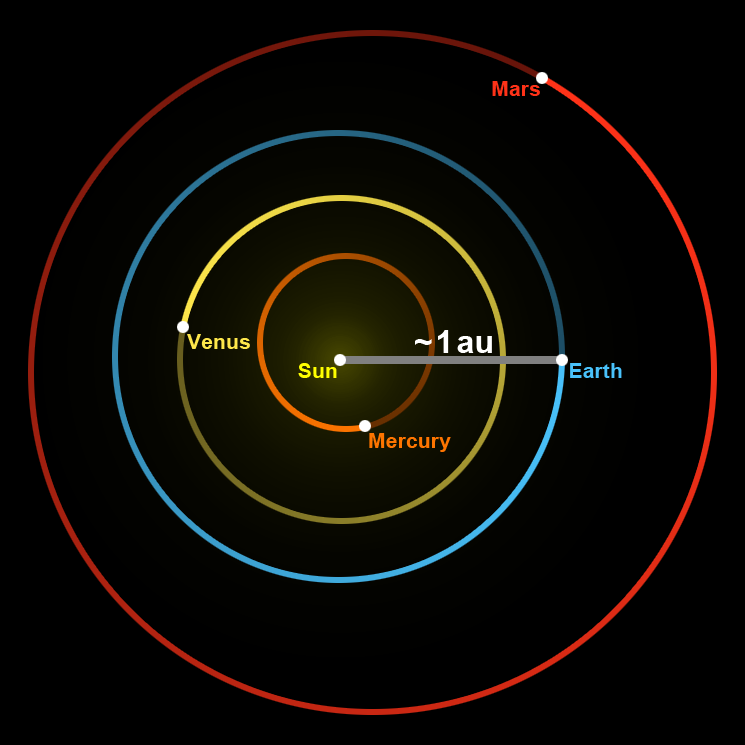
And one AU is the distance from the Earth to the sun.
GorgorodHOST
Right.
GorgorodHOST
So Neptune is 30 times further from the sun than we are.
GorgorodHOST
These ETNOs are residing hundreds of AU away.
GorgorodHOST
Hundreds.
GorgorodHOST
They are way, way past Neptune's neighborhood.

Jesse RogersonGUEST
It's at four astronomical units.
Jesse RogersonGUEST
So we're, Earth is at one AU from our star.
Jesse RogersonGUEST
We're, and this is at four AU from its star, four times farther.
Jesse RogersonGUEST
So it's a hotter star, but it's further out.
Jesse RogersonGUEST
It actually gets less...
Jesse RogersonGUEST
It's at four astronomical units.
Jesse RogersonGUEST
So Earth is at one AU from our star.
Jesse RogersonGUEST
And this is at four AU from its star, four times farther.
Jesse RogersonGUEST
So it's a hotter star, but it's further out.
Jesse RogersonGUEST
This planet is getting slightly less light than we do, but it's still within what you could call the habitable range.

Paul M. SutterHOST
We have the inner planets, Mercury, Venus, Earth, Mars.
Paul M. SutterHOST
These are anywhere from point four to one point five AU.
Paul M. SutterHOST
AU is astronomical unit, the average distance between the Earth and the Sun.
Paul M. SutterHOST
These are the settled cities, the streetlights, the cobblestones, the carriages, the opera houses.
Paul M. SutterHOST
I don't know why that came to mind, but it, it, it spoke to me of civilization.
Paul M. SutterHOST
And out past the settled cities at two to four AU is, is the asteroid belt, the, the dusty stockyard, you know, where all the, all the farms and cattle sit around.
Paul M. SutterHOST
And then we have Jupiter and Saturn at five and ten AU respectively.
Paul M. SutterHOST
These are the frontier towns.

Paul M. SutterHOST
We have the inner planets, Mercury, Venus, Earth, Mars.
Paul M. SutterHOST
These are anywhere from .4 to 1.5 AU.
Paul M. SutterHOST
AU is astronomical unit, the average distance between the Earth and the Sun.
Paul M. SutterHOST
These are the settled cities, the streetlights, the cobblestones, the carriages, the opera houses.
Paul M. SutterHOST
I don't know why that came to mind, but it, it, it spoke to me of civilization.
Paul M. SutterHOST
And out past the settled cities at two to four AU is, is the asteroid belt, the, the dusty stockyard, you know, where all the, all the farms and cattle sit around.
Paul M. SutterHOST
And then we have Jupiter and Saturn at 5 and 10 AU respectively.
Paul M. SutterHOST
These are the frontier towns.

speaker_5HOST
How far out are we talking?
speaker_6HOST
It is sitting at roughly fifty-five astronomical units, or AU.
speaker_5HOST
Okay, let's pause there.
speaker_6HOST
Sure.
speaker_5HOST
One AU is the distance from the Earth to our sun.
speaker_5HOST
So this planet is fifty-five times further away from its star than we are from our sun.
speaker_6HOST
Exactly.
13 MINS LATER
speaker_5HOST
Let's contextualize that distance for you listening because the scale here is the actual problem.