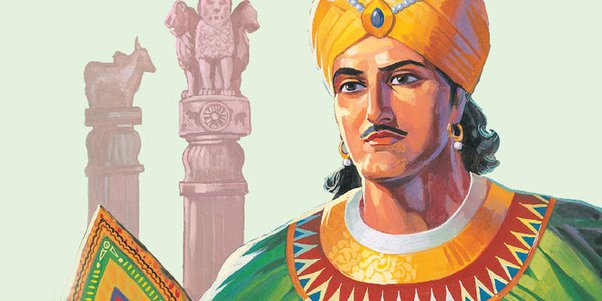
Ashoka the Great
Former Emperor of the Maurya EmpireWikipedia
35
MENTIONS
15
EPISODES
14
PODCASTS
Search complete. 35 mentions across 15 episodes found for "Ashoka the Great".
Oct 13, 2026

Nicholas James BridgewaterNARRATOR
Footnote Ruhani, spiritual.
Nicholas James BridgewaterNARRATOR
Evidently he thought that my work was not entirely done, and would have me be ever looking for help to the spirit, whose strength is made perfect in weakness.
Nicholas James BridgewaterNARRATOR
Since then he has written me a tablet letter from which I quote the following lines.
Nicholas James BridgewaterNARRATOR
O thou my spiritual philosopher, thy letter was received.
3 HRS 27 MINS LATER
Nicholas James BridgewaterNARRATOR
Footnote, same as above, page 350.
Nicholas James BridgewaterNARRATOR
End footnote.
Nicholas James BridgewaterNARRATOR
At the point at which this brief sketch begins, our Mullah was anxiously looking out for the return of his messenger, Mashhadi Ahmad, from Shiraz, with authentic news of the reported divine manifestation.
Nicholas James BridgewaterNARRATOR
When the messenger returned, he found Mullah Muhammad Ali in the mosque, about to give a theological lecture.

Daniel SimpsonHOST
So there's a partnership being struck up between warriors and, uh, priests or, uh, sages.
Daniel SimpsonHOST
And, uh, in a way, that also seems to have some connection to the historical context if we think back to the Emperor Ashoka and his, you know, uh, embrace of, uh, the Buddhist dharma, and particularly the idea of non-harming.
Daniel SimpsonHOST
And, uh-
James FitzgeraldGUEST
Right

Mark SmithNARRATOR
The Vatsyayana Sutra Introductory Preface Salutation to Dharma, Artha, and Kama In the beginning the Lord of beings created men and women, and in the form of commandments in one hundred thousand chapters laid down rules for regulating their existence with regard to Dharma, Artha, and Kama.
Mark SmithNARRATOR
Footnotes Dharma is acquisition of religious merit, and is fully described in chapter 5, volume 3 of Tallboy's Wheeler's History of India, and in the edicts of Asoka.
Mark SmithNARRATOR
Artha is acquisition of wealth and property, etc.
Mark SmithNARRATOR
Kama is love, pleasure, and sensual gratification.

Swaminathan GurumurthyGUEST
You know, the number of killings that have taken place outside India is one point four billion in the last two thousand years.
Swaminathan GurumurthyGUEST
And the number of deaths in India till the 13th century, only in one case it exceeded one lakh, and that was Ashoka's war, Kalinga war.
Swaminathan GurumurthyGUEST
Only after the Muslim invasion there was four point five million deaths in this country.
Swaminathan GurumurthyGUEST
Outside India, one point four billion.

Nicholas James BridgewaterNARRATOR
In the sight of God, we should seek to get back to first principles and to determine on a course of action which shall prove us to be worthy citizens of His kingdom.
Nicholas James BridgewaterNARRATOR
In making this effort, let us remember those groups of men and women in all the other nations concerned who will be animated by a similar spirit and who believe with us that the fundamental unity of men in the family of God is the one enduring reality, even when we are forced into an apparent denial of it.
Nicholas James BridgewaterNARRATOR
Although it would be premature to make any pronouncement upon many aspects of the situation on which we have no sufficient data for reliable judgment, we can and do call ourselves and you to a consideration of certain principles which may safely be enunciated.
Nicholas James BridgewaterNARRATOR
One, the conditions which have made this catastrophe possible must be regarded by us as essentially unchristian.
2 HRS 7 MINS LATER
Nicholas James BridgewaterNARRATOR
Unfortunately, he adopted from the Muslims the unworkable idea of a sacred language, and his first contributions to the new divine library, for the new Qur'an ultimately became this, were in Arabic.
Nicholas James BridgewaterNARRATOR
These were a commentary on the surah of Yusuf, Joseph, and the Arabic Bayan.
Nicholas James BridgewaterNARRATOR
The language of these, however, was a barrier to the laity, and so the first believer wrote a letter to the bulb enforcing the necessity of making himself intelligible to all.
Nicholas James BridgewaterNARRATOR
This seems to be the true origin of the Persian Bayan.

Mark SmithNARRATOR
The Vatsyayana Sutra Introductory Preface Salutation to Dharma, Artha, and Kama In the beginning the Lord of beings created men and women, and in the form of commandments in one hundred thousand chapters laid down rules for regulating their existence with regard to Dharma, Artha, and Kama.
Mark SmithNARRATOR
Footnotes Dharma is acquisition of religious merit, and is fully described in chapter 5, volume 3 of Tallboy's Wheeler's History of India, and in the edicts of Asoka.
Mark SmithNARRATOR
Artha is acquisition of wealth and property, etc.
Mark SmithNARRATOR
Kama is love, pleasure, and sensual gratification.

Jack AthertonGUEST
But let's go way back and consider an Indian who's widely considered the noblest ruler the world has ever seen.
Jack AthertonGUEST
A couple of hundred years before Christ, Ashoka started out as a warrior, as bloody as they come, until he learned about another Indian prince who renounced wealth and power to seek peace, starting with inner peace.
Jack AthertonGUEST
Siddhartha Gautama came to be called the Buddha, the enlightened being.
Jack AthertonGUEST
Emperor Ashoka embraced Buddhism, but he did not decree that others follow him.
Jack AthertonGUEST
Ashoka tolerated all religions and practices and spread Buddhist teachings, not at the point of a sword, but through inscriptions carved on rocks and pillars, many of which we can still visit on their ancient sites throughout the subcontinent from India to Nepal.
Jack AthertonGUEST
Beyond teaching, Ashoka directed his officials to relieve suffering wherever they found it, even in neighboring lands.
Jack AthertonGUEST
That was remarkable for the time and in most times, but folks...
Jack AthertonGUEST
You know which other country has done this? The United States of America.
Jack AthertonGUEST
But let's go way back and consider an Indian who's widely considered the noblest ruler the world has ever seen.
Jack AthertonGUEST
A couple of hundred years before Christ, Ashoka started out as a warrior, as bloody as they come, until he learned about another Indian prince who renounced wealth and power to seek peace, starting with inner peace.
Jack AthertonGUEST
Siddhartha Gautama came to be called the Buddha, the enlightened being.
Jack AthertonGUEST
Emperor Ashoka embraced Buddhism, but he did not decree that others follow him.
Jack AthertonGUEST
Ashoka tolerated all religions and practices and spread Buddhist teachings, not at the point of a sword, but through inscriptions carved on rocks and pillars, many of which we can still visit on their ancient sites throughout the subcontinent from India to Nepal.
Jack AthertonGUEST
Beyond teaching, Ashoka directed his officials to relieve suffering wherever they found it, even in neighboring lands.
Jack AthertonGUEST
That was remarkable for the time and in most times, but folks...
Jack AthertonGUEST
You know which other country has done this? The United States of America.

VihanHOST
It is a site that kept changing for centuries.
MahimnaHOST
There was an early brick stupor associated with the time of Emperor Ashoka.
MahimnaHOST
Later rulers enlarged it, faced it with dressed stone, added paths and staircases and built the four gateways that we see today.
VihanHOST
So now when you see the great stupa at Sanchi, you're looking at a monument that has been edited across roughly 8 centuries.

Bruce ChiltonGUEST
But even Beyond that, we have examples of Aramaic-speaking Jewish communities in Egypt during the 5th century before the Common Era.
Bruce ChiltonGUEST
And two centuries later, we have from India examples of Aramaic that show up in the edicts of Ashoka.
Bruce ChiltonGUEST
And the reason for that was that Aramaic was an extremely widespread commercial language.
Bruce ChiltonGUEST
It gave the Middle East a koine before we could speak of koine Greek.
5 more episodes mention Ashoka the Great.
Create an account to see the whole feed, search across every transcript, and follow the entities you care about.