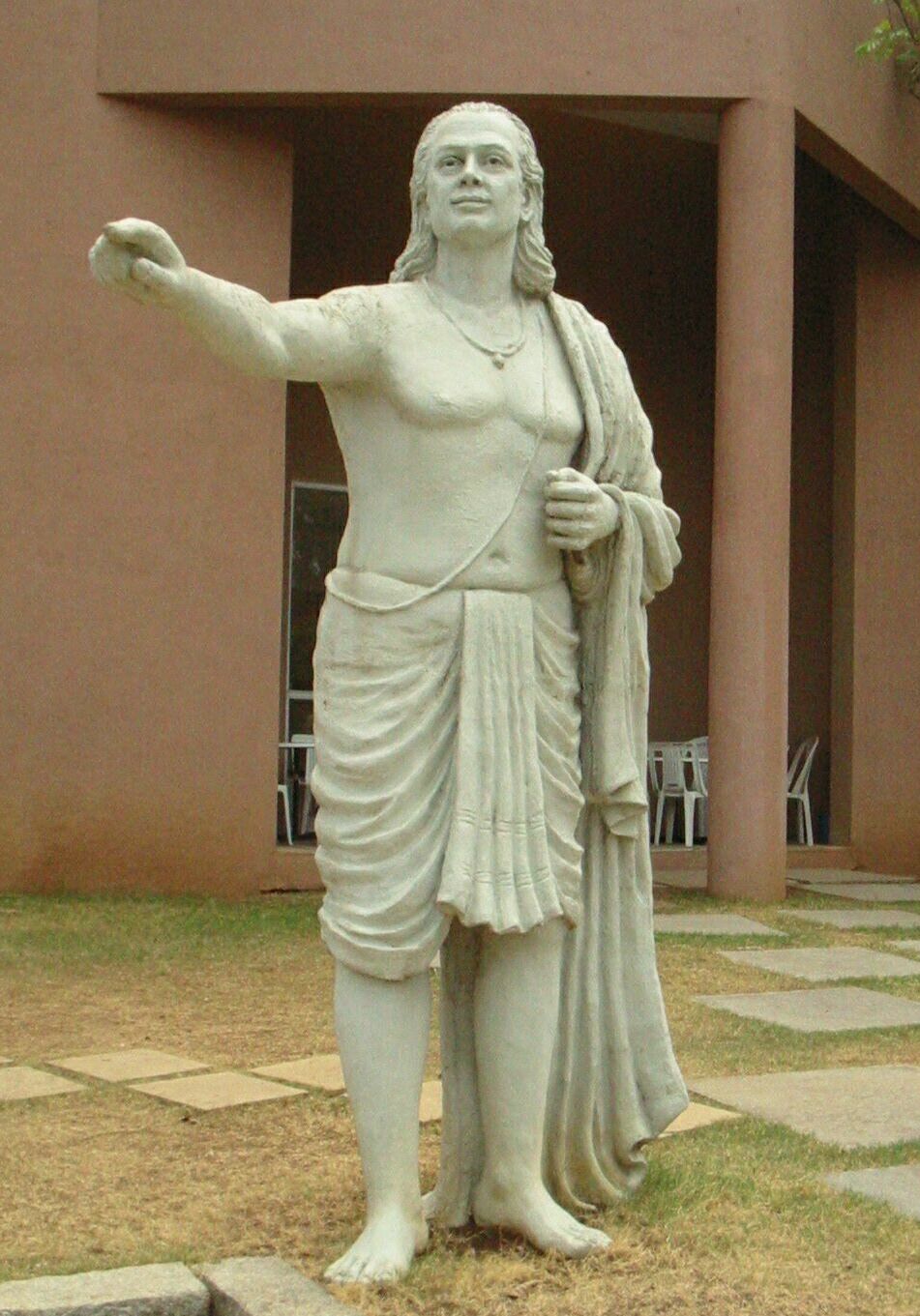
Aryabhata
Mathematician and astronomerWikipedia
19
MENTIONS
4
EPISODES
4
PODCASTS
Search complete. 19 mentions across 4 episodes found for "Aryabhata".
Nov 4, 2026

Bhaswati BhattacharyaGUEST
So if you, I can't quite do it, but it's like this around the galaxy.
Bhaswati BhattacharyaGUEST
So Ayurveda talks about the spiral and the ancient books of astronomy by Aryabhata and the various ancient mathematicians and astronomers, they talked about the spiral.
Bhaswati BhattacharyaGUEST
That movement of a spiral, you'll see in the ocean, you'll see the marine animals, you know, like conch shells and the spiral Often it's the
John VincentHOST
Fibonacci sequence.

Benjamin CornishHOST
So Brahmagupta has the name guarded by God, or perhaps guardian of God.
Benjamin CornishHOST
His dad was Jishnagupta, who was also a scholar and studied in the scholarly tradition of Aryabhata.
Benjamin CornishHOST
So that's nice.
Benjamin CornishHOST
Brahmagupta spent most of his career at the famous centre of learning Ujjain, also connected with Varaha Mihira and Yavanasavara.
13 MINS LATER
Benjamin CornishHOST
not his only contribution to arithmetic algorithms.
Benjamin CornishHOST
We also have an algorithm for computing square roots.
Benjamin CornishHOST
Now, you may recall that Aryabhata has already done this, but he used a method that was equivalent to binomial expansion.
Benjamin CornishHOST
It was heavy, but gave accurate values immediately to an arbitrary level of precision, depending on how long you want the algorithm to run for.

Theo WrenfieldNARRATOR
Let your mind drift now to a river town called Kusumapura, thought to be near present-day Patna, where in the year 476 of the Common Era, a child was born, who would grow up to become one of the most extraordinary minds in human history.
Theo WrenfieldNARRATOR
His name was Aryabhata, and though many centuries have passed since he walked those riverside paths, his calculations still echo through classrooms and observatories around the world today.
Theo WrenfieldNARRATOR
Picture him as a young man, perhaps sitting beneath the dappled shade of a mango tree, surrounded by scrolls covered in Sanskrit verse.
Theo WrenfieldNARRATOR
For in that era, mathematics and poetry were not separate pursuits.
Theo WrenfieldNARRATOR
Numbers danced within metre and rhyme.
Theo WrenfieldNARRATOR
Aryabhata wrote his greatest work, a slim but astonishingly dense text called the Aryabhatya, entirely in verse, so that students could memorize it and carry its wisdom in their minds, long before paper and ink became common tools of learning.
Theo WrenfieldNARRATOR
Imagine reciting the circumference of a circle the way one might recite a lullaby, letting rhythm carry truth from one generation to the next.
Theo WrenfieldNARRATOR
Within this gentle singing text lies one of the most precise calculations of its time for the value of pi, that mysterious and infinite number describing the relationship between a circle's edge and its center.

Dave FarinaHOST
They were mathematicians, scientists, and poets.
Dave FarinaHOST
Among them was Aryabhata, a mathematician and astronomer who wrote about subjects like algebra, trigonometry, and quadratic equations.
Dave FarinaHOST
He also designed a system of notation that used the syllabic characters of Sanskrit to represent even very large numbers by substituting consonants for the numbers 1 through 25 and vowels for powers of 10, so that each syllable would stand for a single digit and indicate which column it belonged in.
Dave FarinaHOST
Another of the jewels was the poet and playwright Kalidasa, who like the playwrights of classical Greece, based his work on ancient myths like the Vedas and the Mahabharata.