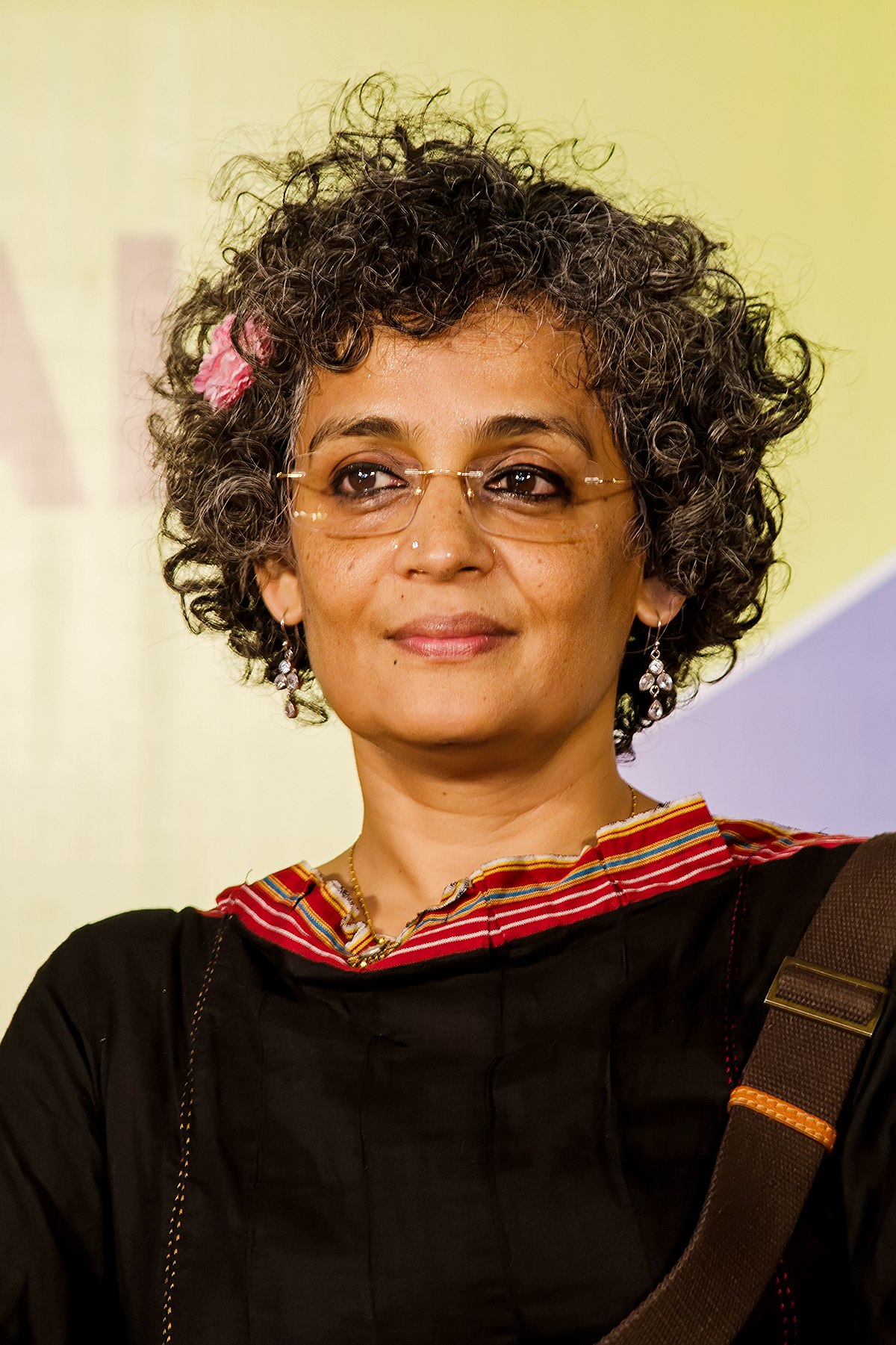
Arundhati Roy
Indian authorWikipedia
39
MENTIONS
31
EPISODES
28
PODCASTS
Search complete. 39 mentions across 31 episodes found for "Arundhati Roy".
Oct 2, 2026

Arundhati RoyGUEST
I think just understanding the way the chain reaction that takes place
Joline VermeulenNARRATOR
You just heard Indian author and activist Arundhati Roy live at Bazaar in Brussels.
Joline VermeulenNARRATOR
How can you understand the whole story and not just your own part in it? Welcome to Writers and Thinkers Stage, a podcast by Bozar where we share favorite moments from our live conversations.
Joline VermeulenNARRATOR
Arundhati Roy came to Bozar in October 2025 to present Mother Mary Comes to Me, her long-awaited memoir revisiting a life of courageous descent.
Joline VermeulenNARRATOR
A life deeply shaped by her relationship with her mother, the Indian educator and women's right activist Mary Roy.
Joline VermeulenNARRATOR
In this episode, joined by Belgian journalist and writer Catherine Welstieke, Arundhati Rohr recalls her last visit to her mother's home and reflects on how facing cruelty as a child shaped her voice as a writer, the deeply empathetic novelist she became.
Ocean VuongGUEST
At that point, she was 73 years old.
Ocean VuongGUEST
She's already published Arundhati Roy, Thomas Pynchon, Zadie Smith.
Ocean VuongGUEST
So she's seen it all.
Ocean VuongGUEST
And this is also a wonderful story about queer collaboration, because I don't think I would have been able to do that if it wasn't for her.

Jasnea SarmaMODERATOR
Uh, of course, there's a great translation, uh, culture also in India.
Jasnea SarmaMODERATOR
But I, I do see that some of the most political writings that come, let's say, just from Kerala, right? So this year itself, there has been several kind of biographies or, or, like in your novel, it's a documentary, um, novel, and Arundhati Roy's book also came out, Mother Mary Came, Came, Comes to Me, also a Syrian Christian, right? And so, and then, uh, you, you have the great lineages of Kamala Das and so on.
Jasnea SarmaMODERATOR
And where and what kind of Dalit literature is coming out of Kerala? Can, and, and how is that disruptive, and what are its reaches? Um, not just from Kerala, but also perhaps India and also the diaspora
Jeet ThayilGUEST
I, I would, uh, point to Meena Kandasamy, for example.

Kate LaycockHOST
You will find the full episode on the Living Planet podcast feed under the title The Imperfect Activist.
Kate LaycockHOST
There are, by the way, some other great episodes to discover, including interviews with climate giant Bill McKibben and novelist Arundhati Roy.
Kate LaycockHOST
Am I jealous? No, not much.
Kate LaycockHOST
This programme was produced by Thomas Sparrow and me, Kate Laycock, with studio manager assistance from Sarah Hoffman.

Mary MoynihanHOST
The idea that when we celebrate life, human dignity, creativity, and the human experience, we're also affirming the rights of every person to live with equality, freedom, and dignity.
Mary MoynihanHOST
And that ma- leads me to the second quote from Arundhati Roy, the prominent Indian writer, novelist, and political activist, who says, "Our strategy should be not only to confront empire, but to lay siege to it with our art, our music, our literature, our stubbornness, our joy, our brilliance, our sheer relentlessness, and our ability to tell our own stories." Now, there's something very powerful in that idea of telling our own story, of using creativity, imagination, music, literature, theater, and the arts as a way of challenging injustice, giving voice to different experiences, and creating spaces where people can come together and be heard.
Mary MoynihanHOST
And that brings me to the third quote, which is specifically about the festival, and it's from Kevin Courtney writing in The Irish Times, where he says about the Irish Arts and Human Rights Festival, "In a world where human rights continue to be under attack, the Arts and Human Rights Festival sets out to celebrate the people who have stood up for them around the world and throughout history, and to highlight the role artists can play in promoting a more just society." I think these three quotes really speak to the heart of what the festival is about, the relationship between art, human rights, storytelling, participation, and social change.
Mary MoynihanHOST
And the Smashing Times International Centre for the Arts and Equality and Frontline Defenders, and a range of partners are doing a huge amount of work to present the festival every year.

Shipra AgarwalGUEST
So as a child reading those stories, I thought that's what characters or that's what stories are supposed to be.
Shipra AgarwalGUEST
I didn't read stories that were set in India until I was in my teens and Arundhati Roy wrote The God of Small Things, which won a Booker Prize and became a big deal.
Shipra AgarwalGUEST
And that was a story set completely in an Indian village about people who looked like me and ate like me and talked like me.
Shipra AgarwalGUEST
And for the first time, I was like, oh, people want to read stories about someone living in India.

Stephen HinerHOST
I started reading Chomsky and slowly became very interested in anything that had to do with Israel and Palestine.
Stephen HinerHOST
Reading Edward Said, Mahmoud Darwish, Hassan Kanafani, John Berger, Tanya Reinhart, Ilan Papeh, Norman Finkelstein, Noam Chomsky, Kurt Vonnegut, Arundhati Roy, Naomi Klein, all became part of my daily routine.
Stephen HinerHOST
Books changed me, and I think that they are, more than anything else, one of the best tools we can use to learn, reflect on, and truly understand the world we are living in.
Stephen HinerHOST
They are a bridge between languages, continents, and people.

John CusackGUEST
I co- I wrote, I wrote a bunch of like, um...
John CusackGUEST
I wrote a, some political essays with Arundhati Roy.
Alex ZalbenHOST
Mm-hmm.
John CusackGUEST
And then I've written a bunch of s- stuff about politics, and I've written a bunch of my own movies.

DerekHOST
What are you reading at the moment?
Jonty RhodesGUEST
Uh, Arundhati Roy, um, The God of Small Things.
Jonty RhodesGUEST
So she's an Indian author.
Jonty RhodesGUEST
Um, yeah, really fascinating.

Arthur SzeSOUNDBITE_SPEAKER
When I have my closing event at the Library of Congress in April 2027, I'm going to assemble a selection of different translations of people from all around the country who have made translations, some for the first time in their life, some who are practice and professional translators.
Arthur SzeSOUNDBITE_SPEAKER
And as a final note, I'll say totally out of the blue because I've never met her, but the writer Arundhati Roy emailed me from Delhi, India, and she said, Arthur, we've never met, but Transient Worlds found me.
Arthur SzeSOUNDBITE_SPEAKER
You are inviting people to become part of a global literary citizenship.
Arthur SzeSOUNDBITE_SPEAKER
You're saying anyone can read and make a translation and they have their own voice and vision and they can experiment with language and take pleasure in that.
21 more episodes mention Arundhati Roy.
Create an account to see the whole feed, search across every transcript, and follow the entities you care about.