Neural network
193
MENTIONS
41
EPISODES
19
PODCASTS
Search complete. 193 mentions across 41 episodes found for "Neural network".
Nov 22, 2026

Bruce LambertHOST
Hence the term artificial intelligence was born.
Bruce LambertHOST
The second term is neural network.
Bruce LambertHOST
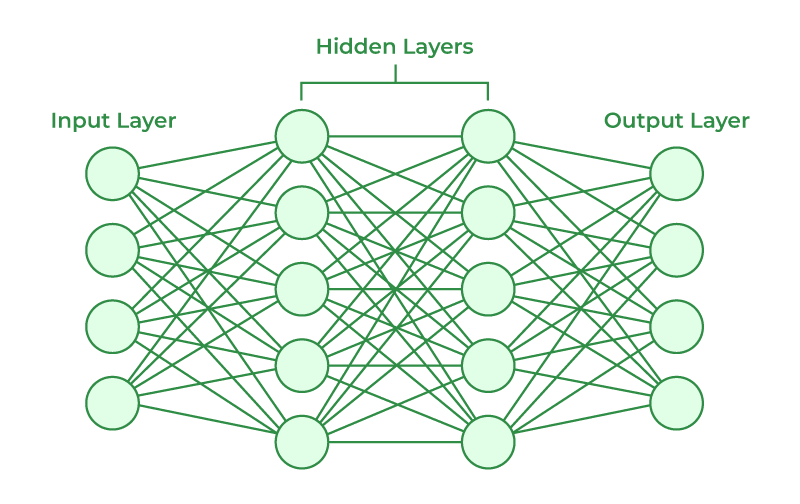
now this is a term you'll hear a lot in relation to modern ai it comes from a biological metaphor so biologically in our own brains and in all mammalian brains there are networks of neurons connected to one another by dendrites and synapses and neurons process information by sending electrical signals to one another and in this way they could recognize patterns and produce all the cognitive properties of thought at least in human beings and reason and perception so So computer scientists in the 1950s and 60s asked themselves, can we create an abstract model of these neural networks? And they did by creating nodes or neurons and connections, which were like synapses to other nodes.
Bruce LambertHOST
So a neural network is a mathematical abstraction lying at the heart of all modern AI systems that has an architecture or a design that is at least metaphorically analogous to the human brain, especially nodes and links or nodes and connections, which correspond to neurons and then dendrites and synapses.
Bruce LambertHOST
The third term is deep learning.
Bruce LambertHOST
In the beginning, neural networks only had an input layer and an output layer.
Bruce LambertHOST
The earliest computer neural networks were very simple.
Bruce LambertHOST
They had two layers.

Percy LiangHOST
So here's the agenda.
Percy LiangHOST
I want to start transitioning us to PyTorch, and we're going to talk about the motivation for nonlinear methods, and then go through sort of basic multi-layered neural networks, and then talk about all of these tricks that you have to be aware of when you're doing deep learning.
Percy LiangHOST
Okay, so let's start with the basics.
Percy LiangHOST
So far what we've done is we are hopefully fairly comfortable with NumPy at this point, which gives us a way to create tensors and do operations on tensors.
34 MINS LATER
Percy LiangHOST
we need nonlinear models to make the, to basically create a larger set of predictors.
Percy LiangHOST
So what you would use here, there's actually a lot of things you can do here.
Percy LiangHOST
And things that you might have heard of are in a case of classification or decision trees, nearest neighbors, neural networks.
Percy LiangHOST
But it turns out that actually even linear models can do the job.

Harrison KinsleyHOST
So for every fully connected layer, we're going to have input, and the input is whatever is coming into this output.
Harrison KinsleyHOST
layer so in this case the input is is the actual input layer which happens to be the flattened image the output can be whatever we want so we could say this if we wanted but we're we're going with 64. so uh finally the next thing is uh nn.linear this just means fully connected it's just a flat simple you might also when we do a convolutional neural network it'll be nn.com and so on so uh so cool i think i've described everything there so now we're going to say pasta pasta and then we'll do one more pasta so then we're going to say two three four so keep in mind though that certain things have changed when we go from image to actual code because this kind of this is this is the extent of our input layer right and This number here is kind of the extent of our hidden layer the hidden layers are almost in between these calls or something but anyways fully connected to takes in 64 because the previous layer output 64 so this one has to take in 64 but but now what it outputs we could pick anything we want i'm gonna go with 64 though so that means uh layer three has to take in 64 again we could output anything we want i'm gonna go with 64 again so this final layer four takes in 64 but we said this was a three by 64 so you got 64 64 64 And then this is our output layer.
Harrison KinsleyHOST
So I'm going to say 10.
Harrison KinsleyHOST
Where does 10 come from? We have 10 classes, right? We've got 0, 1, 2, 3, 4, all the way to 9.

Bridget CarragherGUEST
We want to be able to decide which are the good 2D class averages, which are the good 2D maps with some more help.
Bridget CarragherGUEST
I have thought neural networks might be able to help us with this for some time, because people are doing this, but they're doing it a billion times.
Bridget CarragherGUEST
So we're capturing a lot of training data, because people are doing it every day.
Bridget CarragherGUEST
And there's a program called Topaz.

Chris HayesHOST
Maybe we can do this together.
Chris HayesHOST
So let's, can we start with neural networks, which I actually think are like the core concept of, to build off of here and is sort of an intuitive analogy.
Kevin RooseGUEST
Yes, the neural networks are a type of AI system that consists of sort of many interconnected layers.
Kevin RooseGUEST
When we talk about neural networks, we usually talk about deep neural networks.
Kevin RooseGUEST
So basically what that means is you just have a bunch of sort of mathematical layers.
Kevin RooseGUEST
There's a process called backpropagation whereby you can sort of teach the network all of the layers things as you learn them in the training data.
Kevin RooseGUEST
Yes.
Kevin RooseGUEST
So yeah, it's a very different way.

speaker_0NARRATOR
Lightweight, lasts for decades, and most everyone has one.
speaker_0NARRATOR
Computers are understandably jealous of our brains and like to imitate them with neural networks.
speaker_0NARRATOR
Unlike the compact and portable brain that is powered by hamburger sandwiches, a modern large neural network requires its own power plant and countless servers.
speaker_0NARRATOR
For software, all you need is PyTorch.
speaker_0NARRATOR
Are you already well acquainted with tensors? If not, we recommend starting with our separate introduction.
speaker_0NARRATOR
Tensors are the foundational building blocks of neural networks, so understanding them is essential.
speaker_0NARRATOR
A tensor is a container for numerical data.
speaker_0NARRATOR
Unlike lists or arrays, tensors are optimized for the computations required in AI and machine learning.
speaker_0NARRATOR
Addition, multiplication, neural network layers.
speaker_0NARRATOR
The tensors flow through each transformation, hence the name.
speaker_0NARRATOR
While neural networks are TensorFlow's primary application, It is not constrained to a single algorithm class.
speaker_0NARRATOR
Other models include support vector machines, decision trees, and random forests.
speaker_0NARRATOR
The framework distributes computations across multiple processing units.
5 MINS LATER
speaker_0NARRATOR
This distinction is critical for performance because different devices have unique strengths.
speaker_0NARRATOR
CPUs excel at general purpose tasks.
speaker_0NARRATOR
GPUs are optimized for parallel computations, making them essential for training very large neural networks.

Jordan FreryGUEST
And the other way is the quantization-aware train.
Jordan FreryGUEST
And here, so on the left graph, for example, it's MNIST with a pretty connected neural network.
Jordan FreryGUEST
The numbers on the graph are the accumulator bit width.
Jordan FreryGUEST
And on the x-axis, it's the weights and activation bits.
Harrison KinsleyHOST
What is going on everybody and welcome to a State of the Centex channel for 2020 address.
Harrison KinsleyHOST
So we started off 2020 with, as most of you are probably aware, the neural networks from scratch announcement slash Kickstarter, which I'm happy to say has been going better than I honestly could have expected.
Harrison KinsleyHOST
We've got over $20,000, 400 plus backers.
Harrison KinsleyHOST
We've got hundreds of people in the draft document.
Harrison KinsleyHOST
You guys are amazing.
Harrison KinsleyHOST
Moving forward, we did get a couple of pretty common questions on that announcement.
Harrison KinsleyHOST
One is people asking, will you cover conv nets and recurrent nets? The initial plan was just neural networks from scratch, so feed forward neural network.
Harrison KinsleyHOST
There's so much information to cover just on that topic.
Harrison KinsleyHOST
So, anyway, that opportunity is there.
Harrison KinsleyHOST
Finally, just as a channel update, the Neural Networks from Scratch series, probably one to two months, one month is really cutting it close, I highly doubt that the videos will start coming out.
Harrison KinsleyHOST
My goal there is to finish the public, well, public, it's for backers, but, So finish that draft from cover to cover.
Harrison KinsleyHOST
So get a full first draft done and then my plan is to go start doing the videos and then as we're doing the videos keep kind of honing in on that draft and improving that draft because my main focus is delivering the book on time to people who have purchased the book.
Harrison KinsleyHOST
you have purchased the book you should already have access to that draft and that draft just got a huge update basically everything from beginning to training a model is done so now we're getting into kind of the actual you know tweaking a model doing having like training and testing data and what what to look for as your model trains so in terms of actually coding the neural network That's all done now.
Harrison KinsleyHOST
So if you are on that, definitely go check out the draft if you're not aware of that update.
Harrison KinsleyHOST
Also, if you want access to that draft, if you're just dying to get access to the Neural Networks from Scratch series, you can pre-purchase or pre-order the book.
Harrison KinsleyHOST
And you get access to the draft.
31 more episodes mention Neural network.
Create an account to see the whole feed, search across every transcript, and follow the entities you care about.