Article Five of the United States Constitution
36
MENTIONS
14
EPISODES
12
PODCASTS
Search complete. 36 mentions across 14 episodes found for "Article Five of the United States Constitution".
Oct 30, 2026

Randall ArringtonGUEST
They'll never vote for term limits.
Randall ArringtonGUEST
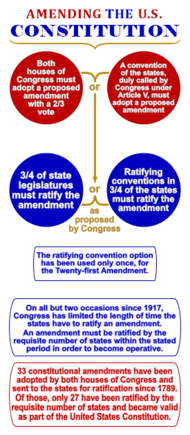
That'll have to come through an Article V Convention of the States to create term limits, because they'll never vote to end their career.
Randall ArringtonGUEST
But if you get an Article V Convention of the States, you have to have 26 states, I think.
Randall ArringtonGUEST
And then you say, we want a new amendment.
Randall ArringtonGUEST
The 28th Amendment is term limits, and here it is.

Aziz HuqGUEST
If that convention was held today, what you would get is a convention in which Republican states, Republican legislatures in red states would be able to appoint a supermajority of that body in ways that would prevent or that would effectively allow that Republican supermajority in a proposed constitutional convention to do whatever it wanted.
Aziz HuqGUEST
So the bias that's built into the state-by-state representational function that exists in the Senate also exists in the Article V process in ways that make Article V just as problematic were it ever to be used.
Aziz HuqGUEST
And then these culminate in the...
Aziz HuqGUEST
I think I'll skip this slide.

Aziz HuqGUEST
If that convention was held today, what you would get is a convention in which Republican states, Republican legislatures in red states would be able to appoint a supermajority of that body in ways that would prevent or that would effectively allow that Republican supermajority in a proposed constitutional convention to do whatever it wanted.
Aziz HuqGUEST
So the bias that's built into the state-by-state representational function that exists in the Senate also exists in the Article V process in ways that make Article V just as problematic were it ever to be used.
Aziz HuqGUEST
And then these culminate in the...
Aziz HuqGUEST
I think I'll skip this slide.

JRHOST
Number three, use the invocation of the Insurrection Act to create a national sense of illegitimacy whereby demonic rat governors appear justified in taking the extreme action of refusing to acknowledge federal authority rights.
JRHOST
and pushed to form a new form of federal government through various means, including an Article V transformation of the Constitution.
JRHOST
Maybe there's more to this, and it's not as bad as it seems, but right now this appears to be a conspiracy to create the next Fort Sumter.
JRHOST
This is a CIA-style color revolution in real time on our own soil.

Pete KalinerHOST
Number two, make the violent civil unrest so bad that Trump invokes the Insurrection Act.
Pete KalinerHOST
And number three, "...use that to create a national sense of illegitimacy whereby Democrat governors appear justified in taking the extreme action of refusing to acknowledge federal authority and push to form a new form of federal government via various means, including an Article V transformation of the Constitution." Maybe there's more to it, and it's not as bad as it seems.
Pete KalinerHOST
But right now, this appears to be a conspiracy to create the next Fort Sumter.
Pete KalinerHOST
This is a CIA-style color revolution in real time on our own soil.

Mark MecklerGUEST
Yeah.
Mark MecklerGUEST
We're using Article V of the US Constitution to call a convention of states to propose amendments to restrain federal tyranny, and you do that by getting 34 states who want to call that convention.
Mark MecklerGUEST
They pass resolutions in the state saying they want it.
Mark MecklerGUEST
They gather, and the goal is to propose amendments to restrain federal tyranny.

Gary BarnesGUEST
[laughs] And, uh, you know, collaboration is...
Gary BarnesGUEST
I mean, there's an Article V thing going on now.
Gary BarnesGUEST
I'm sure you've heard of that.
Gary BarnesGUEST
They have, like, over 30 states that have already committed to Article V, you know, to basically have constitutional conventions.
Matt DavisHOST
Man, that's my language right there.
Gary BarnesGUEST
So there's a, there's an- there's another venue that, you know, if we start collaborating all together, 'cause part of the problem is when we're all, uh, w- when you have all the people and they're all broken into 100 different things, it's easier for the people in power just to make sure nothing ever happens.
13 MINS LATER
Matt DavisHOST
And I believe, you know, I, I, I like to call it, uh, I like to say, if it's not, if, if it's not living, it'll die, but I don't believe in like the living where...
Matt DavisHOST
I don't think it says anywhere in the Constitution we should subjectively be able to interpret the Constitution living.

Mark MecklerHOST
I hope you enjoy it as much as I did.
Rita PetersHOST
So for our first session today, I thought it would be most appropriate for us to consider the question of whether the Article 5 Convention process is even the right solution to the problem we all know we have, the problem of federal overreach.
Rita PetersHOST
So to kick off that discussion, I get to introduce you to our first speaker on the topic.
Rita PetersHOST
He is one of my very favorite human beings, my friend and mentor, Michael Farris.

Julie SukGUEST
And there was not a lot of...
Julie SukGUEST
And I think there was probably a lot of different views, but they didn't talk that much about Article V, the amendment rule.
Julie SukGUEST
And I would say if they really intended it for it to change and intended it for it to change by the will of the people, probably they would not have designed the amendment rule the way they did.
Julie SukGUEST
One of the voices that's very clear as they discuss Article V is the voice of people from the slave-owning states, like South Carolina, saying that they don't want it to be too easy to change slavery.
Julie SukGUEST
So one of the compromises that goes into Article V is that you're-- they can't even use Article V, uh, to change the slave trade, to get rid of the slave trade for the first twenty years.
Julie SukGUEST
And they can't use Article V to change the equal representation of the states in the Senate, which I've already been talking to you about as one of the anti-democratic features of the Constitution and of the way that we appoint Supreme Court justices.
Lee RawlesHOST
Mm-hmm.
Julie SukGUEST
Uh, but it was people from some of the slave-owning states that said they didn't want the equal representation of the states to be changed so easily using Article V.
4 more episodes mention Article Five of the United States Constitution.
Create an account to see the whole feed, search across every transcript, and follow the entities you care about.