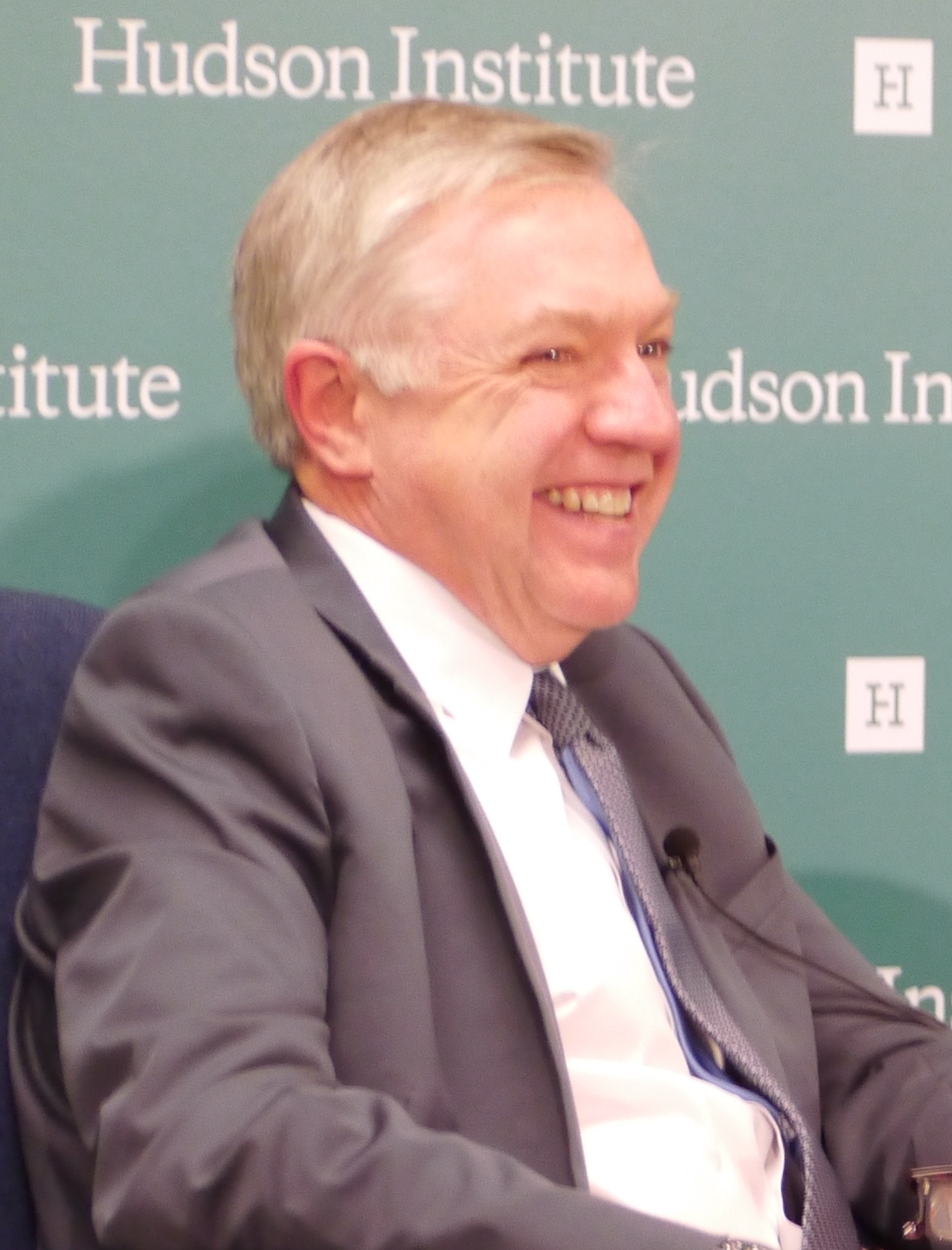
Arthur Herman
American historian
50
APPEARANCES
16
PODCASTS
Sep 6, 2026

Arthur HermanGUEST
Beautiful setup for the discussion of one of the principal characters in my book, Freedom's Forge, but also I think one of the really forgotten heroes of America's experience in World War II and someone who not only changed the direction of the Second World War when President Roosevelt brought him into the White House and said, We need to get this country ready for modern mechanized warfare of the kind that is unfolding right now in Europe and in the fields of France and will soon be taking place over the skies of Britain.
Arthur HermanGUEST
but also someone who came to that experience and was brought there because he understood America's underlying economic strength, which was its industrial might, particularly the automobile industry, but also about how once you set the American economy and industry pointing in a single-minded direction, that nothing could be impossible under those conditions.
Arthur HermanGUEST
Knudsen was, when Roosevelt made the call in the summer of 1940, was CEO of General Motors.
Arthur HermanGUEST
But he's a very different figure from what we think about when we think about a CEO as the man in the corner office or presiding at the boardrooms.
16 MINS LATER
Arthur HermanGUEST
What he demonstrated when America goes into World War I was just how antithetical to the American tradition, an American way of waging war even, was that he basically tries to use the government's power the power that he has as president, the power of Washington as the center of the federal government, in order to control and direct everything that happens.
Arthur HermanGUEST
It's important to remember, you know, I did a book on Woodrow Wilson, my book on 1917, Wilson, Lenin, and the Birth of the New World Disorder.
Arthur HermanGUEST
It's important to realize his model for government was German, He was very much influenced and impressed by the 19th century Hegel influenced approach to how government should function, which was to boil it all down crudely.
29 MINS LATER

John BatchelorHOST
But he had a moment, and the moment was in Mexico, I believe, when he had a vision that suddenly all of us who read science fiction our whole lives think, why didn't I think of that? What was the vision, Arthur? What is the vision?
Arthur HermanGUEST
11 years later, in 1787, as they're drawing up a new constitution, a new group of founders, including Alexander Hamilton and James Madison and James Wilson, have now stepped up in order to create a nation out of this grouping of independent colonies.
Arthur HermanGUEST
What happens is that Washington realizes from the beginning they're on the right track, that we do need to replace the Articles of Confederation, which was kind of the management model.
Arthur HermanGUEST
You know, I talk in the book about the conflict between founders and managers, founders who are risk-takers, who have this deep, profound vision driving them forward.
Arthur HermanGUEST
and managers who are more like, let's take it slow, let's take it incrementally, let's look before we leap.
10 MINS LATER

Jul 31 · 11m
John BatchelorHOST
Where do they go when the war ends? And the answer from Bush is they go away unless, Arthur, what's the, unless, what has Vannevar Bush pitched FDR that he goes for?
Arthur HermanGUEST
He said that Bush tells Roosevelt that science is, the process of discovery that has become key, both to the growth of American economy, but also to winning this war, to winning this global conflict against Nazi Germany and imperial Japan.
Arthur HermanGUEST
That coming together of industry and science and academia to create this incredible war machine that has emerged with new technologies, including, of course, the atomic bomb as being the capstone of that alliance and that cooperation between science, industry, and academia.
Arthur HermanGUEST
But that alliance will fall apart and will go back to the way it was in the 20s and 30s.
Jul 31 · 7m
Arthur HermanGUEST
Well, Martin Luther King gets involved in all this, and he's another key founder in my mind, precisely because he brings to bear those founders' characteristics that we've been talking about, that sense of vision.
Arthur HermanGUEST
that the idea embedded in the Declaration that all men are created equal hasn't been fulfilled even after slavery has been abolished, but segregation and Jim Crow has reimposed that inequality into the American system.
Arthur HermanGUEST
We're going to do it starting with the back of buses and with bus boycott in the city of Montgomery, Alabama.
Jul 31 · 10m
Arthur HermanGUEST
What he demonstrated when America goes into World War I was just how antithetical to the American tradition and American way of waging war, even, was that he basically tries to use the government's power the power that he has as president, the power of Washington as the center of the federal government, in order to control and direct everything that happens.
Arthur HermanGUEST
It's important to remember, you know, I did a book on Woodrow Wilson, my book on 1917, Wilson, Lenin, and the Birth of the New World Disorder.
6 MINS LATER
Jul 31 · 8m
Arthur HermanGUEST
in that they were at the same time recognized that they had the enormous constraints that were placed upon them by what customers were willing to pay and what customers wanted.
Arthur HermanGUEST
And meeting those needs is what motivates if you look at the history of all the of those who get branded as robber barons then and now then and now that what you see the key to their success is figuring out what it is that customers want and finding ways to deliver that at the lowest possible price lower certainly than your competitors can deliver and one of the key advantages we had in the 19th century was the railroads that it created a connectivity across the country.
Arthur HermanGUEST
I compare it in the book to the internet and AI at the same instant as a way in which to connect but also accelerate development and to build the connections between communities and between founders and customers.
Arthur HermanGUEST
And if you look at almost all of the key figures in what we call the build-in age, whether you're talking about Cornelius Vanderbilt or John D. Rockefeller or the founders of the Swift meatpacking industry or Andrew Carnegie or James J. Hill, the railroad plays a crucial part in all of their stories as enabling them to reach customers and to build businesses in ways that really only I think we think about it compared to the way in which the connectivity of the internet today allows for businesses and founders to create new businesses and to reach new customers in ways that we couldn't have imagined 20 years ago.
Jul 31 · 10m
Arthur HermanGUEST
I mean, not the sense of that Henry Ford is a founder or Edison is a founder as someone who creates their own business or, creates an invention which changes the world and opens up the possibilities for others.
Arthur HermanGUEST
But he is a founder in having those same characteristics that I mentioned, those three key ones.
Arthur HermanGUEST
Lincoln very early on had realized that the promise of the Declaration of Independence, that all men are created equal, wasn't being fulfilled, that this was a missing element in what America's promise should be.
Arthur HermanGUEST
And as I describe it in the book, he was someone who had had as a young man an encounter with slavery, with slaves and chains, and he was horrified by it.
Arthur HermanGUEST
One of them, George Washington, who actually signs the Northwest Ordinance, which finally, finally opens up the lands beyond the Allegheny Mountains to settlement.
Arthur HermanGUEST
and creates a model for how American settlers could now move into that territory, which had been denied to them by the British crown ever since, well, basically ever since the end of the Seven Years' War.
Arthur HermanGUEST
So Washington signs that document, opening up the possibility for future settlement, for pushing what we would call the frontier further west than it had ever gone before.
Arthur HermanGUEST
Revolutionary War veteran who gathers together a group of hardy pioneers with their backpacks and axes and muskets and set out on this incredible journey.
Jul 31 · 10m
John BatchelorHOST
Who is Henry Ford at that moment and what does he have to tell Thomas Edison, who's hard of hearing?
Arthur HermanGUEST
So what Ford realizes is, well, first of all, you understand that this is, you know what reminds me of in many ways is the scene from that television program, Shark Tank, where you get to meet one of your idols, which was Thomas Edison, the inventor of the light bulb, the phonograph, this giant, the elder statesman of American inventors and founders.
Arthur HermanGUEST
And Dow thinks that this is a moment when Henry Ford would benefit from meeting the founder in chief, the man who represents American invention and ingenuity around the world at this point.

speaker_3UNKNOWN
Yeah.
Arthur HermanGUEST
Managers tend to be expert in numbers and in the metrics that goes with a business, with an enterprise, of understanding how the graphs work, you know? And of course you always want the graphs to go up.
Arthur HermanGUEST
It's always important to have an upward direction with those, but being able to point those out on the chart and so on, and to show growth, that's a measure of progress and, of success, and it may even become the sole mana- measure of success for a business or for a government, uh, or for, uh, any kind of enterprise in which the size tends to attract people who see their mission as keeping the enterprise going instead of growing, and who see, and more and more as time goes on, that the measure of success, the measure of growth, is the number of people that they hire who will be working in their department year after year.
Arthur HermanGUEST
We're very familiar with this from the way in which the federal government works.
26 MINS LATER


Roger ZakheimHOST
And to talk about that, for example, I mean, I guess to charge you here, Perhaps it wasn't surprising or wouldn't be surprising to Franklin and Jefferson and Adams and other founders that this Democratic Republic would yield the sorts of founders that are dominating our not just economy today, but our national culture today.
Arthur HermanGUEST
And one of the things that I stress in the book is that I believe they actually designed this new republic with precisely that end in mind.
Arthur HermanGUEST
So just to back up for a little bit, when we talk about founders, what kinds of people are we talking about? What are the characteristics that we look for? Well, there's three that I can isolate right off the bat for you.
Arthur HermanGUEST
of the future and of how their product or service or technology fits into creating a brighter or greater future.
Arthur HermanGUEST
They're looking to, their focus is not just on the bottom line for the company that they're creating, but it's also on the far horizon of where is this going? How is this going to change people's lives for the better? in ways that customers will recognize and who will wanna buy and be involved with this.
13 MINS LATER

35:05

Can you talk about the role of American founders in winning the great wars of the 20th century? Also, maybe some examples of how the managerial mindset, uh, has fared in military conflicts.
Arthur HermanGUEST
Well, one of the other gifts that our founders gave to the United States, uh, and, uh, from, from the very beginning was, and I talk about this also in the book, was the creation of the Springfield Arsenal.
Arthur HermanGUEST
Uh, when Jefferson was in Paris, um, uh, after the, after the Revolution, uh, he met an inventor there, a French inventor, who was making muskets from interchangeable parts.
Arthur HermanGUEST
And Jefferson was deeply impressed by this, uh, uh, development of what this inventor was...
5 MINS LATER
41:04
Would you say that, uh, McNamara in Vietnam was an example, uh, and perhaps kind of the acceleration of that managerial mindset?


Bo WatsonHOST
How does, if you can, how does your thesis on founders, how can that be applied to a larger body like an institution, like the General Assembly in Tennessee, where we challenge the status quo in terms of the entire state rather than just in a single enterprise like that?
Arthur HermanGUEST
And I think if you look at the course of American history, and what I wanted to do in this book, Founders Fire, was to give really a very fresh approach to understanding American history as punctuated by these moments when the founder mentality comes through, not just in business.
Arthur HermanGUEST
or even in the realm of invention and discovery like an Edison or a Steve Jobs, but we can see it operating also in the larger sphere, just as you were saying, in governments, in education, in a range of religious movements as well.
Arthur HermanGUEST
And what happens, I think, where you see that founder instinct coming forward, Beau, where that happens is when you get someone in government who comes in and who says, not how can we do this better, but why are we doing this at all? In other words, let's go back to the basics and rethink, as you use the term reset, our priorities and our ways of operating so we can get back to the original principles that set us here in the first place.
Arthur HermanGUEST
And if you look at the course of American history, you see those moments arising where key figures, key leaders in our history will look back to the Declaration of Independence or look back to the Constitution and discover their principles, basic principles that need to be brought forward once again, a kind of refounding of the nation, the Classic example of this and one who's very important, of course, in my book is Abraham Lincoln and the way in which he understood that that principle buried in the Declaration of Independence, that all men are created equal, was not being fulfilled.
16 MINS LATER
Bo WatsonHOST
How about on the horizon? Do you see any people or do they just kind of pop up? But do you see people out there who are starting to kind of move into the founder's role, particularly, I would think, in the technology space?


Scott BertramHOST
Why do they sometimes get this resistance from the public and from those around them?
Arthur HermanGUEST
And their story, the story of the founder is that kind of resistance and being able to confront and overcome that resistance.
Arthur HermanGUEST
including with the founding fathers themselves, right? In 1776, the idea of American independence and fighting a war in order to secure that independence was not met with spontaneous applause all through the 13 colonies, quite the opposite.
Arthur HermanGUEST
There was enormous pushback against it, even within the Continental Congress.
Scott BertramHOST
Arthur, where do we see conflicts between some of these mindsets that we've been discussing?


Aaron MacLeanHOST
And so I wanna ask you, what, what do you mean by founder, and how do all these things go together?
Arthur HermanGUEST
Yeah, it's, I think that's a pretty, very good summary actually of the main thrust of the book, which is that when we talk about Founding Fathers in an historical sense, uh, especially in the context of the 250th, and then when we talk about founders in the business context of entrepreneurs who have this kind of vision and drive and determination to sort of chart their own way with the businesses and enterprises that they create, what I'm suggesting is exactly that these two overlap.
Arthur HermanGUEST
They overlap in a cultural sense as well as in, if, I guess you could say a, a mindset sense.
Arthur HermanGUEST
And that when you look at the Founding Fathers, and the earlier chapters of the book, uh, talk about both the, uh, writing of the, uh, Declaration of Independence, but also the creation of the US Constitution, um, that what you see is many of those same characteristics that people who are working in the business realm or business schools identify as being typical of founders or builders, a term that's sometimes used, uh, synonymously with founders.
Arthur HermanGUEST
Uh, one of those characteristics, first of all, is a sense of vision, uh, of an idea about that the enterprise that you're engaged in will have some important contribution to, uh, improving the lives, improving the direction of the country or of your com- of your clients and customers in ways that really spur on your efforts and really drive you.
Arthur HermanGUEST
It's about a vision of how your product, your service, your declaration, uh, or, or mission statement, uh, has this, can have this kind of impact.
26 MINS LATER
speaker_5UNKNOWN
Right

Scott BertramHOST
Why do they sometimes get this resistance from the public and from those around them?
Arthur HermanGUEST
And their story, the story of the founder is that kind of resistance and being able to confront and overcome that resistance.
Arthur HermanGUEST
including with the founding fathers themselves, right? In 1776, the idea of American independence and fighting a war in order to secure that independence was not met with spontaneous applause all through the 13 colonies, quite the opposite.
Arthur HermanGUEST
There was enormous pushback against it, even within the Continental Congress.
Scott BertramHOST
Arthur, where do we see conflicts between some of these mindsets that we've been discussing?

Scott BertramHOST
Why do they sometimes get this resistance from the public and from those around them?
Arthur HermanGUEST
And their story, the story of the founder is that kind of resistance and being able to confront and overcome that resistance.
Arthur HermanGUEST
including with the founding fathers themselves, right? In 1776, the idea of American independence and fighting a war in order to secure that independence was not met with spontaneous applause all through the 13 colonies, quite the opposite.
Arthur HermanGUEST
There was enormous pushback against it, even within the Continental Congress.
Scott BertramHOST
Arthur, where do we see conflicts between some of these mindsets that we've been discussing?

22:11

And I'm wondering, to what extent or what lessons can we learn about that relationship, specifically today in regards to our kind of technological competition with China?
Arthur HermanGUEST
And I think a way to answer this through the example of my discussion about World War II and about the relationship between founders and national defense in our history, the way in which to sum this up, Michael, would be this way, that the U.S. Constitution, the U.S. Constitution, basically left the country, I think, three gifts for posterity.
Arthur HermanGUEST
which have enabled us to preserve and to really extend that founder's fire and that creativity, that vision, drive, and creativity that I talk about the course of the book.
Arthur HermanGUEST
The first one we just talked about, and that was the creation of presidential power.
6 MINS LATER
29:08
And so I'm wondering, in your framework, do you see Trump as more of a backlash figure or actually a founder?


Arthur HermanGUEST
Um, the possibilities of, of deadly crashes haunted their early work and pioneering work for, for years.
Arthur HermanGUEST
But by and large, the risk that they assume, financial risk, risk to their families, risk to their reputations.
Arthur HermanGUEST
If something goes wrong, or if the product doesn't sell, or that a, a competitor comes, uh, and steals their patents or has a patent before they do, before they can go to market, all of those kinds of risks are ones that founder personalities, the people I talk about in the book and the, are really the main subject of the chapters, those are risks that they assume and were willing to take on 'cause they see opportunity.
Arthur HermanGUEST
They are threatened by it, threatened by the kind of, uh, charismatic personalities that founders bring to the table as a result of their push to create, to do something new.
34 MINS LATER


Arthur HermanGUEST
He disregarded the advice of his advisors who said, "We need to do this top-down, government calling the shots," even nationalizing key industries.
Arthur HermanGUEST
I think this is gonna have to be bigger than, than even we can pull together, and the best way to do that is to mobilize American industry and industrial leaders." And that's what that book i- really lays out as the key lesson.
Arthur HermanGUEST
But what I also came to realize, Steve, in writing it and, and in, and in thinking about it now a decade later, decade after the book originally came out, was it's, yes, it's, is about industrial might, and it is about building factories, and it is about, you know, amazing weapons.
21 MINS LATER
Arthur HermanGUEST
Well, up until then, everything, the power, the way you got things done was basically muscle power, either animal muscle power or human muscle power.
7 MINS LATER

speaker_0HOST
[laughs]
Arthur HermanGUEST
So how are you all? [beep] How the United States was able to, uh, become the world's armorer in World War II, um, arming not just ourselves, but also all of our allies in the course of that conflict.
Arthur HermanGUEST
And what I want to, to pose to you is that the usual story that you get of how this process took place through, uh, documentaries or from news reels and books, especially in schools, you know, you have-- usually there's-- it's done with a pic-- first with this picture of Pearl Harbor, right? And the battleships smoking and sinking, uh, under Japanese attack.
Arthur HermanGUEST
And then there's another picture that we get to see of factories and of, uh, planes and tanks like this on the cover here, coming down the assembly line, and of, uh, women with their hair tied up in scarves and so on, working to build these contraptions or turning out artillery shells, and so on and so on.
Arthur HermanGUEST
And, and the idea that it usually goes with it is that, you know, that finally, after Pearl Harbor, America woke up, this world's a dangerous place, and we just kicked into gear.
Arthur HermanGUEST
Well, what I wanna tell you is that that picture is wrong, that if you really wanna understand how this process got underway, what I want you to do for me is to put yourself in the Oval Office in May of nineteen forty.
Arthur HermanGUEST
You're the President of the United States, and your military advisors have told you, and your own guts, your own instincts told you, that your country is gonna be at war in about two years, maybe less than two years, and it's gonna be a war unlike anything the United States has ever fought before.
1 HR 2 MINS LATER
speaker_10AUDIENCE
I don't think the United States' contribution to the Soviet economy came near to that.
John BatchelorHOST
Arthur, did they resolve central command, centralized economy, and building all the parts necessary for the B-29? Was that ever solved in 1945? No.
Arthur HermanGUEST
There will always be those in Washington who think that the federal government and the bureaucracy really know best how to get things done and how to get things and what the goals are and how to reach those goals.
Arthur HermanGUEST
And those who actually are engaged in the process of mobilizing America's industrial might to war production, who know that the real secret is to unleash the energy, the expertise, the innovation of the private sector in order to solve major public problems.
Arthur HermanGUEST
public sector problems and issues, like in this case of America facing the crisis of a modern mechanized warfare and being ready for that task.
Arthur HermanGUEST
And by air supremacy now, what we have to understand is that there was major changes taking place in the way in which even leading air enthusiasts talked about what war in the air would look like.
Arthur HermanGUEST
By and large, at that point, it was understood from the World War II, from the World War I experience, that the solution to dealing with the decisive edge of victory would go to big bombers.
Arthur HermanGUEST
This was always the assumption of a range of thinkers about where our air power and the use of airplanes would come into hand in terms of modern strategy.
Arthur HermanGUEST
The idea that the bombers would always get through, that they would carry this decisive edge was tested and then proved wrong.
Arthur HermanGUEST
during the London Blitz when Germany subjected Britain's cities and industrial centers and airfields, RAF airfields, to constant bombardment.
Scroll for more appearances