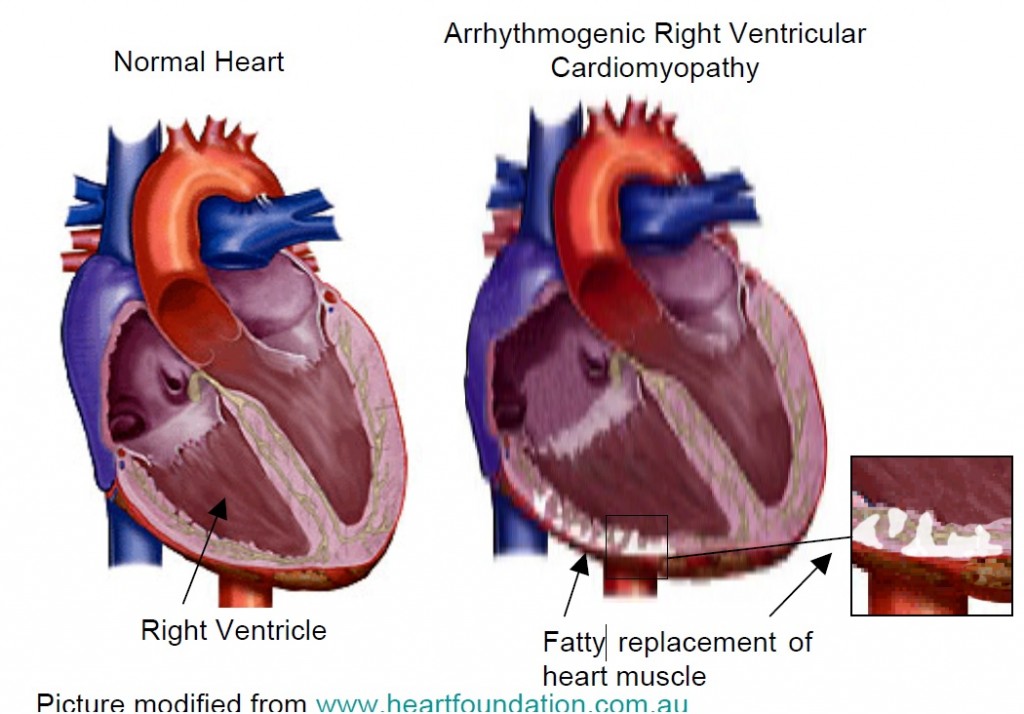
arrhythmogenic right ventricular cardiomyopathy
DiseaseWikipedia
5
MENTIONS
3
EPISODES
3
PODCASTS
Search complete. 5 mentions across 3 episodes found for "arrhythmogenic right ventricular cardiomyopathy".
Oct 5, 2026

Ruth BillerGUEST
Lorraine, who lost many family members to the rare channelopathy CPVT.
Ruth BillerGUEST
Esther, who lost her son, Angel, to the rare cardiomyopathy ARVC, or better ACM, arrhythmogenic cardiomyopathy, at age fifteen.
Ruth BillerGUEST
And I, who lost my daughter, Judith, to ARVC at age fourteen, and two years later, my niece at age twenty-three.
Ruth BillerGUEST
We drafted an initial version of a letter to the families explaining what is important in this situation and why.
Ruth BillerGUEST
That an autopsy should be performed, and if there is any doubt, genetic testing as well.

Jenny SimpsonGUEST
I mean, you come in, and they triage a situation that they have no idea what this young person has, um, and, and, and they kinda take care of you with a lot of unknowns.
Jenny SimpsonGUEST
But several days later, I was diagnosed with, um, an inherited heart condition called ARVC, arrhythmogenic right ventricular cardiomyopathy, and that means that a section of my heart, um, does- when it breaks down due to just normal exercise, right? Like, we exercise our muscles, the muscle breaks down, and then it rebuilds.
Jenny SimpsonGUEST
There's a portion of my heart, a segment of my heart, that when that muscle breaks down, it rebuilds in a dysfunctional way, and so when the material that it uses to rebuild doesn't properly conduct electricity.
Jenny SimpsonGUEST
And so accumulated over a long period of time, um, that ele- that, that scarring or that, um, uh, dysfunctional tissue in my heart eventually interrupted, um, the electrical pulse.
13 MINS LATER
Rob SimmelkjaerHOST
You know, I, I want you, Jenny, to also think about what our runners should think about when it comes to the gift that they have to be able to run this race, right? You, you spent your life doing this, and, you know, you're not able to do it going forward.
Rob SimmelkjaerHOST
How does that make you think about the gift of being able to run the marathon?
Jenny SimpsonGUEST
marathon?Yeah, on this, on this conversation is that as a result of my diagnosis with ARVC, after a lifetime of running as an elite athlete, um, it's kind of unbelievable.
Jenny SimpsonGUEST
I'm still wrapping my mind around the reality that it's not, it's not gonna be, uh, safe for me to return to running really, um, at any level.

Morgan BryanNARRATOR
ACM is associated with a significant risk of sudden cardiac death due to ventricular arrhythmias, especially in young patients and endurance athletes.
Morgan BryanNARRATOR
In a state-of-the-art review article entitled Arrhythmogenic Right Ventricular Cardiomyopathy, Alessio Gasperetti and colleagues from Johns Hopkins University in Baltimore, Maryland, USA, address the main pathogenic aspects of ACM, as well as a modern approach to diagnosis and management of the classical and non-classical left-sided ACM phenotype, without addressing here the larger and partially overlapping non-dilated left ventricular cardiomyopathy phenotype.
Morgan BryanNARRATOR
The aim of this review is to summarize the changing in understanding and framing of this multifaceted disease, in particular highlighting the current transition from a phenotype-first to a genotype-first framework for diagnosis and management.
Morgan BryanNARRATOR
In a viewpoint article entitled Hypertension With Defective IGF-1R/PI3K Signaling May Trigger Atrial Cardiomyopathy, Atrial Fibrillation, and Stroke, Julia McMullan, Renata Schnabel, and Ben Freedman from the University of Sydney in Australia and the University Medical Center Hamburg-Eppendorf in Germany aim to examine how hypertension and impaired insulin-like growth factor one receptor phosphoinositide three kinase, or IGF-1R/PI3K, signaling may contribute to atrial cardiomyopathy, or ATCM, and the development of atrial fibrillation, or AF, heart failure, or HF, and stroke.