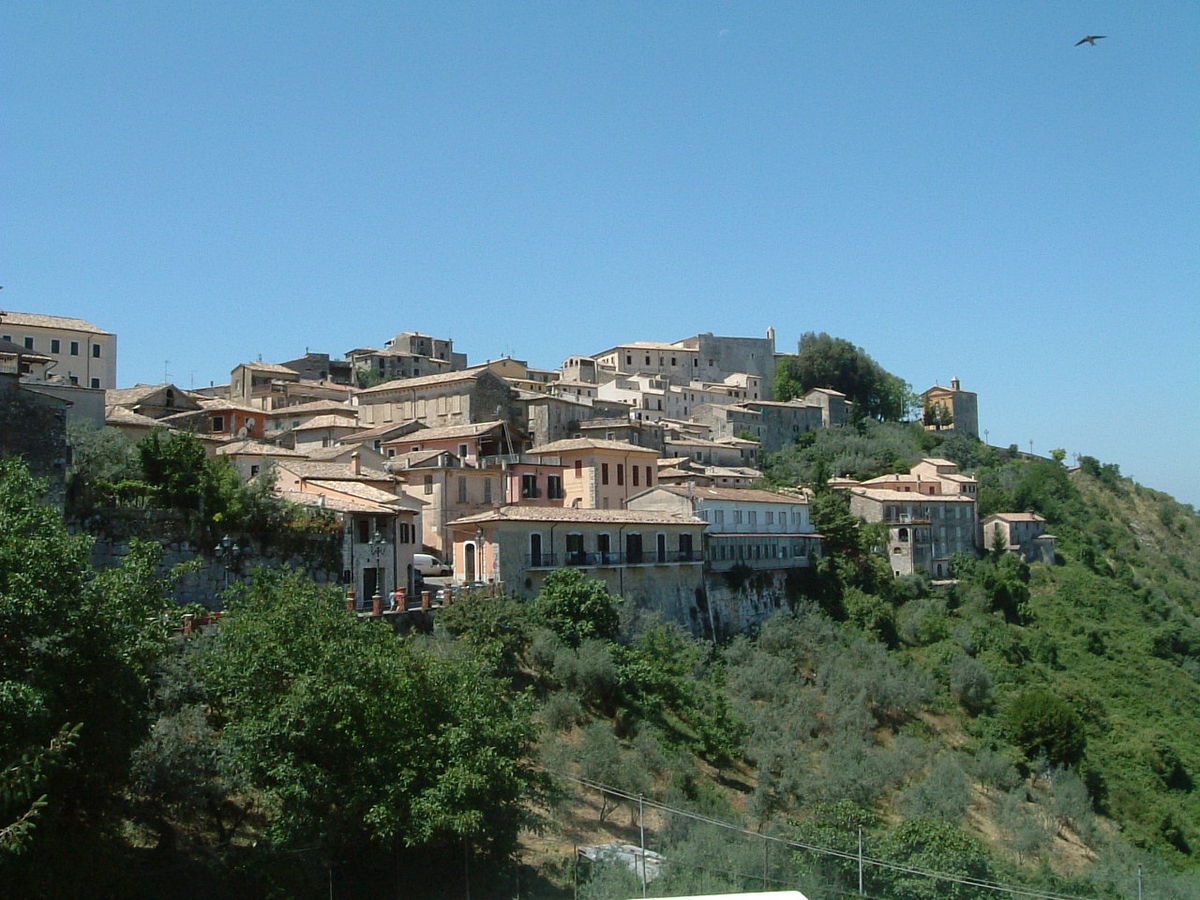
Arpino
Comune in ItalyWikipedia
39
MENTIONS
16
EPISODES
15
PODCASTS
Search complete. 39 mentions across 16 episodes found for "Arpino".
Sep 15, 2026

Catharine EdwardsGUEST
Uh, so at this time, the Romans were gradually gaining more and more control of Italy way beyond Rome, and there were actually quite a lot of Roman citizens who didn't live in Rome and communities that had Roman citizenship.
Catharine EdwardsGUEST
Cicero was born to a family based in Arpinum, around 80 miles or so from Rome itself.
Catharine EdwardsGUEST
But they were, you know, it was a citizen community, and Cicero was not the first man from Arpinum to become consul in Rome.
Catharine EdwardsGUEST
And the great General Marius had come from Arpinum himself a generation previously.
Catharine EdwardsGUEST
And Marius, of course, had been very skilled on the battlefield, so he was a great general.
Catharine EdwardsGUEST
Cicero, by contrast, p-pursued a more peaceful route to high office through his extraordinary rhetorical skills.
12 MINS LATER
Catharine EdwardsGUEST
He'd then stood again, trying to be elected consul in the summer of 63 and had again been unsuccessful, and Catiline was pretty desperate.
Catharine EdwardsGUEST
Now, Catiline came from a very aristocratic, distinguished background.

speaker_1ADVERTISER
Any door, the right support.
Alan MapstoneNARRATOR
INTRODUCTORY NOTE Marcus Tullius Cicero, the greatest of Roman orators and the chief master of Latin prose style, was born at Arpinum January 3, 106 B.C. His father, who was a man of property and belonged to the class of the knights, moved to Rome when Cicero was a child, and the future statesman received an elaborate education in rhetoric, law, and philosophy.
Alan MapstoneNARRATOR
studying and practicing under some of the most noted teachers of the time, he began his career as an advocate at the age of twenty-five and almost immediately came to be recognized not only as a man of brilliant talents but also as a courageous upholder of justice in the face of grave political danger after two years of practice he left rome to travel in greece and asia taking all the opportunities that offered to study his art under distinguished masters he returned to rome greatly improved in health and in professional skill and in seventy six b c was elected to the office of quaestor he was assigned to the province of lilibarum in sicily and the vigour and justice of his administration earned him the gratitude of the inhabitants it was at their request that he undertook in seventy b c the prosecution of verres who as praetor had subjected the sicilians to incredible extortion and oppression and his successful conduct of this case which ended in the conviction and banishment of verres may be said to have launched him on his political career he became ideal in the same year in sixty seven b c praetor and in sixty four b c was elected consul by a large majority the most important event of the year of his consulship was the conspiracy of catiline this notorious criminal of patrician rank had conspired with a number of others many of them young men of high birth but dissipated character to seize the chief offices of the state and to extricate themselves from the pecuniary and other difficulties that had resulted from their excesses by the wholesale plunder of the city the plot was unmasked by the vigilance of cicero five of the traitors were summarily executed and in the overthrow of the army that had been gathered in their support catiline himself perished cicero regarded himself as the saviour of his country and his country for the moment seemed to give grateful assent but reverses were at hand during the existence of the political combination of pompey caesar and crassus known as the first triumvirate p claudius an enemy of cicero's proposed a law banishing any one who had put roman citizens to death without trial this was aimed at cicero on account of his share in the catiline affair and in march fifty eight b c he left rome the same day a law was passed by which he was banished by name and his property was plundered and destroyed a temple to liberty being erected on the side of his house in the city during his exile cicero's manliness to some extent deserted him he drifted from place to place seeking the protection of officials against assassination writing letters urging his supporters to agitate for his recall sometimes accusing them of lukewarmness and even treachery bemoaning the ingratitude of his country or regretting the course of action that had led to his outlawry and suffering from extreme depression over his separation from his wife and children and the wreck of his political ambitions finally in august fifty seven b c the decree for his restoration was passed and he returned to rome the next month being received with immense popular enthusiasm during the next few years the renewal of the understanding among the triumvirs shut cicero out from any leading part in politics and he resumed his activity in the law courts his most important case being perhaps the defence of milo for the murder of clodius cicero's most troublesome enemy this oration in the revised form in which it has condoned to us is ranked as among the finest specimens of the art of the orator though in its original form it failed to secure milo's acquittal meantime cicero was also devoting much time to literary composition and his letters show great dejection over the political situation and a somewhat wavering attitude towards the various parties in the state in fifty five b c he went to cilicia in asia minor as proconsul an office which he administered with efficiency and integrity in civil affairs and with success in military he returned to italy in the end of the following year and he was publicly thanked by the senate for his services but disappointed in his hopes for a triumph the war for supremacy between caesar and pompey which had for some time been gradually growing more certain broke out in forty nine b c when caesar led his army across the rubicon and cicero after much irresolution threw in his lot with pompey who was overthrown the next year in the battle of pharsalus and later murdered in egypt cicero returned to italy where caesar treated him magnanimously and for some time he devoted himself to philosophical and rhetorical writing in forty six b c he divorced his wife terentia to whom he had been married for thirty years and married the young and wealthy publia in order to relieve himself from financial difficulties but her also he shortly divorced caesar who had now become supreme in rome was assassinated in forty four b c and though cicero was not a sharer in the conspiracy he seems to have approved the deed in the confusion which followed he supported the cause of the conspirators against antony and when finally the triumvirate of antony octavius and lepidus was established cicero was included among the proscribed and on december seventh forty three b c he was killed by agents of antony his head and hands were cut off and exhibited at rome the most important orations of the last months of his life were the fourteen philippics delivered against antony and the price of this enmity he paid with his life to his contemporaries cicero was primarily the great forensic and political orator of his time and the fifty-eight speeches which have come down to us bear testimony to the skill wit eloquence and passion which gave him his pre-eminence but these speeches of necessity deal with the minute details of the occasions which called them forth and so require for their appreciation a full knowledge of the history political and personal of the time the letters on the other hand are less elaborate both in style and in the handling of current events while they serve to reveal his personality and to throw light upon roman life in the last days of the republic in an extremely vivid fashion cicero as a man in spite of his self-importance the vacillation of his political conduct in desperate crises and the whining despondency of his times of adversity stands out as at bottom a patriotic roman of substantial honesty who gave his life to check the inevitable fall of the commonwealth to which he was devoted the evils which were undermining the republic bear so many striking resemblances to those which threaten the civic and national life of america to-day that the interest of the period is by no means merely historical as a philosopher cicero's most important function was to make his countrymen familiar with the main schools of greek thought much of his writing is thus of secondary interest to us in comparison with his originals but in the fields of religious theory and of the application of philosophy to life he made important first-hand contributions from these works have been selected the two treatises on old age and on friendship which have proved of most permanent and widespread interest to posterity and which give a clear impression of the way in which a high-minded roman thought about some of the main problems of human life
speaker_0SOUNDBITE_SPEAKER
The hardest part was figuring out where to go.

NathanNARRATOR
The horsemen of Namentum spurred hard out of the fray, the footman of Velitre, threw shield and spear away, and underfoot was trampled, amidst the mud and gore, the banner of proud Tusculum, that never stooped before.
NathanNARRATOR
And down went Flavius Faustus, who led his stately ranks, from where the apple blossoms wave on Anio's echoing banks, and Tullus of Arpinum, chief of the Volscian aides, and Metius, with the long fair curls, the love of Anxur's maids.
NathanNARRATOR
and the white head of Volso, the great Arician seer, and Nepos of Laurentum, the hunter of the deer, and in the back false Sextus felt the good Roman steel, and wriggling in the dust he died like a worm beneath the wheel, and flyers and pursuers were mingled in a mass, and far away the battle went roaring through the pass.
NathanNARRATOR
Sempronius Atratinus, sate in the eastern gate.

speaker_3SOUNDBITE_SPEAKER
So Gaius Marius, he's the provincial, he is the coming man, he is the meritocrat who is going to be the protagonist of our story.
speaker_3SOUNDBITE_SPEAKER
He is born in 157 BC in a town called Arpinum, which is about 80 miles outside Rome.
speaker_3SOUNDBITE_SPEAKER
Arpinum is a classic example of how the kind of that's the
David RobertsonHOST
rest is history.
David RobertsonHOST
We've mentioned the rest is history before, but I've just been listening to it.

NathanNARRATOR
The horsemen of Namentum spurred hard out of the fray, the footmen of Velitre threw shield and spear away, and underfoot was trampled amidst the mud and gore the banner of proud Tusculum that never stooped before.
NathanNARRATOR
And down went Flavius Faustus, who led his stately ranks, From where the apple-blossoms wave on Anio's echoing banks, And Tullus of Arpinum, chief of the Volscian aides, And Metius with the long fair curls, the love of Anxos' maids, And the white head of Volso, the great Arician seer, And Nepos of Laurentum, the hunter of the deer, And in the back false Sextus felt the good Roman steel, and wriggling in the dust he died like a worm beneath the wheel, and flyers and pursuers were mingled in a mass, and far away the battle went roaring through the pass.
NathanNARRATOR
Sempronius Atratinus, sate in the eastern gate, beside him were three fathers, each in his chair of state, Fabius, whose nine stout grandsons that day were in the field, and Manlius, eldest of the twelve who keep the golden shield.
NathanNARRATOR
and Sergius the high pontiff, for wisdom far renowned, in all Eutererius' colleges was no such pontiff found.

Dominic SandbrookHOST
The case of Marius is a really good example of the disparity of opportunities.
Dominic SandbrookHOST
So if you're a Roman, as Marius is, you can win six consulships if you're from Arpinum.
Dominic SandbrookHOST
But if you're from Pompeii, you, you can't win a single consulship, right? You can't win a single Roman office.
Tom HollandHOST
'Cause you, you don't have the vote.

Dominic SandbrookHOST
The case of Marius is a really good example of the disparity of opportunities.
Dominic SandbrookHOST
So if you're a Roman, as Marius is, you can win six consulships if you're from Arpinum.
Dominic SandbrookHOST
But if you're from Pompeii, you can't win a single consulship, right? You can't win a single Roman office.
Dominic SandbrookHOST
Because you don't have the vote.

Jeremy Ryan SlateHOST
Marius wasn't one of them.
Jeremy Ryan SlateHOST
He was from Arpinum, a small hill town about 60 miles southeast of Rome, which is nowhere near Rome.
Jeremy Ryan SlateHOST
And I mean that socially more than geographically.
Jeremy Ryan SlateHOST
The Romans had a word for a man like that, Novus Homo, a new man, the first in his family to claw his way into Roman politics.
Dominic SandbrookHOST
And this brings us very neatly, doesn't it, to, um, our protagonist, to Gaius Marius.
Dominic SandbrookHOST
So Marius is born in 157 BC in Arpinum, which is about, uh, 80 miles outside Rome.
Dominic SandbrookHOST
And is there a British town that would be a nice equivalent for Arpinum, Tom?
Tom HollandHOST
I guess it's kind of Swindon, basically.
Dominic SandbrookHOST
Wow.
Tom HollandHOST
[laughs]
Dominic SandbrookHOST
Roundabouts and warehouses.
Tom HollandHOST
I mean, having said that, uh, Arpinum is actually a kind of very old city, so perhaps the, the parallel doesn't exactly hold.

Dominic SandbrookHOST
Roundabouts and warehouses.
Tom HollandHOST
I mean, having said that, Arpinum is actually a kind of very old city, so perhaps the parallel doesn't exactly hold.
Tom HollandHOST
But I guess that the people in Rome would view Arpinum as, I don't know, people in W1 might view Swindon.
Tom HollandHOST
Right, yeah.
Tom HollandHOST
As being not exactly the obvious breeding ground of great dominant figures in the state.
Tom HollandHOST
And actually, Arpinum is a classic example of how the kind of the immediate hinterland around Rome, so Latium as it's called, has come to be knitted into the fabric of the Republic and basically kind of turned into the people of Latium have been turned into Romans.
Tom HollandHOST
So Arpinum had been conquered back in 305 BC and its people initially had been given a slightly inferior form of Roman citizenship.
Tom HollandHOST
So the Romans called it civitas sine suffragio, citizenship without, well, without suffrage, without the vote.
6 more episodes mention Arpino.
Create an account to see the whole feed, search across every transcript, and follow the entities you care about.