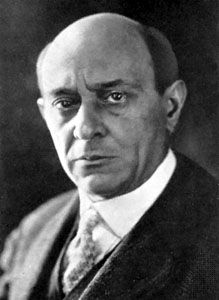
Arnold Schoenberg
Austrian composer and music theoristWikipedia
59
MENTIONS
41
EPISODES
38
PODCASTS
Search complete. 59 mentions across 41 episodes found for "Arnold Schoenberg".
Nov 4, 2026

John BirgeHOST
Not content with just a superb venue for chamber music, Mrs. Coolidge diligently commissioned new works to be played there.
John BirgeHOST
The list of important chamber pieces her foundation commissioned is impressive and includes Bartok and Schoenberg string quartets, the original chamber versions of Copland's Appalachian Spring, Stravinsky's Apollo Ballets, and modern works by American composers as diverse as Samuel Barber, Milton Babbitt, George Crumb, and John Corigliano.
John BirgeHOST
Mrs. Coolidge was herself an amateur composer and accomplished pianist.
John BirgeHOST
Her passion for music and enthusiasm for the creation of new works was all the more remarkable considering that, tragically, she herself battled deafness from her mid-30s.

Nicholas MulroyHOST
Look at you,
Robert HollingworthHOST
Schoenberg.
Helena CookeGUEST
Did you say you see a bit of me in her?
Robert HollingworthHOST
Well, no, I was just making a facile comparison about the way you were brought up with a lot of music going on around you.

TraceyHOST
And I remember liking that experience well enough when it was new to me, not all the pieces, um, not all and he puts in parentheses not all of the planets are super exciting but the parts that are exciting are really good you're gonna have to take the ride if you haven't been on it before but yeah yeah i know it's something like i think like people should hear at some point just to kind of
David PizzoHOST
100 no this is foundational with beethoven's ninth along with a flight of the valkyries i mean there's you know in terms of the the things i would hand somebody like this is what yeah european quote-unquote classical music is and can be i mean this is this yeah um who else is influenced by schoenberg because there's sometimes some dissonant stuff going on it isn't just pure euphony that he's using which is very much a sort of a schoenberg thing um again we don't do a lot of classical music on this podcast but
TraceyHOST
we don't maybe we should
David PizzoHOST
anyway um because obviously things like wagner are heavy as fuck like there's a lot of we we could have easily have a blast of heavy as fuck classical music

Anne FernaldGUEST
She's fantastic.
Anne FernaldGUEST
And Warner herself had these pivots, right? I mean, she was going to go to Germany to study with Schoenberg and World War I broke out.
Anne FernaldGUEST
And so then she became a musicologist.
Anne FernaldGUEST
And because England was at war with Germany, there was foundation money for England to study English music, right? Because everyone in England who was interested in classical music, for good reason, was studying German music.

Anne FernaldGUEST
She's fantastic.
Anne FernaldGUEST
And Warner herself had these pivots, right? I mean, she was going to go to Germany to study with Schoenberg and World War I broke out.
Anne FernaldGUEST
And so then she became a musicologist.
Anne FernaldGUEST
And because England was at war with Germany, there was foundation money for England to study English music, right? Because everyone in England who was interested in classical music, for good reason, was studying German music.

Stephen StearnsHOST
So anyone who has listened to Bach is probably going to recognize Telemann.
Stephen StearnsHOST
And people who have listened to Schoenberg are going to recognize more modernist composers.
Stephen StearnsHOST
So you can think of those as being clades, and you can think of the cultural tradition as being inherited, and as constraining variation within the range of scores that are composed on the piano.
Stephen StearnsHOST
Of course, what we're dealing with in a genome is like the biggest symphony orchestra you ever saw in your life.

Steven HobéHOST
Some moved away from traditional tonality.
Steven HobéHOST
Arnold Schoenberg developed 12-tone composition, while Igor Stravinsky experimented with startling rhythms and shifting accents.
Steven HobéHOST
Others took different paths.
Steven HobéHOST
Claude Debussy explored new harmonies.

Nate BrownHOST
I really enjoyed both of them.
Nate BrownHOST
let's move on to Arnold Schoenberg and the chamber symphony.
Nate BrownHOST
And one of the interesting things about this is that it's from early in Schoenberg's career before he developed kind of the, the 12 tone system, but he was starting to move towards a tonality or he was at least stretching the bounds of normal tonality.
Nate BrownHOST
So this piece has some key signatures.
Nate BrownHOST
So he was thinking of it being in a key and, at various times.

Marion JonesHOST
the place where Schubert was born and worked, and where so many other famous composers also spent a large part of their working life.
Marion JonesHOST
Haydn, Mozart, Beethoven, the Strauss family, Brahms, Bruckner, Schoenberg, the list is really very long.
Marion JonesHOST
It's also, of course, the home of the Vienna Boys Choir, founded in 1498. a choir in which both Haydn and Schubert were members when they were boys, and which still can be heard today singing mass at the Hofburg Chapel on Sunday mornings.
Marion JonesHOST
I don't think you can just turn up, you'll need to buy tickets, but certainly something to bear in mind.
31 more episodes mention Arnold Schoenberg.
Create an account to see the whole feed, search across every transcript, and follow the entities you care about.