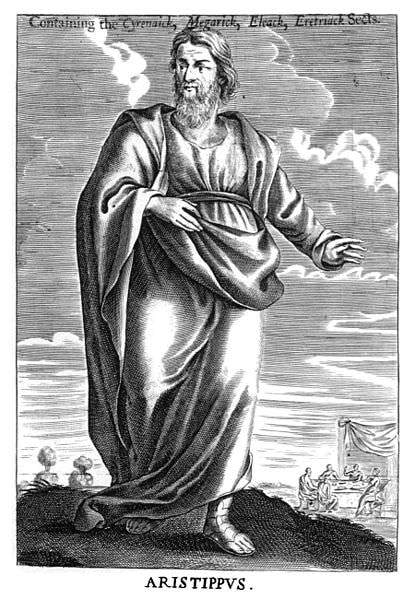
Aristippus
PhilosopherWikipedia
194
MENTIONS
35
EPISODES
32
PODCASTS
Search complete. 194 mentions across 35 episodes found for "Aristippus".
Sep 9, 2026

Philip GouldNARRATOR
really indifferent to them, and indeed nothing valuable but in its tangible ministration to life, was precisely this, that it gave them free play in using as their ministers or servants things which to the uninitiated must be masters or nothing.
Philip GouldNARRATOR
yet how little the followers of aristippus made of that whole comely system of manners or morals then actually in possession of life is shown by the bold practical consequence which one of them maintained with a hard self-opinionated adherence to his peculiar theory of values in the not very amiable paradox that friendship and patriotism were things one could do without while another, death's advocate as he was called, helped so many to self-destruction led by his pessimistic eloquence on the evils of life, that his lecture-room was closed.
Philip GouldNARRATOR
That this was in the range of their consequences, that this was a possible if remote deduction from the premises of the discreet Aristippus, was surely an inconsistency in a thinker who professed above all things an economy of the moments of life.
Philip GouldNARRATOR
and yet those ulciranax felt their way as if in the dark we may be sure like other men in the ordinary transactions of life beyond the narrow limits they drew of clear and absolutely legitimate knowledge admitting what was not of immediate sensation and drawing upon that fantastic future which might never come a little more of such walking by faith a little more of such not unreasonable assent and they might have profited by a hundred services to their culture from Greek religion and Greek morality as they actually were.
Philip GouldNARRATOR
The spectacle of their fierce, exclusive, tenacious hold on their own narrow apprehension makes one think of a picture with no relief, no soft shadows, nor breadth of space, or of a drama without proportionate repose.

Joshua Fields MillburnHOST
Yeah, well, I mean, the, the thing that I, I wrote down here is the richest person in the room isn't the one who can afford everything, but the one who needs nothing.
Joshua Fields MillburnHOST
I think about Diogenes when y- he's just sort of there eating lentils, and, uh, Aristippus comes up one day and wa- says, "Hey, you know, um, if you learned to be subservient to the king, you wouldn't need to subside on lentils." And Diogenes looks up at Aristippus, said, "If you learned to live on lentils, you wouldn't have to be subservient to the king." And I think we're so subservient to the kings that if I got more wealth, I'd be even betterly, better subservient to the king.
Joshua Fields MillburnHOST
I'd be a better servant to the king as opposed to, well, hey, maybe I, what you did pick up there is a, is a type of freedom, and I'm not against wealth at all.
Joshua Fields MillburnHOST
Uh, I am against overconsumption for any of us.

Leon MeyerNARRATOR
As to the nature of happiness, there was the utmost variety of opinion.
Leon MeyerNARRATOR
Democritus had made it consist in mental serenity, Anaxagoras in speculation, Socrates in wisdom, Aristotle in the practice of virtue with some amount of favor from fortune, Aristippus simply in pleasure.
Leon MeyerNARRATOR
These were the opinions of the philosophers.
Leon MeyerNARRATOR
But besides these, there were the opinions of ordinary men, as shown by their lives rather than by their language.

Bob NeufeldNARRATOR
And was
Bob NeufeldNARRATOR
Aristippus there, and
Bob NeufeldNARRATOR
Cleombrotus? No, they were said to be in Aegina.
Bob NeufeldNARRATOR
Anyone else? I think that these were nearly all.

LambdaNARRATOR
But he rejoined, I said suffering, not from life.
LambdaNARRATOR
For he seemed to bear his disease the more calmly from his love of life, and there is an epigram on him written by ourselves which runs thus, in your life you were a bitter dog antisthenes born to bite people's minds with saying sharp not with your actual teeth now you are slain by fell consumption passers-by may say why should he not one wants a guide to hell there were also three other people of the same name of antisthenes one a disciple of heraclitus the second, an Ephesian, the third, a historian of roots, and since we have spoken of those who proceeded from the school of Aristippus and Phaedon, we may now go on to the Cynics and Stoics who derived their origin from Antisthenes, and we will take them in the following order.
Troy MillingsADVERTISER
This is Troy Millings from Earn Your Leisure.
Troy MillingsADVERTISER
On Earn Your Leisure, we're all about smart money moves.
8 MINS LATER
LambdaNARRATOR
Another of his saying was that he thought a man ought oftener to provide himself with a reason than with a halter.
LambdaNARRATOR
On one occasion, when he noticed Plato at a very costly entertainment tasting some olives, he said, Oh, you wise man! Why, after having sailed to Sicily for the sake of such a feast, do you not enjoy what you have before you? And Plato replied, By the gods, Diogenes, while I was there I ate olives, and all such good things a great deal.
LambdaNARRATOR
Diogenes rejoined, What then did you want to sail to Syracuse for? Did not Attica at that time produce any olives? But Favorinus, in his Universal History, tells the story of Aristippus.
LambdaNARRATOR
At another time he was eating dried figs when Plato met him, and he said to him, You may have a share of these.

Geoffrey EdwardsNARRATOR
These, he maintains, lie at the root of every act of choice and of avoidance.
Geoffrey EdwardsNARRATOR
This is the doctrine of Aristippus, and it is upheld more cogently and more frankly by the Cyrenaics, but nevertheless it is in my judgment a doctrine in the last degree unworthy of the dignity of man.
Geoffrey EdwardsNARRATOR
Nature, in my opinion at all events, has created and endowed us for higher ends.
Geoffrey EdwardsNARRATOR
I may possibly be mistaken, but I am absolutely convinced that the Torquatus who first won that surname did not wrest the famous necklet from his foe in the hope of getting from it any physical enjoyment, nor did he fight the battle of the Veseris against the Latins in his third consulship for the sake of pleasure.
Geoffrey EdwardsNARRATOR
What have you left to him except that, whatever his style may be, you find his meaning intelligible? His doctrines in natural philosophy were second-hand, and in your opinion unsound at that, and his attempts to improve on his authority only made things worse.
Geoffrey EdwardsNARRATOR
Dialectic he had none.
Geoffrey EdwardsNARRATOR
His identification of the chief good with pleasure, in the first place, was in itself an error, and secondly, this also was not original, for it had been said before, and said better, by Aristippus.
Geoffrey EdwardsNARRATOR
To crown all, you added that Epicurus was a person of no education.

Bill BoerstNARRATOR
Democritus had made it consist in mental serenity, Anaxagoras in speculation, Socrates in wisdom, Aristotle in the practice of virtue with some amount of favor from fortune.
Bill BoerstNARRATOR
aristippus simply in pleasure these were opinions of the philosophers but besides these there were the opinions of ordinary men as shown by their lives rather than by their language zeno's contribution to thought on the subject does not at first sight appear illuminating he said that the end was to live consistently the implication doubtless being that no life but the passionless life of reason could ultimately be consistent with itself.
Bill BoerstNARRATOR
Cleanthes, his immediate successor in the school, is credited with having added the words with nature, thus completing the well-known Stoic formula that the end is to live consistently with nature.
Bill BoerstNARRATOR
it was assumed by the greeks that the ways of nature were the ways of pleasantness and that all her paths were peace this may seem to us a startling assumption but that is because we do not mean by nature the same thing as they did we connect the term with the origin of a thing they connected it rather with the end by the natural state we mean a state of savagery they meant the highest civilization we mean by a thing's nature what it is or has been they meant what it ought to become under the most favourable conditions not the sour crab but the mellow glory of the hesperides worthy to be guarded by a sleepless dragon was to the greeks the natural apple hence we find aristotle maintaining that the state is a natural product because it is evolved out of social relations which exist by nature nature indeed was a highly ambiguous term to the greeks no less than to ourselves but in the sense with which we are now concerned the nature of anything was defined by the peripatetics as the end of its becoming another definition of theirs puts the matter still more clearly what each thing is when its growth has been completed that we declare to be the nature of each thing following out this conception the stoics identified a life in accordance with nature with a life in accordance with the highest perfection to which man could attain now as man was essentially a rational animal his work as man lay in living the rational life and the perfection of reason was virtue hence the ways of nature were no other than the ways of virtue and so it came about that the stoic formula might be expressed in a number of different ways which yet all amounted to the same thing the end was to live the virtuous life or to live consistently or to live in accordance with nature or to live rationally DIVISION OF PHILOSOPHY Philosophy was defined by the Stoics as the knowledge of things divine and human.

Ed HumpalNARRATOR
If I succeed in this, and with the aid of a cloud of witnesses from both Testaments prove too strong for him, I will then accept his challenge, and adduce illustrations from secular literature.
Ed HumpalNARRATOR
I will show that even among philosophers and distinguished statesmen, the virtuous are wont to be preferred by all to the voluptuous, that is to say, men like Pythagoras, Plato, and Aristides, to Aristippus, Epicurus, and Alcibiades.
Ed HumpalNARRATOR
I entreat virgins of both sexes, and all such as are continent, the married also, and the twice married, to assist my efforts with their prayers.
Ed HumpalNARRATOR
Jovian is the common enemy, for he who maintains all to be of equal merit does no less injury to virginity in comparing it with marriage than he does to marriage, when he allows it to be lawful, but to the same extent as second and third marriages.
6 HRS 5 MINS LATER
Ed HumpalNARRATOR
On your side are the fat and the sleek in their festal attire.
Ed HumpalNARRATOR
If I may mock like Socrates, add if you please, all swine and dogs, and since you like flesh so well, vultures too, eagles, hawks, and owls.
Ed HumpalNARRATOR
You shall never be afraid of the host of Aristippus.
Ed HumpalNARRATOR
If ever I see a fine fellow, or a man who is no stranger to the curling irons, with his hair nicely done and his cheeks all aglow, he belongs to your herd, or rather grunts in concert with your pigs.

Gabriel HughesHOST
So he was reasoning in the synagogue with the Jews and the God-fearing Gentiles and in the marketplace every day with those who happened to be present.
Gabriel HughesHOST
And also some of the Epicurean and Stoic philosophers were conversing with him.
Gabriel HughesHOST
Some were saying, what would this idol babbler wish to say? Others were saying, He seems to be a proclaimer of strange deities, because he was proclaiming the good news of Jesus and the resurrection.
Gabriel HughesHOST
And they took him and brought him to the Areopagus, saying, May we know what this new teaching is which you are speaking? For you are bringing some strange things to our ears, so we want to know what these things mean.
13 MINS LATER
Gabriel HughesHOST
through the gospel of Jesus Christ.
Gabriel HughesHOST
So he is reasoning with him in the synagogue, but it says also in verse 17, he's going out into the marketplace and sharing these things with those who happen to be present.
Gabriel HughesHOST
And also some of the Epicurean and Stoic philosophers were conversing with him.
Gabriel HughesHOST
Some were saying, what would this idle babbler wish to say? Others were saying he seems to be a proclaimer of strange deities because he was proclaiming the good news of Jesus and of the resurrection.
Bob NeufeldNARRATOR
Were there any strangers? Yes, there were—Semius the Theban, and Cebes, and Phaedondes, Euclid and Turpesson, who came from Megara.
Bob NeufeldNARRATOR
And was Aristippus there, and Cleombrotus? No, they were said to be in Aegina.
Bob NeufeldNARRATOR
Any one else? I think that these were nearly all.
speaker_1ADVERTISER
Well, and what did you talk about?
25 more episodes mention Aristippus.
Create an account to see the whole feed, search across every transcript, and follow the entities you care about.