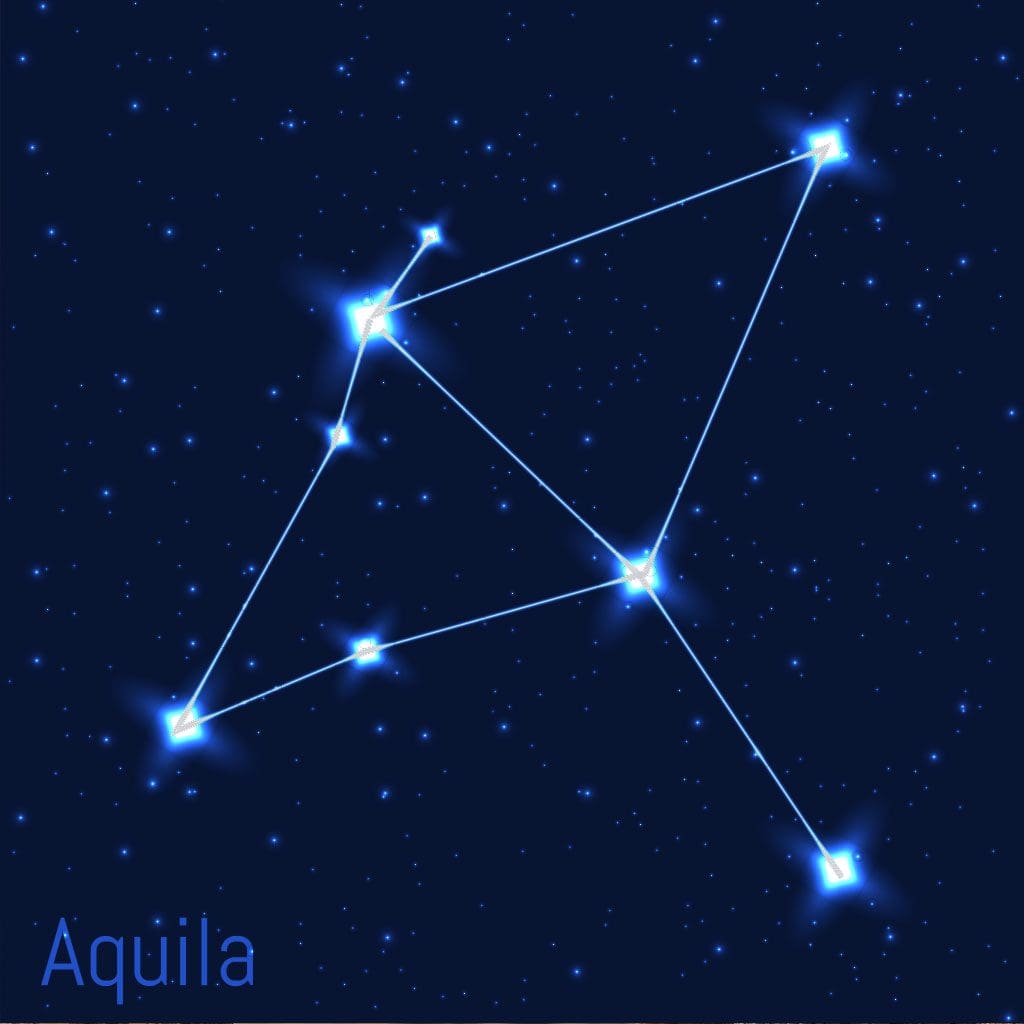
Aquila
ConstellationWikipedia
23
MENTIONS
10
EPISODES
9
PODCASTS
Search complete. 23 mentions across 10 episodes found for "Aquila".
Sep 7, 2026

Marty LeedsHOST
is associated with three different animals, the scorpion, the snake, and the eagle, and the eagle is sometimes interchangeable with the phoenix.
Marty LeedsHOST
So here you have Scorpio, Aquarius, Leo, and Taurus, and Scorpio is the eagle, and here is why, because Ophiuchus is standing on him, and he is holding the serpent, and what's on the end of the serpent is Aquila the eagle.
Marty LeedsHOST
We actually just saw this the other night, and it was pretty amazing.
Marty LeedsHOST
So here in Hawaii, we could see it very clearly.
Marty LeedsHOST
And of course, here it is.
Marty LeedsHOST
John the Apostle is a fucus on top of Scorpio.
Marty LeedsHOST
Scorpio is on the other side there, but then there's the Aquila.
Marty LeedsHOST
There's the eagle.

Chris BeckettHOST
And NGC 6781 is well-placed, as is B 142, and should have 143 there as well.
Chris BeckettHOST
That's Barnard's E up in, uh, constellation of Aquila.
Chris BeckettHOST
What is NGC 6781? That's a planetary nebula.
Chris BeckettHOST
Might just be one of the finest NGCs, uh, but 11 and a half magnitude there.
Chris BeckettHOST
Um, also up, uh, in Aquila and, uh, sort of in the northern side.
Chris BeckettHOST
Looks, uh, pretty cool, like a halo circle giant donut and, uh-
Shane LudtkeHOST
Yeah.
Chris BeckettHOST
Um, my list is that I'm observing all of, uh, H.D. Curtis', uh, planetary nebulas that he, uh, put into a catalog back in 1918.
Jenifer MillardHOST
...
Jenifer MillardHOST
Aquila.
Jenifer MillardHOST
Makes a triangle with, uh, Altair, so the brightest star of Aquila, and Delphinus.
Jenifer MillardHOST
So it's, it's small, but highly recognizable once you spot it, right? And, and-
Paul HillHOST
Yeah, it's a little arrow.

JennyHOST
So where is Sagittarius, first of all? So Sagittarius is a small, faint constellation.
JennyHOST
It's near Cygnus and Aquila.
JennyHOST
It makes a triangle with Altair, so the brightest star of Aquila, and Delphinus.
JennyHOST
So it's...
JennyHOST
It's small but highly recognisable once you spot it, right? Yeah, it's a little

Claire VennisNARRATOR
Turning to the stars, September is the ideal time to observe the charming little constellation of Delphinus the dolphin.
Claire VennisNARRATOR
Looking due south around late evening, the brightest star you'll see in that part of the night sky is Altair in Aquila the Eagle.
Claire VennisNARRATOR
In the 10 o'clock position from Altair, there's a small pattern of four stars in a diamond shape with a fifth underneath.
Claire VennisNARRATOR
The diamond shape is an asterism known for uncertain reasons as Job's Coffin.

Claire VennisHOST
Turning to the stars, September is the ideal time to observe the charming little constellation of Delphinus the Dolphin.
Claire VennisHOST
Looking due south around late evening, the brightest star you'll see in that part of the night sky is Altair in Aquila the Eagle.
Claire VennisHOST
In the 10:00 position from Altair, there's a small pattern of four stars in a diamond shape with a fifth underneath.
Claire VennisHOST
The diamond shape is an asterism known for uncertain reasons as Job's Coffin.

ChrisHOST
And should have 143 there as well.
ChrisHOST
That's Barnard's E up in constellation of Aquila.
ChrisHOST
What is NGC 6781? That's a planetary nebula.
ChrisHOST
One of the finest NGCs, but 11 and a half magnitude there.
ChrisHOST
Also up in Aquila and sort of in the northern side.
ChrisHOST
Looks pretty cool.
ChrisHOST
Like a halo circle giant donut.

Paul AbelHOST
It is.
Paul AbelHOST
Uh, the region to the north of Aquila is populated by small constellations.
Paul AbelHOST
Some are well-defined.
Paul AbelHOST
Others are, frankly, rather obscure.
Paul AbelHOST
Okay.
Pete LawrenceHOST
But Delphinus is much, much bigger, and it's, it's quite well-defined, really.
Pete LawrenceHOST
Uh, an interesting fact about Delphinus, actually, is that the star Rho Aquilae sits in it-
Paul AbelHOST
Oh, really?

Stuart GaryHOST
Just below Capricornus on the eastern horizon, you'll see the constellation Aquarius, the water carrier to the gods.
Stuart GaryHOST
Greek mythology describes Aquarius as the most beautiful looking boy that ever lived, and so was carried from Earth up to Mount Olympus by Zeus in the guise of Aquila the eagle to become the water carrier.
Stuart GaryHOST
The two brightest stars in Aquarius are Alpha and Beta Aquarii, a pair of luminous yellow supergiants that were once spectral type B blue-white stars.
Stuart GaryHOST
The pair are moving through space perpendicular to the plane of the Milky Way galaxy.
Stuart GaryHOST
Vega has about twice the mass of our sun, and it's a relatively young star, less than five hundred million years old, and it's also fairly close, just twenty-five light years away.
Stuart GaryHOST
Now, once again, due to the precession of Earth's rotational axis, Vega used to be the northern pole star around fourteen thousand years ago, and it will do so again in another twelve thousand years' time.
Stuart GaryHOST
Just above Vega is Alpha Aquilae or Altair, the brightest star in the constellation Aquila.
Stuart GaryHOST
It's a spectral type A white-yellow star with about twice the mass of our sun.

speaker_0HOST
And when we add Altair, Altair's been dancing with Pluto for quite some time.
speaker_0HOST
Altair, as I have said before, is the brightest star in the constellation Aquila, the eagle.
speaker_0HOST
And really, it's inviting us to remember that there's a bigger picture that's happening here.
speaker_0HOST
And in Greco-Roman mythology, Aquila became associated with the eagle of Zeus, the bird that carried thunderbolts.
speaker_0HOST
So Altair gives Pluto an image that I just kind of want to name here.
speaker_0HOST
It's the eagle's perspective.