Aquarius
ConstellationWikipedia
19
MENTIONS
11
EPISODES
11
PODCASTS
Search complete. 19 mentions across 11 episodes found for "Aquarius".
Nov 1, 2026

Kelly BeattyHOST
And yet there are a bunch of constellations in this region.
Kelly BeattyHOST
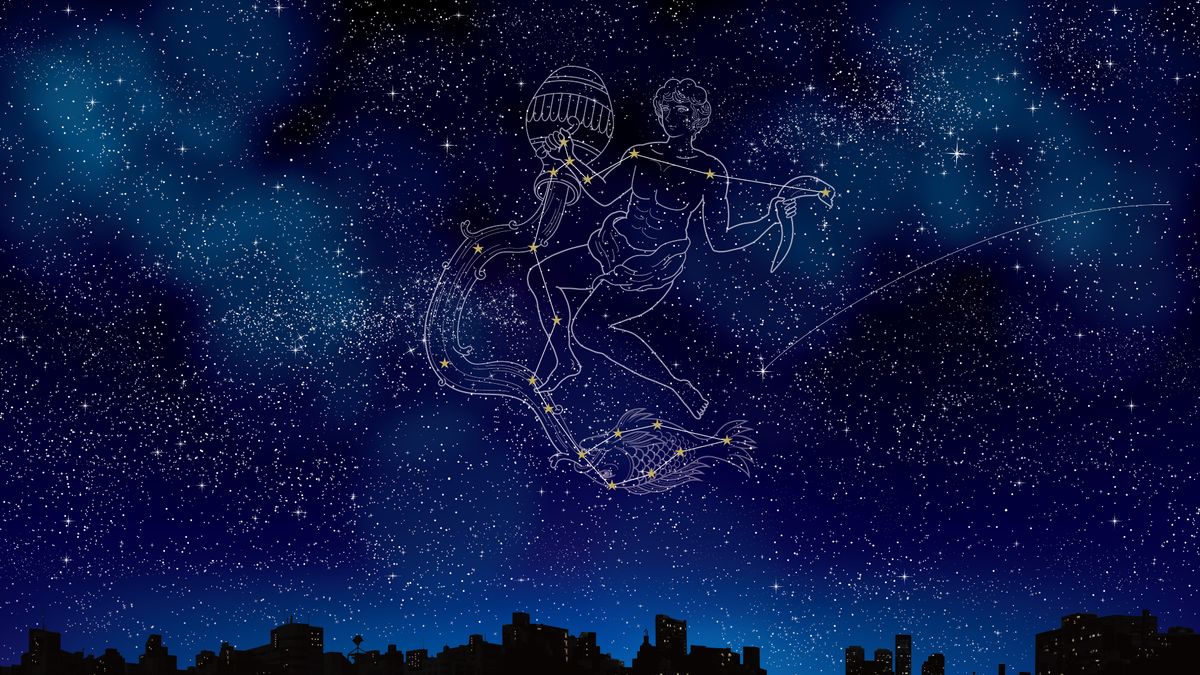
Directly above Fomalhaut is Aquarius, the water bearer.
Kelly BeattyHOST
To its upper right is Capricornus, the sea goat.
Kelly BeattyHOST
Well to its left, above and below Saturn, are Pisces, the fish, and Cetus, the whale.

Elizabeth GarciaHOST
Lots of geometry this month.
Elizabeth GarciaHOST
And lastly, Aquarius, the water bearer, pouring the river of water into the night sky.
Elizabeth GarciaHOST
The river of water the cup bearer is pouring out is called the Eridanus cup.
Elizabeth GarciaHOST
just in case you needed to know its name.
Elizabeth GarciaHOST
Aquarius lies directly under or west of the head of Pegasus and south of the octagon fish of Pisces.
Elizabeth GarciaHOST
The shape is a boy pouring out a cup of water in the direction of Pisces.
Elizabeth GarciaHOST
In Greek mythology, Ganymede is a boy that pours nectar into the goblet of Zeus, king of the gods.

Pete LawrenceHOST
yeah okay well let's finish off then with a look at the night sky so if we face south early evening um we're presented with the faint watery constellations of autumn it's actually called the sea that region isn't it because it's just full of full of water Full of watery constellations.
Pete LawrenceHOST
You've got Aquarius, Pisces, Capricornus, which is the sea goat, of course.
Pete LawrenceHOST
Eridanus is there as well.
Pete LawrenceHOST
Cetus, the whale or sea monster.
Paul AbelHOST
I've seen some really nice deep sky images taken with smart telescopes.
Pete LawrenceHOST
Yeah, you know, that short, it's a 10 second typically exposure, 10 second exposure, but they're just integrated together over a huge amount of time and you can get some really nice results with it.
Pete LawrenceHOST
Okay, so southwest of Aquarius is Capricornus, the sea goat, which is an ancient constellation resembling a misshapen down-pointing triangle.
Pete LawrenceHOST
And that contains the infamous globular M30.

JordanHOST
The nebulae around these are what is left.
JordanHOST
An example from a prior episode would be the Ring Nebula in Lyra, or the Medusa Nebula in Gemini, or the Helix Nebula in Aquarius, and the Oyster Nebula in Camelopardalis.
KitHOST
Oh my gosh, yes.
KitHOST
We've talked about a lot of planetary nebulae.

Mark BreenHOST
With the last of the twilight essentially gone by 7:00, you'll see the moon within the stars of Capricorn, though seeing the stars of Capricorn itself will be problematic, as their brilliance is lackluster at best.
Mark BreenHOST
Through the rest of the week, the moon enters Aquarius and approaches Pisces, those stars even more obscure than Capricorn, as well as positioned low in the south.
Mark BreenHOST
That allows us to refocus in the west, where two of the sky's great luminaries are featured, the golden white Arcturus sinking low, the brightest star we've seen from May through October.
Mark BreenHOST
Then shining very high in the west, the steely blue Vega sparkles as our second brightest star.

Sky CarambaHOST
I've never seen it with my eyes and a scope, but my smart telescope got pictures last year.
Sky CarambaHOST
Wednesday and Thursday, the moon moves through Aquarius.
Sky CarambaHOST
It passes Neptune on Friday, the same day the moon goes north of the equator.
Sky CarambaHOST
The moon's close to Saturn on Saturday, although at 6.0 degrees separation, it's not very close.

CedricHOST
Yes
RicarioHOST
... 'cause it's, like, Leo, Gemini, Aquarius.
CedricHOST
Yes.
Tony of PrideHOST
Yeah.

speaker_1HOST
Yeah.
Billy NewmanHOST
And it, I think it was coming up in Aquarius sometime around 2:00 or 3:00 AM.
Billy NewmanHOST
Um, and so that means that we had really dark skies for the whole first segment of the night, and in that location in Oregon, a dark sky is really great.
Billy NewmanHOST
A dark, clear sky is, is just a really interesting, um, thing out there because you, there's so little light pollution that you can really make out so many more things, or so many more, um, fine details in the constellations that you're not, not able to see-

Jenifer MillardHOST
We can start enjoying more things.
Paul HillHOST
And one that, you know, we, um, we're always a fan of that kind of overlooked constellations, and this is Aquarius.
Paul HillHOST
Because Aquarius is quite, it's quite low.
Paul HillHOST
It's quite low in the British sky.
Jenifer MillardHOST
Yeah, it's not bright.
Jenifer MillardHOST
Yeah
Paul HillHOST
... look down.
Paul HillHOST
Look down And you will see Aquarius.

Jonathan NallyGUEST
Um, they don't have a lot of bright stars and things.
Jonathan NallyGUEST
We should get a telescope onto them, a backyard telescope, you can see lots of things within them, but just to the naked eye, Capricornus, Sculptor, Aquarius, Cetus, and others, um, they look fairly bland.
Jonathan NallyGUEST
The northern part of the sky, apologies to our northern listeners, northern hemisphere listeners, but down here in the south, the bits that we can see at this time of year, it's pretty dull there as well.
Jonathan NallyGUEST
If we were much further north of the equator, then there'd be plenty of things to see.
1 more episode mentions Aquarius.
Create an account to see the whole feed, search across every transcript, and follow the entities you care about.