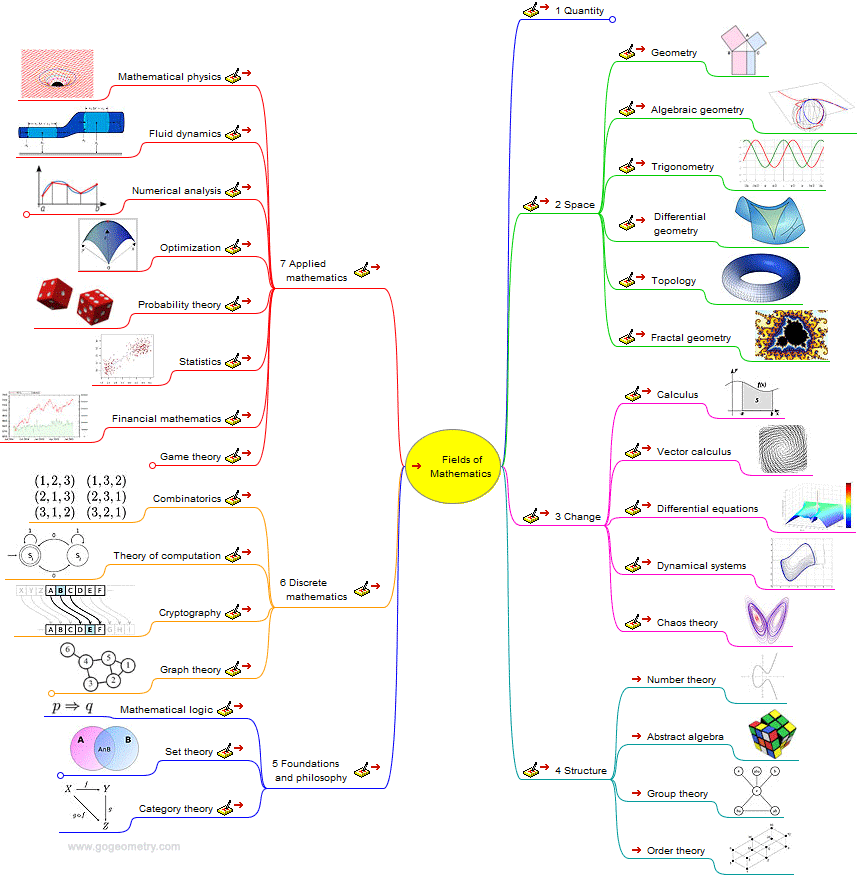
Applied mathematics
Field of studyWikipedia
11
MENTIONS
7
EPISODES
7
PODCASTS
Search complete. 11 mentions across 7 episodes found for "Applied mathematics".
Sep 24, 2026

Rachel ThomasHOST
And alongside that, we're also the editors of plus.maths.org, an outreach initiative here.
Marianne FreibergerHOST
The person you just heard was Carola-Bibiane Schönlieb, Professor of Applied Mathematics, talking about the use of artificial intelligence in mathematics.
Marianne FreibergerHOST
Now, we spoke to Carola at the International Congress of Mathematicians, which took place in Philadelphia in July this year, and it was quite exciting to be at the ICM, wasn't it, Rachel? What did you enjoy in particular?
Rachel ThomasHOST
I think the thing about the ICM, the International Congress of Mathematicians, is it's really enormous, has thousands of mathematicians, and it's one of the few meetings where there's people from all parts of mathematics there.
Marianne FreibergerHOST
Some people are grieving.
Rachel ThomasHOST
Some people are grieving.
Rachel ThomasHOST
Um, but there's, what's interesting talking to people like Carola is they ha- is she and others have a much more positive view coming from applied mathematics.
Rachel ThomasHOST
Um, it's really an extension of the way they have used tools to further their work over the years.

Julien RiposoGUEST
And I'm also the CEO and founder of JR Enterprise.
Julien RiposoGUEST
My background is in applied mathematics, quantitative finance, but also digital assets.
Julien RiposoGUEST
I hold a PhD in applied mathematics and the certificate of quantitative finance.
Julien RiposoGUEST
And I have worked across multiple domains like model validation, market infrastructure, blockchain, and of course, quantitative research.
Julien RiposoGUEST
I also write, I want to say a lot, more than I publish, actually.

Donald GoldfarbGUEST
And I wrote that paper.
Donald GoldfarbGUEST
It was in Siam Journal of Applied Mathematics.
Donald GoldfarbGUEST
I mean, I eventually wrote it.
Donald GoldfarbGUEST
It was my thesis, okay? So the next story about Courant comes after that.
Donald GoldfarbGUEST
It's not a Newton direction.
Donald GoldfarbGUEST
You're projecting with an orthogonal projection on the manifold.
Donald GoldfarbGUEST
And Rosen wrote this paper in SIAM, Journal of Applied Mathematics, analyzing gradient projection.
Donald GoldfarbGUEST
It was the first paper analyzing.

Elizabeth SpiersHOST
That's the number of advanced degrees a guy named James Beaton, who's 31, has.
Elizabeth SpiersHOST
He has an MBA from Stanford, a Yale Law degree, an MA in Applied Math from Harvard.
Elizabeth SpiersHOST
This guy has just gone to school perpetually while also running an education company with a bunch of employees.
Elizabeth SpiersHOST
And this is my rich person dream.

Elizabeth SpiersHOST
That's the number of advanced degrees a guy named James Beaton, who's 31, has.
Elizabeth SpiersHOST
He has an MBA from Stanford, a Yale Law degree, an MA in Applied Math from Harvard.
Elizabeth SpiersHOST
This guy has just gone to school perpetually while also running an education company with a bunch of employees.
Elizabeth SpiersHOST
And this is my rich person dream.

Nasir RajpootGUEST
Uh, finished my PhD in 2001.
Nasir RajpootGUEST
During my PhD, I spent a couple of years at, in fact, more time at Yale Applied Maths Department in the US than I did in, in Warwick during my PhD.
Nasir RajpootGUEST
Um, main reason why I ended up being there was that I wanted to work in the area of medical imaging-
Sidney Ocanagil-TunstallHOST
Okay

David FergusonHOST
Dr.
David FergusonHOST
Brown received his BA Magna Cum Laude in Applied Mathematics from Harvard College, his MA and his PhD in Statistics from Harvard University, and his MD Magna Cum Laude from Harvard Medical School.
David FergusonHOST
Dr.
David FergusonHOST
Brown is an anesthesiologist statistician whose experimental research has made important contributions towards understanding the neuroscience of how anesthetics act in the brain to create the state of general anesthesia.