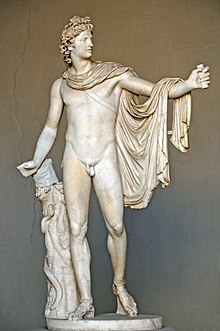
Apollo
DeityWikipedia
1.4k
MENTIONS
59
EPISODES
51
PODCASTS
Search complete. 1357 mentions across 59 episodes found for "Apollo".
Oct 28, 2026

Stephen SmithSOUNDBITE_SPEAKER
A piercing shriek, she reeled and dropped Aeneas.
Stephen SmithSOUNDBITE_SPEAKER
But Phoebus Apollo plucked him up, swathed him round, and got him out of there.
Stephen SmithSOUNDBITE_SPEAKER
The reason I spend some time on this is because it is a moment when we have an immortal wounded by a mortal.
Stephen SmithSOUNDBITE_SPEAKER
And it brings into focus the difference between men and gods in the poem, or at least one difference.

speaker_0NARRATOR
A fury that was, in some sense, cosmically justified.
speaker_0NARRATOR
The Olympians, Zeus, Hera, Athena, Apollo, Artemis, Ares, Hermes, Hephaestus, Dionysus, Poseidon and the others were, by the time of the Gigantomachy, the reigning order of the universe.
speaker_0NARRATOR
They had already overthrown the Titans in a ten-year war called the Titanomachy.
speaker_0NARRATOR
and had settled into their respective domains with the comfortable authority of those who believe, quite sincerely, that they deserve what they have.
21 MINS LATER
speaker_0NARRATOR
Ares fought beside her with characteristic ferocity and somewhat less characteristic effectiveness.
speaker_0NARRATOR
Ares was always more enthusiasm than strategy, and the Gigantomachy was a battle that punished enthusiasm without strategy.
speaker_0NARRATOR
Apollo and his twin Artemis fought together, as they so often did.
speaker_0NARRATOR
Apollo's silver bow sent arrows into the chaos with a precision that the randomness of the battlefield could not entirely defeat.

Stephen SmithSOUNDBITE_SPEAKER
A piercing shriek, she reeled and dropped Aeneas.
Stephen SmithSOUNDBITE_SPEAKER
But Phoebus Apollo plucked him up, swathed him round, and got him out of there.
Stephen SmithSOUNDBITE_SPEAKER
The reason I spend some time on this is because it is a moment when we have an immortal wounded by a mortal.
Stephen SmithSOUNDBITE_SPEAKER
And it brings into focus the difference between men and gods in the poem, or at least one difference.

InkelNARRATOR
Men feared the anger of Poseidon scarcely less than that of Zeus, because, though he had no thunderbolts, he could make the earth rend in quake or the sea run mountains high with one blow of his trident.
InkelNARRATOR
but though he was fierce and terrible if offended none of the immortals were more kindly to the race of man and none it was said were so faithful a friend to those who had once pleased him and this as you will hear presently was a true saying close to poseidon and leaning lovingly against his broad shoulder tantalus saw a bright-haired youth at whose feet lay a bow and quiver and a golden lyre it was the archer apollo who was the sweet singer of heaven and near him sat nine fair sisters crowned with violets who called them muses as the feast went on another youth whose smiling eyes sparkled with mischief slipped from his place and stood beside apollo and stealthily picked up the golden lyre but Apollo turned, and took it from him laughing, and said, Ah, thieving Hermes, did you not give me this to make amends for the kind you stole from me in the Arcadian pastures, when you were yet a little roguish boy, and now would you steal it too? Nay, let me keep it, my brother, and you shall hear me sing with the nine, in honour of our kind host.
InkelNARRATOR
Then Tantalus looked eagerly at the merry face of Hermes, for there were many greater gods, but none more beloved than he.
InkelNARRATOR
the god of homely shepherds and of wayfarers.
InkelNARRATOR
and now apollo sang to the golden lyre and the nine mutas sang with him they sang in praise of tantalus the generous the hospitable the bounteous friend of the needy and the stranger and how his name was glorious in many lands They told how the gods looked down with favour on the good deeds that he had done, and how, in days to come, that favour should not cease from his house, but bring yet greater glory upon his children's children.
InkelNARRATOR
That golden palace, they declared, should vanish from the earth and be no more remembered, but generations yet unborn should marvel while mighty bards told in song the wondrous story of the race of Tantalus.
InkelNARRATOR
Now Apollo and those violet-crowned goddesses sang so enchantingly that not only the mortals but the heavenly guests who heard them sat as if spellbound.
InkelNARRATOR
even the eagle, which had made Tantalus uneasy from time to time by fixing a fierce gaze upon him and snapping its terrible hooked beak, was lulled to sleep by the gracious harmony and sat with bluish eyelids closed, motionless for the rise and fall of its feathers like ripples on brown water as its glossy back heaved in slumber.

TriciaGNARRATOR
Zeus is merely accompanied by a snake, an eagle, a bull, or at worst assumes for his private purposes the forms of those animals.
TriciaGNARRATOR
The cow and the cuckoo are sacred to Hera, the owl and the snake to Athena, the dolphin, the crow, the lizard, the bull to Apollo.
TriciaGNARRATOR
dionysus always like a
TriciaGNARRATOR
wilder and less middle-aged zeus appears freely as a snake bull he-goat and lion allowing for some isolated
13 MINS LATER
TriciaGNARRATOR
which guided and sustained them.
TriciaGNARRATOR
This daimon has no necessary name.
TriciaGNARRATOR
A man may be named after him, or Ibazius, belonging to the mountain dancer, just as others may be named Apollonius
TriciaGNARRATOR
or Dionysius.

David WalesNARRATOR
We find firmly established the Olympian patriarchal family.
David WalesNARRATOR
Zeus, the father of gods and men, his wife Hera, his son Apollo, his daughter Athena, his brothers Poseidon and Hades, and the rest.
David WalesNARRATOR
We probably think of each feature more or less as like a statue.
David WalesNARRATOR
A habit of mind obviously wrong and indeed absurd, as if one thought of labor and grief as statues because Rodin or Saint-Gaudens has so represented them.
14 MINS LATER
David WalesNARRATOR
The cow and the cuckoo are sacred to Hera.
David WalesNARRATOR
The owl and the snake to Athena.
David WalesNARRATOR
The dolphin, the crow, the lizard, the bull to Apollo.
David WalesNARRATOR
Dionysus, always like a wilder and less middle-aged Zeus, appears freely as a snake, bull, he-goat, and lion.

Alexia CostadinaHOST
So it's already a really traumatic story.
Alexia CostadinaHOST
Now, in most tellings, Artemis is born first and actually ends up assisting in the birth of a twin brother, Apollo.
Alexia CostadinaHOST
Now, this is early symbolically resonant association between Artemis and the act of childbirth itself, which we'll come back to when we get to her own core domains later in this episode.
Alexia CostadinaHOST
But it's worth mentioning that even here in the origin story, in the birth of her and her twin brother, she is there to assist in the birth of another child.
Alexia CostadinaHOST
And I know I just mentioned Artemis assisting in the birth.
Alexia CostadinaHOST
So you think that the next part of this podcast will be delving into Artemis.
Alexia CostadinaHOST
But actually, we're going to turn to Apollo and try and build out his theological portfolio properly because it's one of the richest and most internally coherent of any Olympian.
Alexia CostadinaHOST
So let's look at prophecy and clarity.

JimmyHOST
The Aramisbea didn't survive intact, but its fragments were widely cited, and it served as the primary Greek source on the peoples of the far north.
JimmyHOST
The poem also made a claim central to the Hyperborea legend, that Apollo spent his winters among the Hyperboreans.
JimmyHOST
The god of light, music, and prophecy lived with them for part of every year when his summer abode became too cold.
JimmyHOST
The most vivid surviving description of Hyperborea from the ancient world comes from the poet Pindar, who wrote his 10th Pythian Ode around 498 BC.
JimmyHOST
In it, he told the story of Perseus traveling to the land of the Hyperboreans, and what he described there was unlike anything else in Greek literature.
JimmyHOST
Pindar described a semi-immortal people who lived entirely without work, disease, or fear of divine punishment.
JimmyHOST
Their days were filled with feasting, music, and the worship of Apollo, who brought them gifts from the gods every year.
JimmyHOST
When Perseus arrived, he found that the entire society was completely dedicated to this patron deity.

Lorina ChristineHOST
So as I was researching a little bit more, I discovered the deeper significance of the Pythia.
Lorina ChristineHOST
So the Pythia was the title given to the priestesses who served as the Oracle of Apollo at Delphi in Greece.
Lorina ChristineHOST
She was regarded as a channel through which Apollo communicated his deeper divine messages.
Lorina ChristineHOST
So people would travel from far and wide to consult the oracles, the priestesses, to seek deeper guidance on matters that would help shape their lives, the communities and kingdoms around.
Lorina ChristineHOST
These women were seen as very remarkable positions in this ancient time.
Lorina ChristineHOST
And they were the voices through which people believed divine wisdom could be received.
Lorina ChristineHOST
So often these women were chosen to be priestesses or oracles at a very young age when they were young maidens.
Lorina ChristineHOST
And later on, it was also women who were older and who chose to devote their life to becoming a priestess and channeling the divine through Apollo.

Andrew M. HenryHOST
Some even toppled into the chasm during their trance.
Andrew M. HenryHOST
According to the story, the inhabitants of the region, in order to eliminate risks, decided to appoint one woman as prophetess for everyone, who would pronounce prophecies from the god Apollo.
Andrew M. HenryHOST
A tripod, an object symbolizing divine presence, was placed above the chasm and thus the Oracle was founded.
Andrew M. HenryHOST
But are these stories of intoxicated goats and oracles rooted in historical reality or in ancient exaggeration? Today we'll explore the origins of the cult of Apollo at Delphi, its staggering rise to an international power, and the plausibility of the theory that the oracle was high on geochemical fumes.
Andrew M. HenryHOST
The Homeric Hymn to Apollo says that Apollo himself came down to Earth in search of a suitable place to found the first oracle for humans.
Andrew M. HenryHOST
After a long and difficult search that brought him across central Greece, he came to a place called Pitho.
Andrew M. HenryHOST
Located beneath the cloud-covered Mount Parnassus, it seemed to be a suitable place to found his oracle.
Andrew M. HenryHOST
Only one problem, the location was already occupied by other gods like Gaia and Poseidon.
49 more episodes mention Apollo.
Create an account to see the whole feed, search across every transcript, and follow the entities you care about.