Apollo 9
Space missionWikipedia
28
MENTIONS
18
EPISODES
17
PODCASTS
Search complete. 28 mentions across 18 episodes found for "Apollo 9".
Oct 30, 2026

Scott ManleyHOST
But the Schweiker Prize is an award that is given to researchers who come up with a proposal which helps to improve planetary defense in some material way, the best idea of the year.
Scott ManleyHOST
It's named for Rusty Schweiker from Apollo 9.
Scott ManleyHOST
And this one, again, it transformed my view because what they pointed out is that now that we are talking about, I know that humanity is expected to have huge numbers of assets in orbit, communications constellations, star mined, the data centers, they're running all sorts of stuff, the telescopes.
Scott ManleyHOST
Now, planetary defense really needs to start taking account of these assets, not just in orbit, also in the moon.

Daven HiskeyHOST
Seventy hours later, they entered lunar orbit, becoming the first humans to visit another world.
Daven HiskeyHOST
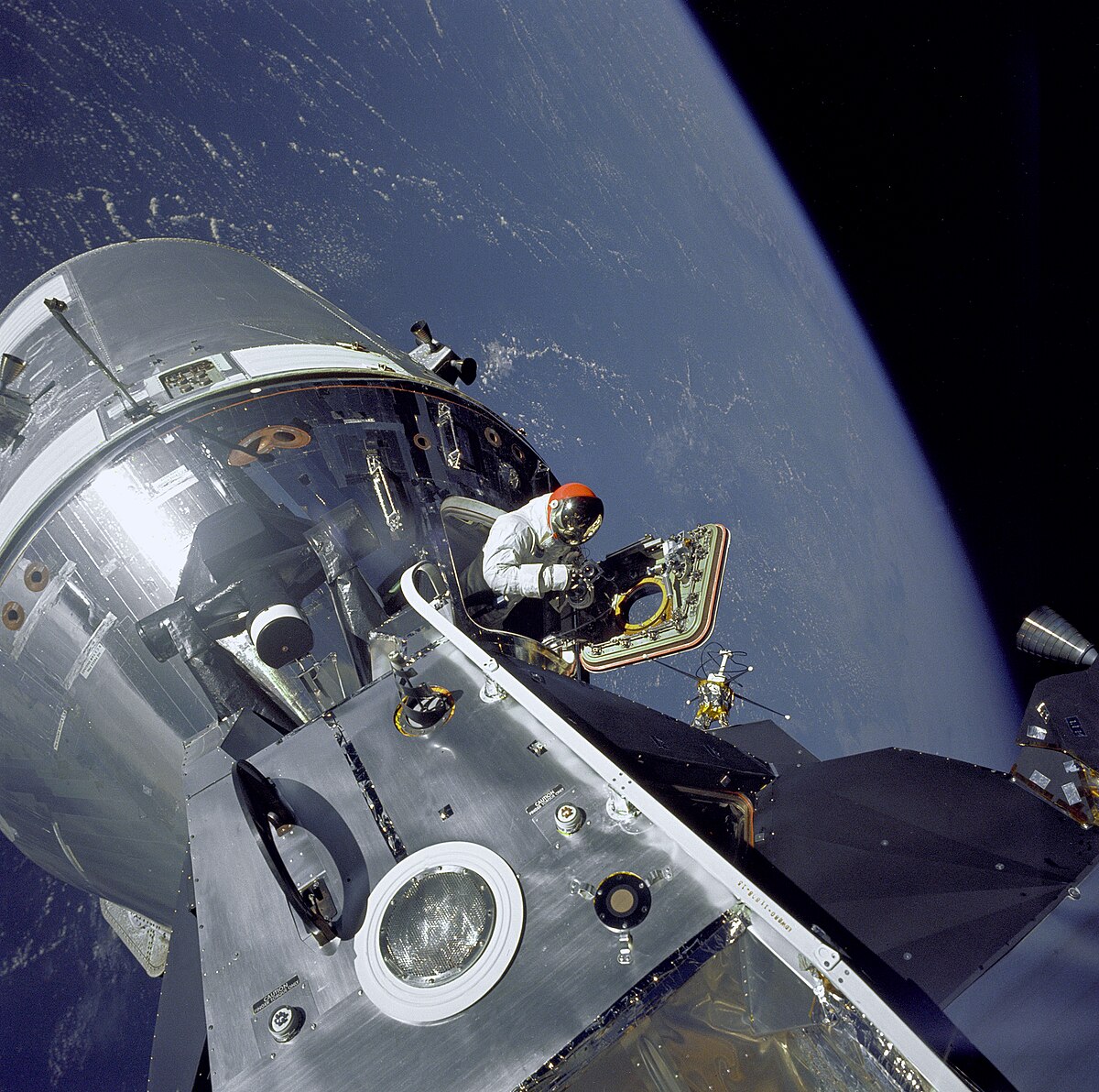
The test of the lunar module, originally scheduled for Apollo 8, was pushed to Apollo 9, flown in Earth orbit by James McDivitt, David Scott, and Russell Rusty Schweickart between March 3 and 13, 1969.
Daven HiskeyHOST
All the pieces came together on May 18, 1969, when Thomas Stafford, Gene Cernan, and John Young blasted off the launch pad.
Daven HiskeyHOST
As a full dress rehearsal, Apollo 10 saw the astronauts perform every step of the Apollo mission profile short of actually landing on the moon.
Daven HiskeyHOST
Three and a half hours later, with nearly 20% of the world's population watching live on television, Mission Commander Neil Armstrong climbed down the ladder of the Lem descent stage, stepped onto the lunar surface, and spoke the immortal words, "'That's one small step for man, one giant leap for mankind.'" He was soon joined by Lunar Module Pilot Edwin Buzz Aldrin, and the two set about the business of collecting geological samples, setting up experiments, planting the American flag, and the dozens of other tasks that they'd been assigned.
Daven HiskeyHOST
Due to the precarious nature of their pioneering mission, Armstrong and Aldrin walked on the lunar surface for only 2 hours 21 minutes and 40 seconds before climbing back onto the ELM, lifting off and rejoining Command Module Pilot Michael Collins back in lunar orbit.
Daven HiskeyHOST
the trio then began their journey back to earth splashing down in the pacific ocean on july the 24th and returning home to a hero's welcome and if for some reason you don't believe we actually landed on the moon or know someone who does why not check out our previous video how do we actually know we landed on the moon so now that nasa had proven it could land men on the moon and return them safely to the earth the apollo program entered a new phase focused on scientific exploration The various Apollo mission profiles were designated by a letter, with the unmanned Apollo 4, 5, and 6 missions being A and B type missions, Apollo 7 was a C mission, Apollo 8 a C Prime mission, Apollo 9 a D mission, Apollo 10 an F mission, and Apollo 11 a G mission.
Daven HiskeyHOST
An E-type mission, in which the Apollo CSM and LEM would be tested in medium Earth orbit, was originally planned but scrapped in favour of the more ambitious F-type mission of Apollo 10.

AnnaHOST
And if that sounds familiar, it should.
AnnaHOST
In March 1969, Apollo 9 took the lunar module up for its first crewed flight and tested it in Earth orbit.
AnnaHOST
Undocking, separation, rendezvous, and docking again.
AnnaHOST
All close to home where a problem could be survived.
AnnaHOST
Two months later, Apollo 10 went to the moon and flew down to within about 15 kilometers of the surface.
AnnaHOST
And then Apollo 11.
AveryHOST
Artemis 3 is Apollo 9, except this time there are two landers from two companies, and they're competing.
AnnaHOST
And that competition is the other half of yesterday's news, because the two companies now have quite different plans for actually getting crew to the surface on Artemis 4, which NASA is targeting for 2028.

AnnaHOST
And if that sounds familiar, it should.
AnnaHOST
In March 1969, Apollo 9 took the lunar module up for its first crewed flight and tested it in Earth orbit.
AnnaHOST
Undocking, separation, rendezvous and docking again.
AnnaHOST
All close to home where a problem could be survived.
AnnaHOST
Two months later, Apollo 10 went to the moon and flew down to within about 15 kilometers of the surface.
AnnaHOST
And then Apollo 11.
AveryHOST
Artemis 3 is Apollo 9, except this time there are two landers from two companies, and they're competing.
AnnaHOST
And that competition is the other half of yesterday's news, because the two companies now have quite different plans for actually getting crew to the surface on Artemis 4, which NASA is targeting for 2028.

Jared IsaacmanSOUNDBITE_SPEAKER
And in less than two months, that mission is going to fly, sending Frank Borman, Jim Lovell, and Bill Anders into lunar orbit.
Jared IsaacmanSOUNDBITE_SPEAKER
In the Vehicle Assembly Building, the Saturn V for Apollo 9 is already waiting.
Jared IsaacmanSOUNDBITE_SPEAKER
The Lunar Module, the LEM for Apollo 10, it's already been delivered.
Jared IsaacmanSOUNDBITE_SPEAKER
And in the midst of all of that mission activity I'm describing, nine months from now, the Eagle's going to land and Neil Armstrong and Buzz Aldrin will walk on the moon.
Jared IsaacmanSOUNDBITE_SPEAKER
And in less than two months, that mission's going to fly, sending Frank Borman, Jim Lovell, and Bill Anders into lunar orbit.
Jared IsaacmanSOUNDBITE_SPEAKER
In the Vehicle Assembly Building, the Saturn V for Apollo 9 is already waiting.
Jared IsaacmanSOUNDBITE_SPEAKER
The Lunar Module, the LEM for Apollo 10, it's already been delivered.
Jared IsaacmanSOUNDBITE_SPEAKER
And in the midst of all of that mission activity I'm describing, nine months from now, the Eagle's going to land, and Neil Armstrong and Buzz Aldrin will walk on the moon.

Soule GravyHOST
David
TalboHOST
Scott's a NASA astronaut who flew on Gemini 8, Apollo 9, and commander of Apollo 15 moon
Soule GravyHOST
missions.
Soule GravyHOST
I understand why.

John BatchelorHOST
Isaacman is good, but right now it looks like he's obeying Trump's imaginary timeline, not something that's practical.
John BatchelorHOST
They're leaving out what they learned with Apollo 9, which was to rendezvous and dock in Earth orbit.
John BatchelorHOST
So if there was something awry, they could get back down.
John BatchelorHOST
And then Apollo 10 did everything but land with men on board.

Matt SteinhausenGUEST
The space capsule.
Basil McJaggerGUEST
The space capsule was Apollo 9.
Basil McJaggerGUEST
It was on the Apollo 9 mission, and it was displayed outdoors outside Morrill Hall on the UNL campus from 1972 until 1991, where it endured weather wear and damage.
Basil McJaggerGUEST
90s.
Basil McJaggerGUEST
Oh, current location housed at the Strategic Air Command and Aerospace Museum in Ashland,

Mark GoberGUEST
Anyone can go read it.
Mark GoberGUEST
Quote, Aside from a few canisters of Apollo 9 telemetry tapes still stored, the Apollo era telemetry tapes no longer exist anywhere.
Mark GoberGUEST
What are we supposed to do with that,
Daniel VitalisHOST
Daniel? Just got rid of it all.
8 more episodes mention Apollo 9.
Create an account to see the whole feed, search across every transcript, and follow the entities you care about.