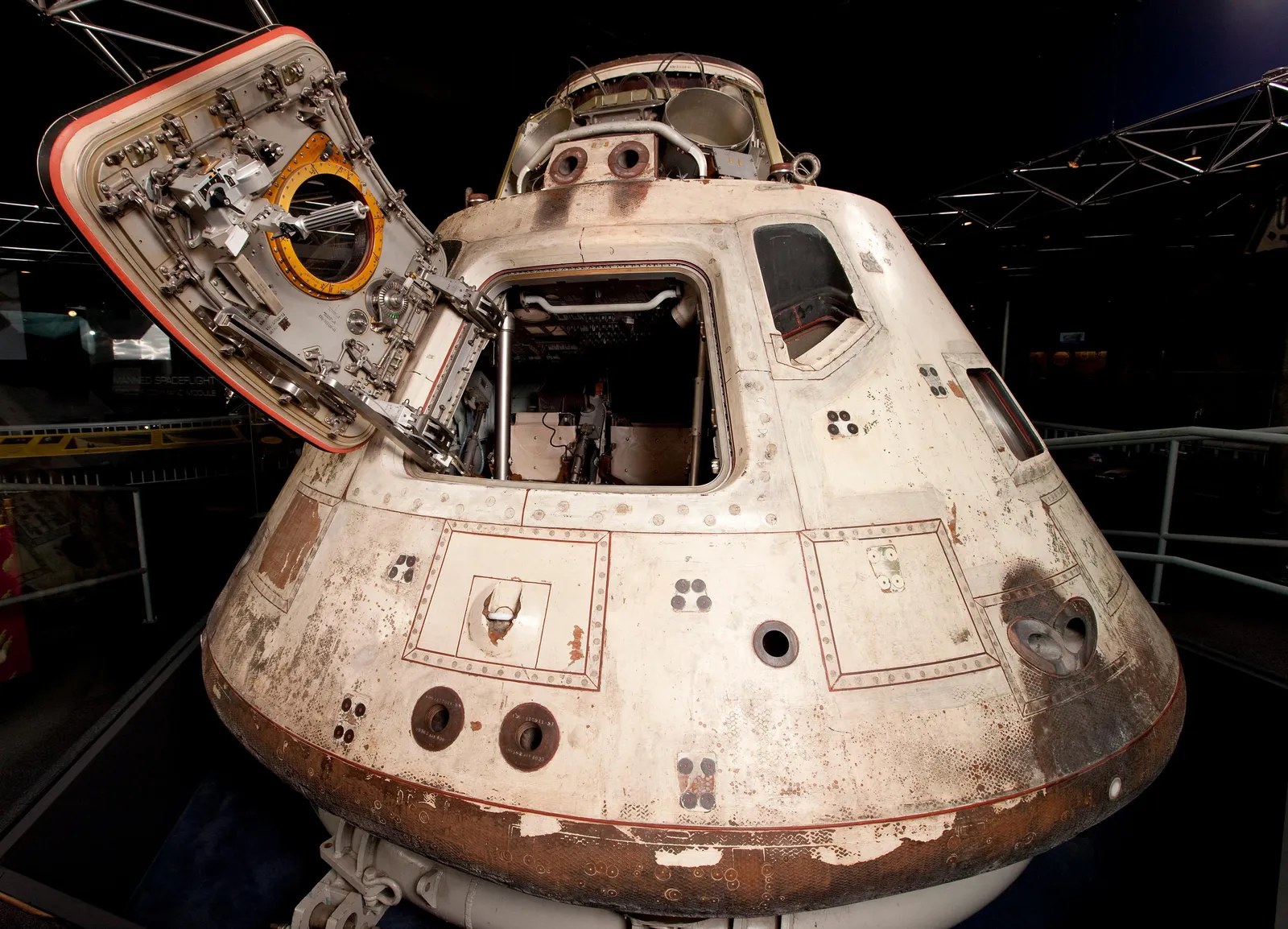
Apollo 8
Space missionWikipedia
161
MENTIONS
54
EPISODES
49
PODCASTS
Search complete. 161 mentions across 54 episodes found for "Apollo 8".
Oct 27, 2026

Ken HudnallHOST
During all the years of the Cold War, it was feared the Soviet Union had captured the Glock and would turn its power against the U.S. and its allies.
Ken HudnallHOST
These spheres weren't laid until 1968 when Apollo 8 published it in the Aristarchus Crater, photographed it in the Aristarchus Crater.
Ken HudnallHOST
The question became how it was smuggled out of Germany.
Ken HudnallHOST
It still remains a mystery to this day.

Daven HiskeyHOST
Seventy hours later, they entered lunar orbit, becoming the first humans to visit another world.
Daven HiskeyHOST
The test of the lunar module, originally scheduled for Apollo 8, was pushed to Apollo 9, flown in Earth orbit by James McDivitt, David Scott, and Russell Rusty Schweickart between March 3 and 13, 1969.
Daven HiskeyHOST
All the pieces came together on May 18, 1969, when Thomas Stafford, Gene Cernan, and John Young blasted off the launch pad.
Daven HiskeyHOST
As a full dress rehearsal, Apollo 10 saw the astronauts perform every step of the Apollo mission profile short of actually landing on the moon.
Daven HiskeyHOST
Three and a half hours later, with nearly 20% of the world's population watching live on television, Mission Commander Neil Armstrong climbed down the ladder of the Lem descent stage, stepped onto the lunar surface, and spoke the immortal words, "'That's one small step for man, one giant leap for mankind.'" He was soon joined by Lunar Module Pilot Edwin Buzz Aldrin, and the two set about the business of collecting geological samples, setting up experiments, planting the American flag, and the dozens of other tasks that they'd been assigned.
Daven HiskeyHOST
Due to the precarious nature of their pioneering mission, Armstrong and Aldrin walked on the lunar surface for only 2 hours 21 minutes and 40 seconds before climbing back onto the ELM, lifting off and rejoining Command Module Pilot Michael Collins back in lunar orbit.
Daven HiskeyHOST
the trio then began their journey back to earth splashing down in the pacific ocean on july the 24th and returning home to a hero's welcome and if for some reason you don't believe we actually landed on the moon or know someone who does why not check out our previous video how do we actually know we landed on the moon so now that nasa had proven it could land men on the moon and return them safely to the earth the apollo program entered a new phase focused on scientific exploration The various Apollo mission profiles were designated by a letter, with the unmanned Apollo 4, 5, and 6 missions being A and B type missions, Apollo 7 was a C mission, Apollo 8 a C Prime mission, Apollo 9 a D mission, Apollo 10 an F mission, and Apollo 11 a G mission.
Daven HiskeyHOST
An E-type mission, in which the Apollo CSM and LEM would be tested in medium Earth orbit, was originally planned but scrapped in favour of the more ambitious F-type mission of Apollo 10.

RichardHOST
and it's just the mores and everything else it just crunched there's something about the um the zeitgeist acknowledging that the calendars clicked over
StephenHOST
well this is it for me and again there's almost like a what was the 1960s equivalent of millennial anxiety so that the decade is coming to a close and the empire is coming to a close and britain as we understand it is sort of transforming into something lesser whilst the Americans are sending man to the moon in fact it's something like three weeks after this Apollo 8 lands on the moon and takes that photograph of the earth from the moon surf from the lunar surface um and you know obviously six months after that they actually land Apollo 11 on the moon and here's Britain um a very sort of gentile, comic, but also quite ludicrously sinister version of it as well, has been packaged up for an American audience where the British charm is the product, right? And they're kind of trading on those past...
StephenHOST
eccentricities as the uh the commodity that they're trading where as i say the americans are kind of the new superpower and there's that sort of sense of transition i spoke about the east of sewers before um but you know this is this is inherent i think into this episode in this episode the way that the ways of the past the old british music hall tradition is coming to a close being you know demolished in favor of a project cupid it is the And these terrible old hams who are losing their homes, losing their livelihoods, losing their culture, they can't accept that.
StephenHOST
And they would rather destroy the future than they would accept that the past is passing.

Richard HoaglandGUEST
So anyway, I got this catalog from one of our Mars mission members, and in going through it, I noticed something peculiar from Apollo 10.
Richard HoaglandGUEST
In these catalogs that have been published on every mission, going back now to Apollo 8, what NASA has done in consonance with the Charter is to publish voluminous amounts of data.
Richard HoaglandGUEST
You know, it's almost like one of those old Johnny Carson routines.
Richard HoaglandGUEST
Everything you ever wanted to know about an Apollo mission is contained within these covers.
Richard HoaglandGUEST
If you go from upper left to lower right, there's about a half a dozen pictures on each page, and you would have overexposed, blank, underexplosed, Okay, underexposed, blank, blank, overexposed.
Richard HoaglandGUEST
So-so, underexposed, blank, blank, blank, overexposed.
Richard HoaglandGUEST
And I began to compare that mission with the previous catalog from Apollo 8, where, with the exception of a couple three frames, every photograph was perfect.
Richard HoaglandGUEST
Then I got an Apollo 12 catalog, which contained the data... from the rendezvous and landing near the Surveyor 3 spacecraft by Alan Bean in the Sea of Storms in November of 69, the second lunar landing mission.

speaker_2ADVERTISER
Visit the website for full terms and conditions.
Dave FarinaHOST
In the previous video, we talked about the development of the legendary Apollo program.
Dave FarinaHOST
We discussed some of the innovations that were required to make it possible, reflected on the tragedy of the Apollo 1 fire, and then explored some of the uncrewed missions and test flights that got NASA back on its feet and ready to start sending humans back into space in the year 1968.
Dave FarinaHOST
The Apollo 1 fire really shook NASA to its core and forced a near-complete redesign of many internal systems aboard the Apollo command module.
Dave FarinaHOST
NASA and the main spacecraft contractor, North American Aviation, decided not to commit any Block 1 command modules to human flight and accelerated the development of the Block 2.
Dave FarinaHOST
This saw a whole host of improvements, from the wiring to the now outward opening hatch to the pressurization system that now used a mixture of nitrogen and oxygen on the ground and slowly purged the nitrogen during ascent, ultimately settling on a much lower pressure of pure oxygen atmosphere for the duration of the mission in space.
Dave FarinaHOST
As we discussed, the Apollo 1 fire was the result of a pure oxygen atmosphere at sea level pressure, resulting in catastrophic damage when a spark jumped from exposed wiring to a flammable material inside the spacecraft.
Dave FarinaHOST
The Block 2 would still use pure oxygen, but at a much lower internal pressure of 5 to 6 psi.
Dave FarinaHOST
But with the Soviet flight of Zond 5 in September, which propelled a pressurized spacecraft that contained live animals on a flight around the moon and back, it was time to take another huge gamble and send an Apollo crew of three American astronauts on a mission into lunar orbit.
Dave FarinaHOST
Less than six weeks before launch, the mission of Apollo 8 was revised and made dramatically more ambitious.
Dave FarinaHOST
Spacecraft commander Frank Borman and command module pilot Jim Lovell, two spaceflight veterans of the Gemini program, together with rookie Bill Anders, would become the first humans to ride the massive Saturn V moon rocket on only its third ever launch and fly a single Apollo command and service module on a mission to the moon.
Dave FarinaHOST
The plan was to orbit the moon 10 times and then return home.
Dave FarinaHOST
The decision by NASA to skip several planned missions and fly an occupied spacecraft to the moon reflected the very real fear and uncertainty that existed over the Soviet Union's capabilities, which often weren't matters of public record until after their successful realization.
Dave FarinaHOST
The particularly dangerous aspect of Apollo 8 had to do with the fact that the lunar module wasn't yet ready to fly.
Dave FarinaHOST
The CSM and the LEM are two separate vehicles, each with their own life support and propulsion systems.
Dave FarinaHOST
If something happened to the command and service module on the way to the moon, the astronauts might have been able to use the lunar module's engines to help return to Earth, and use its life support to keep themselves alive.

Barry LoudermilkGUEST
But what determines victory or defeat is the third element, and that's prayer.
Barry LoudermilkGUEST
And so as I saw, as I was researching everything from... 1746, up into the 20th century, from Washington's prayer at Valley Forge all the way up to the Apollo 8 space mission.
Barry LoudermilkGUEST
Every time we faced insurmountable odds, our national heroes, they planned, they worked, and then they prayed.
Barry LoudermilkGUEST
And so it was very fitting that it was published last year, July 4th of last year, because of our 250th anniversary as a country, which is unbelievable in itself because Every other nation that has ever formed a government similar to ours has only lasted about 7 to 11 years, and we've gone 250.

Clayton AndersonGUEST
There are two answers to that.
Clayton AndersonGUEST
My answer would be when I was about nine and I watched the Apollo 8 astronauts go behind the moon for the first time.
Clayton AndersonGUEST
My mom and dad awakened my brother and sister and I on Christmas Eve around midnight 30 and plunked us in front of a black and white TV to watch all that.
Clayton AndersonGUEST
But my mother, Alice, would have told you that I was six and that we discussed everything.

Jesse WeberHOST
When people ask why we should spend money exploring a distant moon, why we should be interested in space tourism, what is your answer to that? Is it worth it? What's it like? If there are options to explore the solar system in the future, should we all do it?
Terry HartGUEST
Well, you know, Jesse, it's in our DNA, isn't it? Yeah, I always liked the story of Apollo 8.
Terry HartGUEST
And it was the first mission to the moon that circled the moon.
Terry HartGUEST
They were so focused on taking photographs of the landing sites for the following missions that no one thought about the Earth.

Alex SteinGUEST
But what happened after should really tell the story is the fact that the telemetry data, the data that showed exactly where the spaceship was in the sky, was deleted by NASA.
Alex SteinGUEST
The fact that 1969 technology, if you actually go and listen to the recordings on Apollo 8, It was after Apollo 7, obviously.
Alex SteinGUEST
You can see, I forget the astronaut, but he plays music while they're in the lunar lander, when they're blasting off.
Alex SteinGUEST
You can hear the music perfectly, but you can't hear any of the engine from the 7-ton engine that they're sitting on.
44 more episodes mention Apollo 8.
Create an account to see the whole feed, search across every transcript, and follow the entities you care about.