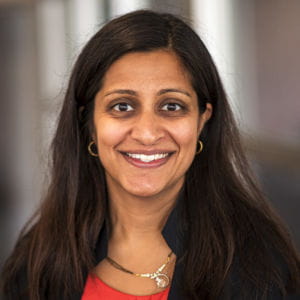
Aparna R Parikh
Researcher
2
APPEARANCES
2
PODCASTS
Sep 16, 2026


Aparna ParikhGUEST
I'm of Indian origin, and I come from kind of a legacy of a family that has been in medicine or public health.
Aparna ParikhGUEST
And I spent childhoods every summer, the entire summer, being in India practicing.
Aparna ParikhGUEST
And I think was exposed very early to just the tremendous disparities of healthcare.
Aparna ParikhGUEST
And I think had family members that, you know, spent their lives to trying to close that equity gap.
10 MINS LATER

Kerry AdamsHOST
And how do you go about in your work Or how would you recommend we go about understanding or getting to understand what those local barriers and issues are, the cultural barriers, the way that health systems established? What is your process? How do you go through that?

Aparna ParikhGUEST
So I mean, just to level set a little bit, circulating tumor DNA in colorectal cancer, and actually across many solid tumors, has Really emerged as one of the most powerful and strongest prognostic biomarkers.
Aparna ParikhGUEST
So time and time again, it really trumps any T-staging, nodal staging, and particularly in stage two colorectal cancer where this study has been evaluating the use of ctDNA, multiple studies that have shown ctDNA being highly prognostic with hazard ratios nearly reaching twenty or twenty-plus in some study sets.
Aparna ParikhGUEST
And what we've seen to date is that observational data has suggested there may be benefit from adjuvant chemotherapy in ctDNA-positive patients.
Aparna ParikhGUEST
But no study to date has actually read out positive to actually show that the use of adjuvant chemotherapy in a stage two patient population changes outcomes.
Aparna ParikhGUEST
By way of other background, the current stage two largest data was out of Australia and was a dynamic study, and dynamic didn't look at actually guiding treatment escalation.
8 MINS LATER

Nilo AzadHOST
Why don't we move on to adjuvant therapy in colon cancer with aspirin? So I'd love to hear your thoughts on the EPISODE study.