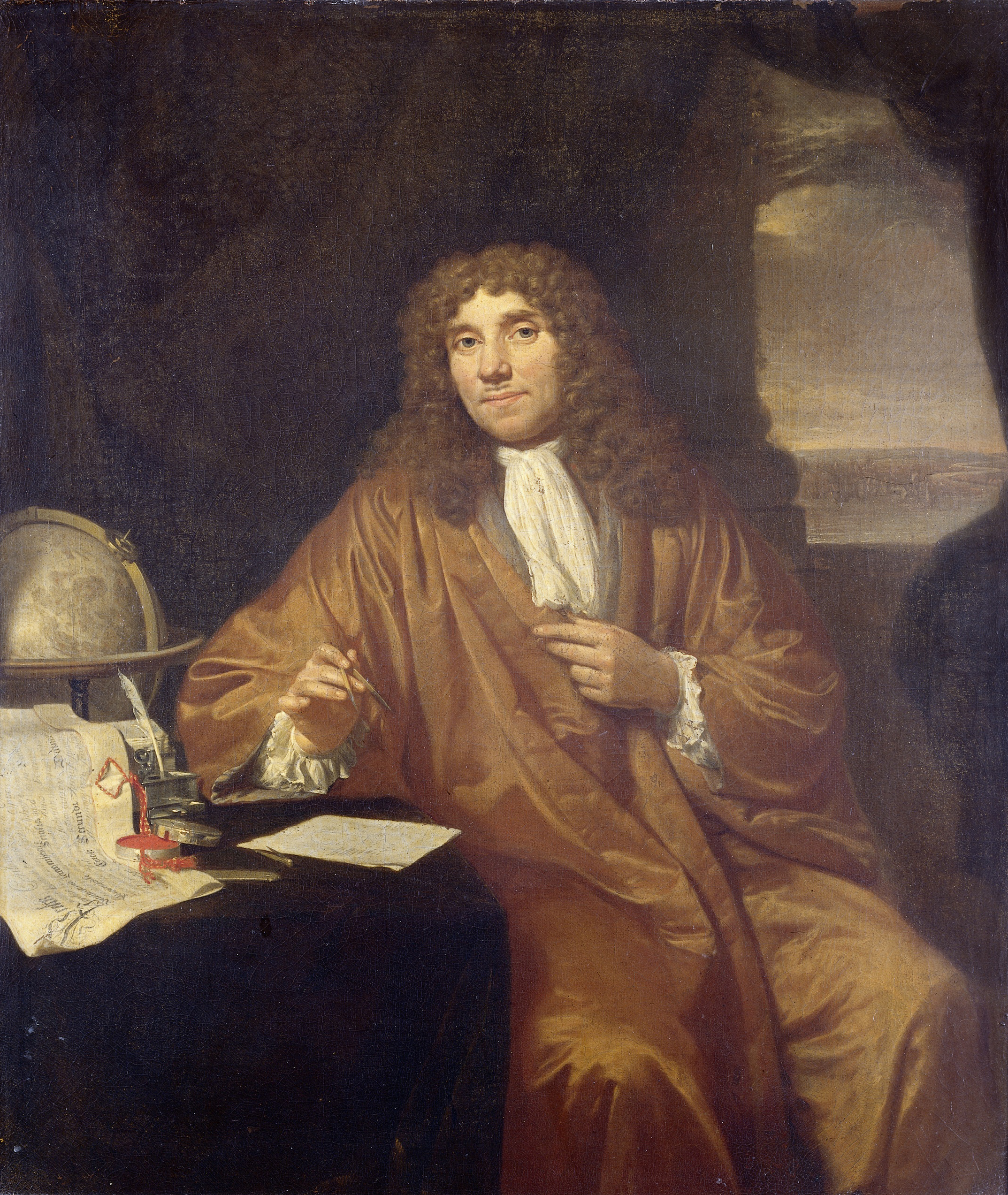
Antonie van Leeuwenhoek

Antonie van Leeuwenhoek

Dutch microbiologistWikipedia

Search complete. 46 mentions across 21 episodes found for "Antonie van Leeuwenhoek".

Oct 27, 2026

John RainHOST
44:09
She says, I'd like to know more about him.
John RainHOST
44:13
She goes, that resonator is a work of genius, though, isn't it? She says, this is the greatest discovery since Van Leeuwenhoek first looked through a microscope and saw an amoeba.
John RainHOST
44:24
Dean, is that right?
Dean BurnettGUEST
44:26
I don't think that's the first thing you go to.

Unknown podcast

How to Culture Live Fish Food at Home | Brine Shrimp, Daphnia, Microworms & More

Oct 26 · 1 Mention

speaker_1HOST
16:43
Yeah.
speaker_1HOST
16:43
The word dates back centuries to the earliest days of microscopy with Anton van Leeuwenhoek.
speaker_1HOST
16:48
Historically, it referred to the microscopic life that spontaneously appeared in a hay infusion, literally taking dried grass or hay and infusing it in water.
speaker_0HOST
16:57
OK.
Kyle WoodHOST
5:01
It's the first documented discovery of blood cells.
Kyle WoodHOST
5:05
A few years later, in 1674, Anton van Leeuwenhoek recorded precise technical descriptions and measurements of human red blood cells.
Kyle WoodHOST
5:15
Van Leeuwenhoek calculated that a person's red blood cells were about 25,000 times smaller than a typical grain of sand.
Kyle WoodHOST
5:25
And most importantly, he showed that blood consists of solid elements suspended inside a clear liquid matrix known as plasma.
speaker_0NARRATOR
77:05
401.
speaker_0NARRATOR
77:06
Bacteria A.N.D. disease in the middle of the 17th century men learned, through the eyes of Leeuwenhoek, that drops of water contained moving animalcules.
speaker_0NARRATOR
77:15
402.
speaker_0NARRATOR
77:16
The Essays of Adam Smith.
AvailleNARRATOR
3:16
Soon, however, great steps were taken, and one of these may be called the discovery of the invisible world of life.
AvailleNARRATOR
3:25
The pioneer explorer was surely the Dutch observer Leeuwenhoek, 1632 to 1723, who discovered minute creatures like the rotifers or wheel animalcules, which are common in ponds, and the infusorians, which abound wherever vegetable matter rots away in water.
AvailleNARRATOR
3:44
He made numerous microscopes, and though they had neither tube nor mirror, they were sufficient to enable him to demonstrate his animalcules before the Royal Society of London, the fellows signing an affidavit that they had seen the little creatures.
AvailleNARRATOR
4:00
It was Leeuwenhoek also who, in 1687, discovered bacteria, the very minute organisms which cause all putrefaction, are responsible for bringing about many diseases, and are yet of immense service to many living creatures.
AvailleNARRATOR
4:18
It was not till long afterwards that Pasteur and others demonstrated the importance of bacteria, but it was a great event in the history of science when Leeuwenhoek first proved their presence.
AvailleNARRATOR
4:31
It was literally the discovery of a new world with a teeming population with incalculable powers for good and evil.
AvailleNARRATOR
4:39
It must have been a seed in the human mind, this idea of an intense activity going on all unseen until men stuck lenses of glass in front of their own.
AvailleNARRATOR
4:51
Another great event, though its importance was not recognized till afterwards, was the discovery of the male elements or spermatozoa of animals which fertilize the egg cells so that these may begin to develop.
Fin TaylorHOST
16:43
So, uh, Robert Hooke, English scientist, peers through a microscope at a slice of cork in the year 1665.
Fin TaylorHOST
16:49
He discovers tiny compartments in the cork, which he calls cells, and nine years later, Antonie van Leeuwenhoek built microscopes so powerful they could actually see actual cells, right? So he scrapes plaque from his own teeth and discovers swimming bacteria and, uh, his own sperm.
Fin TaylorHOST
17:06
So he-
Horatio GouldHOST
17:07
Brian Johnson.

Unknown podcast

History of Biology-Louis Compton Miall

Oct 10 · 5 Mentions

speaker_2UNKNOWN
46:18
he improved upon hook's account of the structure of a feather and his magnified figures of a bit of an ordinary quill and of a bit of an ostrich plume might be inserted into any modern treatise on animal structure the second of the two has actually been so treated but without mention of perrault's name pupar followed the later stages of the development of a feather mairie gave him a new yet animated description of the woodpecker's tongue explaining how it is rendered effective for the picking up of insects how it is protruded and retracted how it is stowed away when not in use tornafort figured the oblique fibres of a leguminous pod which he called muscles and showed how they twist the valves and squeeze out the seeds natural theology was much in the thoughts of the naturalists who studied and wrote between sixteen sixty and seventeen forty ray discoursed upon the wisdom of god as manifested in the creation swammerdamm regularly closed the divisions of his biblia naturie with expressions of pious admiration a long list of books expressly devoted to the same theme might be given see krauss's life of aramis darwin one weakness of the natural theologians was their habit of looking upon the universe as existing for the convenience of man still more fatal was the partiality with which they stated the facts while they dwell upon the adaptations which secure the welfare of particular animals or plants they are silent about the sufferings caused by natural processes spontaneous generation during many ages every naturalist thought that he had ample proof of the generation without parents of animals and plants he knew that live worms appear in tightly closed flasks of vinegar that grubs may be found feeding in the cores of apples which show no external marks of injury and that weeds spring up in gardens where nothing of the sort had been seen before certain kinds of animals and plants are peculiar to particular countries what more likely than they should be the offspring of the soil fables and impostures supported what all took to be facts of observation the great name of aristotle was used to confirm the belief that insects were bred from putrefaction eels and the fishes called amphi from the mud of rivers a belief in the process of transmutation was often combined with a theory of spontaneous generation francis bacon not only held that insects were born of putrefying matter but that oak boughs stuck in the earth produced vines towards the end of the seventeenth century it occurred to one inquiring mind that a particular case of spontaneous generation which had been accepted by everybody without hesitation was capable of a less mysterious explanation francesco ready sixteen twenty six to sixteen ninety eight physician to the duke of tuscany published in sixteen sixty eight an account of his experiments on the generation of blow-flies he found that the flesh of the same animal might yield more than one kind of fly while the same fly might be hatched from different kinds of flesh he saw the flies laying their eggs in flesh and dissected eggs out of their ovaries when he kept off the flies by gauze the flesh produced no maggots but eggs were laid on the gauze reddy concluded that flies are generated from eggs laid by the females he also studied insect galls and the worms which feed on growing seeds like earlier observers he was baffled by finding live grubs in galls or nuts which were apparently intact and by the parasitic worms which are now and then found in the brain case and other closed cavities of quadrupeds such instances led him to jump at the supposition of a vivifying principle which generated living things of itself a supposition contrary to the truer doctrine which he taught elsewhere was able to explain how the egg is introduced into the rosegull which a little later shows no mark of injury while malpighi examined the young nut and found both hole and egg How parasitic worms reached the brain case of the sheep could be explained only in a later age.
speaker_2UNKNOWN
50:34
Meanwhile, Swammerdam, Leeuwenhoek, Reumur, and many other special students confirmed and extended Reddy's experiments on the blowfly, and every fresh instance of normal generation in a minute organism did something to weaken the belief in spontaneous generation.
speaker_2UNKNOWN
50:51
Late in the 18th century, that belief revived in a form less easy of refutation.
speaker_2UNKNOWN
50:57
lewenhoek had discovered that organic matter putrefying in water often yielded abundance of microscopic organisms of the most diverse kinds many of which could resist drying in air and resume their activity when moistened again buffon ever ready with a speculative explanation maintained that such minute organisms were spontaneously generated and that they were capable of coalescing into bodies of larger size and more complex structure needham supported buffon's theories by experiments taking infusions of meat corking them and sealing them with mastic he subjected them to a heat which he thought intense enough to destroy life after an interval the microscope revealed an abundance of living things which he affirmed to have been generated from dead matter spallanzini repeated needham's experiments with stricter precautions sealed his flasks by fusing their necks in a flame and then immersing them in boiling water until they were heated throughout the infusions in such flasks remained limpid no scum formed on the surface no bad smell was given off when they were opened and no signs of life could be detected by the microscope to meet the objection that the vegetative force of the infusions had been destroyed by long heating he simply allowed air to enter when the micro-organisms quickly reappeared spallanzani's methods though far better than any which had been employed before were not quite unimpeachable and could not be relied upon in an atmosphere rich in germs but they suffice to create a strong presumption that life is set up in infusions by germs introduced with the air this was by no means the end of the controversy which broke out again and again until it was laid to rest whether finally or otherwise it would be unwise to predict by the experiments of pasteur The Natural History of John Ray The sixteenth, seventeenth, and eighteenth centuries each possessed at least one naturalist of wide learning and untiring diligence, who made it his care to collect information concerning all branches of natural history, to improve system and to train new workers.

22 MINS LATER

speaker_2UNKNOWN
75:22
of a moth the first full account that was ever given he tells us that all moths have not an effective proboscis though he does not explain how some of them can dispense with what seems so necessary an organ this omission has been made good by later entomologists the proboscis he goes on springs from the head just between the compound eyes when at rest it takes up very little room for it is spirally rolled like a watch-spring in some cases it makes as few as one and a half or two turns in others as many as eight or ten the base is often concealed by a pair of hairy palps which serve as feelers careful study of a moth as she flits from flower to flower shows that she alights on the plant unrolls her proboscis passes it into the corolla and withdraws it perhaps coils it for an instant and then plunges it again into the tube when this manoeuvre has been repeated several times the moth flies off to another flower some moths have a tape-like proboscis in others it is cylindrical it can be made to protrude by gentle pressure on the head or be unrolled by a pin passed into the centre of the spire it is composed of innumerable joints and tapers from the base to the tip when forcibly unrolled it often splits lengthwise into halves at the time of escape from the chrysalis the halves are always free and they require careful adjustment in order that a continuous sucking tube may be obtained a newly emerged moth may be seen to roll and unroll its proboscis repeatedly until at last the halves cohere in the proper position sometimes they begin to dry before the operation is completed the half tubes get curled and then the unfortunate moth becomes incapable of feeding at all each half is a demi canal whose meeting edges interlock by minute hooks the mechanism reminds reaumur of that which connects the barbs of a feather in both cases the hooks can be adjusted rapidly and completely by stroking from base to tip and in both a water-tight junction is obtained besides the central canal along which fluids are sucked up there are lateral canals trache filled with air reaumur was careful to correct his anatomical studies by close observation of the live insect he reared an angle shades moth which he kept several days without food when he saw it repeatedly extending its proboscis he put it near a piece of sugar the moth at once began to suck and became so absorbed in satisfying its hunger that it allowed raimur to carry it on a sheet of paper to a window and to examine it closely with the lens the proboscis was sometimes extended for several minutes at a time and then rolled up for an instant its tip was either employed in exploring the surface or closely applied to the sugar by means of the lens a slender column of liquid was seen to pass along the central canal towards the head now and then however a limpid fluid was seen to pass down the proboscis this was the saliva which was used to moisten the sugar and then sucked up again the budding out of new animals hydra another form of propagation without mating aphids in the year seventeen forty four a young genovese abraham trembly tutor in the family of bentic who was then english resident at the hague rose into sudden fame by a solid and well-timed contribution to natural history trembley and his pupils used to fish for aquatic insects in the ponds belonging to the residents and in the summer of seventeen forty he happened to collect some water weeds which he put into a glass vessel and set in a window when the floating objects had come to rest a small green stalk barely visible to the naked eye was found attached to one of the plants from one end of the stalk filaments or tentacles were seen to project and these moved slowly about when the vessel was shaken the stalk and tentacles contracted but soon extended themselves again was this object a plant or an animal its shape and colour were those of a plant and sensitive plants were known which drooped when touched or shaken further observation showed that it could move from place to place which favoured the animal interpretation trembly determined to cut the stalk in two if the halves lived when separated the fact would favour the plant theory the halves at first gave no signs of life beyond occasional contraction and expansion but after eight days small prominences were seen on the cut end of the basal half next day the prominences had lengthened on the eleventh day they seemed to be growing into tentacles before long eight fully formed tentacles were visible and trembly had two complete specimens in place of one both were able to move about After four years of observation, a handsome quarto volume was published, which told the history of the freshwater polyp, a name suggested by Réumur.
speaker_2UNKNOWN
80:22
The Latin name of Hydra was given by Linnaeus.
speaker_2UNKNOWN
80:25
Hydra had been discovered and slightly described forty years before by Leeuwenhoek, who had seen two young polyps branching from one parent and spontaneously becoming free.
speaker_2UNKNOWN
80:36
Tremblay made out all that a simple lens guided by a skillful hand and a keen eye could discover.
Dave FarinaHOST
83:33
What the fuck are you talking about? We t- we made telescopes, and we go, "What the shit is there? Look at all the stuff I'm looking at." We built microscopes.
Dave FarinaHOST
83:42
You look in the microscope, and fucking Leeuwenhoek and like the first people that used microscopes were like, "Wow, there are like little animalcules.
Dave FarinaHOST
83:53
There are little alive things.
Dave FarinaHOST
83:55
What's that?" They didn't dream up bacteria and, and, uh, and, and, uh, pro- protists and stuff.
Kriben GovenderHOST
18:24
So how's the lay person supposed to decide what's the best? option for them and my advice is work it out you know your body use your intuition and you'll come to a good place so ken we'll move on so the next sort of follow-up question and this will lead nicely into the fermented foods is how did those ancient peoples think about fermented foods in that period of time
Ken AlbalaGUEST
18:54
well they really did not understand microbes Even though they'd seen them, you know, from starting in the 17th century, Leeuwenhoek and Robert Hooke saw what they called animalcules, tiny little, little, you know, bacterium and paramecia and things like that, and blood cells even.
Ken AlbalaGUEST
19:17
They didn't know what they were.
Ken AlbalaGUEST
19:19
They just thought these are tiny little organelles or something that in the water.
Marvin BoltGUEST
16:24
The first detailed microscopic illustrations were produced by Robert Hooke and his Micrographia.
Marvin BoltGUEST
16:30
Inspired by it and the usefulness of microscopes for his own trade, cloth merchant Anthony van Leeuwenhoek crafted his own lenses.
Marvin BoltGUEST
16:39
Each of his microscopes, It's a replica, it's not the real one.
Marvin BoltGUEST
16:44
Trust me, I'd love to have a real one.
Marvin BoltGUEST
17:00
Don't put the pointy side near your eye.
Marvin BoltGUEST
17:05
I'll say it again, but I don't want anybody to sue me.
Marvin BoltGUEST
17:08
All right, van Leeuwenhoek explicitly described his own drawings as experimental and acknowledged that he could not depict the perfection of the things he was seeing.
Marvin BoltGUEST
17:18
We know them as bacteria found in dental plaque, red blood cells, sperm cells, as well as the more prosaic sand grains shown here.

11 more episodes mention Antonie van Leeuwenhoek.

Create an account to see the whole feed, search across every transcript, and follow the entities you care about.

We value your privacy

We use cookies to understand how you use our platform and to improve your experience. Click “Accept All” to consent, or “Decline non-essential” to opt out of non-essential cookies. Read our Privacy Policy.