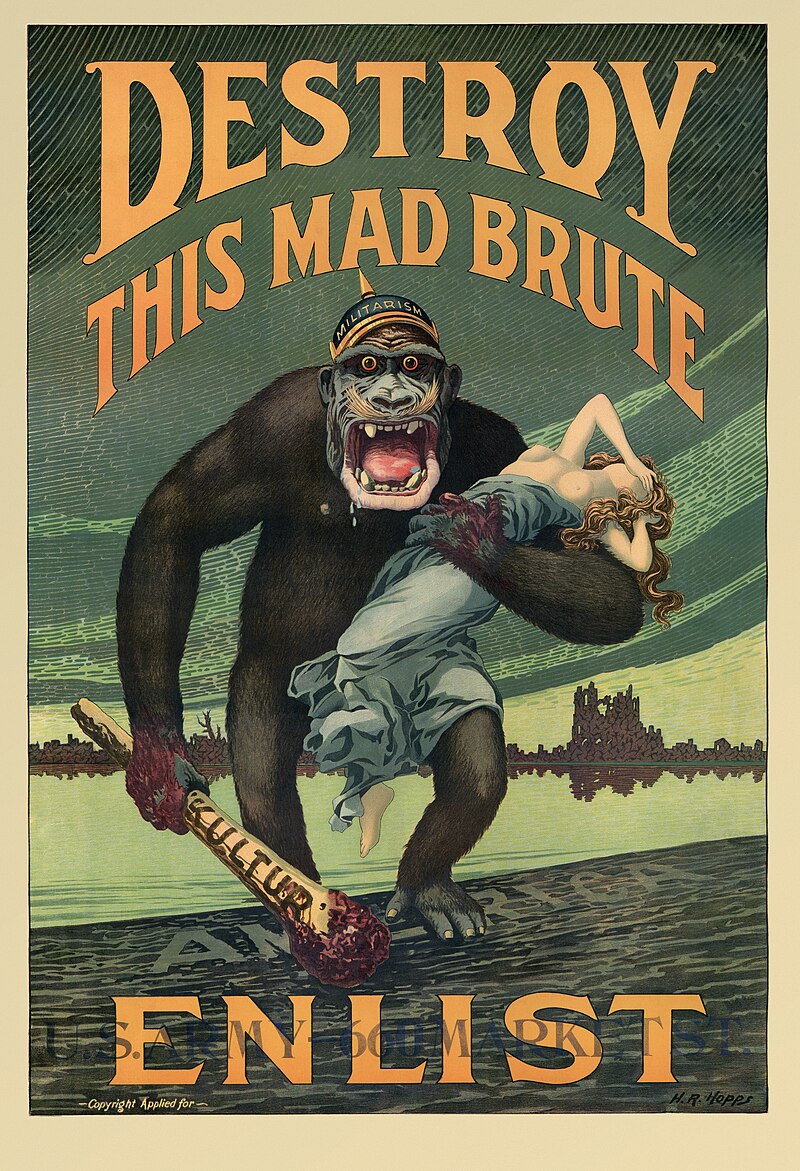
Anti-German sentiment
54
MENTIONS
33
EPISODES
27
PODCASTS
Search complete. 54 mentions across 33 episodes found for "Anti-German sentiment".
Nov 6, 2026

Alex BernardoGUEST
So they didn't have to go out into the field and fight.
Alex BernardoGUEST
And then in 1918 and 1919, at the height of, even after the war ended, at the height of kind of anti-German sentiment in the United States, he had the audacity to write very publicly that Americans had gone too far in stigmatizing Germans and mistreating Germans.
Alex BernardoGUEST
And for that, he lost his job teaching at the university he was working in.
Alex BernardoGUEST
Now, ultimately, he wound up receiving a Nobel Peace Prize for his efforts in the 19-teens because of what he had to sacrifice.

Thomas777GUEST
had been founded initially as a monastic institution in the 14th century.
Thomas777GUEST
It... by the 20th century, particularly, you know, this was kind of the, this kind of the peak of the progressive era, like a tail end in the UK, um, like public secondary school, it'd be kind of become this like revered ideal, you know, and it was part of that was, uh, despite, uh, You know, from the Disraeli from Disraeli's tenure on or Disraeli himself was in particularly Germanophobic.
Thomas777GUEST
But from that period onward, there was this tendency to talk about, you know, the Kaiser Reich like it was lacking in every way compared to the UK.
Thomas777GUEST
in cultural terms, you know, there was a suggestion it was actually culturally impoverished.

ThomasGUEST
It had been founded initially as a monastic institution in the 14th century.
ThomasGUEST
It... by the 20th century, particularly, you know, this was kind of the, this kind of the peak of the progressive era, like a tail end in the UK, um, like public secondary school, it'd be kind of become this like revered ideal, you know, and it was part of that was, uh, despite, uh, You know, from the Disraeli from Disraeli's tenure on or Disraeli himself was in particularly Germanophobic.
ThomasGUEST
But from that period onward, there was this tendency to talk about, you know, the Kaiser Reich like it was lacking in every way compared to the UK.
ThomasGUEST
in cultural terms, you know, there was a suggestion it was actually culturally impoverished.

RyanHOST
And this is what I find so funny about this.
RyanHOST
The Germans believed that it was too anti-German.
KyleHOST
Yeah.
RyanHOST
While France claimed it was too anti-war.
RyanHOST
Okay.
RyanHOST
So, and both of these things could be true.
RyanHOST
Maybe it is anti-German and anti-war, but it's just that, like, that is proof that, like, two opposite sides of this are, like, well, not opposite sides, but two different countries are viewing this differently.
RyanHOST
Right, right.

KeeganHOST
By the time Nietzsche published Human All Too Human, these doubts had developed into a full rejection of Germanism that would characterize the entirety of Nietzsche's career.
KeeganHOST
Many things change from this period in Nietzsche's thought, but he's anti-German for the rest of his career.
KeeganHOST
But if Nietzsche was saying no to German-ness, what was he saying yes to? And at least during this time, what Nietzsche embraced, instead of German Romanticism, was French Enlightenment.
KeeganHOST
It was reason, it was naturalistic explanations of the physical world, it was incisive psychological analysis of human action, it was a rejection of both the metaphysical pessimism of Schopenhauer and the insipid optimism of Leibniz.

Bill TancredGUEST
Marlene Dietrich as well, all entertaining the troops, etc.
Bill TancredGUEST
Very anti-German.
Bill TancredGUEST
And so women did play their part in a big way.
Bill TancredGUEST
So, yes, it's great.

Mark PainterHOST
Try to imagine the feelings of the Red Army soldiers who marched through Warsaw, especially the members of the Polish People's Army.
Mark PainterHOST
Soviet soldiers were already receiving a steady diet of anti-German propaganda, including through the Red Army's newspaper Krasnaya Zvezda, which means Red Star, and most notably in the columns of the Jewish-Russian author and poet Ilya Ehrenberg.
Mark PainterHOST
Shortly after the German invasion began, Ehrenberg was invited to contribute a regular column to Krasnaya Zvezda.
Mark PainterHOST
His essays appeared in Pravda and other civilian publications as well.
12 MINS LATER
Mark PainterHOST
One reason is the deprivations and the poor treatment the soldiers themselves endured.
Mark PainterHOST
There were the horrors these soldiers witnessed, the remains of German war crimes, as they retook the territory of their homeland.
Mark PainterHOST
There was the relentless anti-German propaganda, which often emphasized German soldiers raping women of the Soviet Union, which did indeed happen frequently.
Mark PainterHOST
Red Army soldiers may have concluded it was payback time.
Thomas777GUEST
And I'll get into why in a minute.
Thomas777GUEST
Bismarck was never able to realize that, but what he did do The establishment of what was called the Mediterranean Agreements, the practical effect was creating an adjacent security concord with the UK, okay? And that, coupled with the reinsurance treaty with Russia when it was in effect, that had the effect of freezing France out of any potential anti-German coalition.
Thomas777GUEST
Because for it to attempt to develop such a competing alliance, like any potential party signatories, it would be in direct violation and frustration of purpose of the express conditions of a treaty that was in effect with Germany.
Thomas777GUEST
And in material terms, it would be self-defeating in various ways.
1 HR 13 MINS LATER
Thomas777GUEST
But, um, be as it may, um, it, uh, France came out a big winner in Indochina owing to British concessions and basically like London was able to buy, buy French goodwill in that way.
Thomas777GUEST
Okay? Um, but I mean at the same-- So I mean these, um, what, what became the Entente Cordiale, uh, I'm sure I butchered that as the French called it in 1904.
Thomas777GUEST
This wasn't primarily like an anti-German agreement.
Thomas777GUEST
Like, I mean, the French base-- And the French realized that, I mean, uh, for, for the preceding, you know, for the, for the preceding millennia, I mean, it was, they were intermittently at war with, with Britain.
ThomasGUEST
He said, quote, or the Balkans are, quote, "Not worth the healthy bones of one Pomeranian musketeer." Now, that was not realistic, but the appearance of balanced diplomacy was maintained, and that was what was key, okay? He didn't issue some belligerent statement, you know, saying that there's a line in the sand, and if any dirty slob crosses it, you know, into Croatia or, you know, across the or becomes within sight of the Bosnian frontier, you know, like we're going to, you know, we're going to go to war to, you know, defend our Volkswagens in the Habsburg Empire.
ThomasGUEST
So, I mean, again, like he was the point the point is not the merit of that statement or realistic that statement was it was what was he telegraphing the Russians and the British for that matter too the British interest in the in the Balkans is is obviously totally different than they are the Russians but if you can't move in the Balkans you you can't dominate the Mediterranean but another another big coup when the Russians went to war with the Ottomans 1877 78 that that triggered a major international crisis which on the one hand was remote from Europe in terms of the theater in which it occurred but Europe was impacted in power political terms directly and indirectly in all kinds of ways Bismarck insinuated himself as a mediator over the post-war settlement and he made absolutely no he sought no direct concessions for Germany and he became hailed as this great kind of like man of peace you know like it was a he telegraphed essentially that European peace and German security were synonymous like and again this was a perception whether you believe it or not it's not important like people kind of accepted not kind of people did accept this this view you know that's how they read that's how they read the outcome as having developed okay and this was possible because again by the end the by the last three years of Bismarck's tenure 1887 to 1890 Germany was tied by express agreements of one form or another you know whether they were you know direct military treaties or whether they were you know treaties facilitating deep interdependence on trade or whether they were you know agreements declaring maritime rights Germany was tied one way or another to virtually every continental power the triple most significantly of this era was a triple alliance between Germany Austria-Hungary and Italy it was a it was codified on May 20th 1882 it provided that Germany and the Habsburg Empire would resist Italy if it was attacked by France quote without provocation in turn Italy would assist Germany if if attacked by France and in the event of a war between the Habsburg Empire and Russia Italy declared neutrality now the ultimate ambition of this Bismarck's ambition was to bring the UK into this triple alliance okay and that always that that always was the intended master stroke of German diplomacy that's what Ribbentrop was trying to accomplish decades later okay and that was that wasn't outlandish and I'll get into why in a minute Bismarck was never able to realize that but what he did do the establishment of what was called the Mediterranean agreements the practical effect was creating an adjacent security concord With the UK, okay? And that coupled with the reinsurance treaty with Russia, when it was in effect, that had the effect of freezing France out of any potential anti-German coalition.
ThomasGUEST
Because for it to attempt to develop such a competing alliance, like any potential party signatories, it would be a direct violation and frustration of purpose of the express conditions of a treaty that was in effect with Germany.
ThomasGUEST
And in material terms, it would be self-defeating in various ways, you know, owing to the underlying catalyst for these treaties with those countries that had provided them tangible benefits.

David HarrisHOST
And by the way, when it comes to aid for Israel that somehow deprived those poor consumers in the US supermarket of eggs and bananas, let's remember a few things.
David HarrisHOST
The United States spends many more billions of dollars in our true presence and defense of Germany of Japan and of South Korea than we do with respect to Israel, and you don't hear a word from anyone, much less anything terrifyingly anti-German, anti-Japanese, or anti-Korean.
David HarrisHOST
Moreover, when it comes to aid to Israel, let's all remember that all but a tiny share of that aid is spent right here in the United States.
David HarrisHOST
It never leaves the American shores.
23 more episodes mention Anti-German sentiment.
Create an account to see the whole feed, search across every transcript, and follow the entities you care about.