Anti-Ballistic Missile Treaty
26
MENTIONS
17
EPISODES
15
PODCASTS
Search complete. 26 mentions across 17 episodes found for "Anti-Ballistic Missile Treaty".
Oct 24, 2026

Ray McGovernGUEST
And I finally found the job down there, but I felt so euphoric.
Ray McGovernGUEST
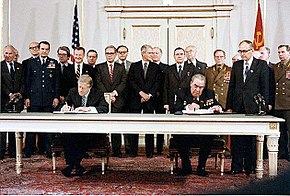
I mean, I had felt euphoric when I was in Moscow for the signing of the Anti-Ballistic Missile Treaty in 1972.
Ray McGovernGUEST
My branch, the branch that I led there on Soviet foreign policy were instrumental in helping Nixon and Kissinger figure out, well, is this possible? Do they really want to do this? And we told them, yes, partly because they were afraid that China will steal a march on them have better relations with you than they do.
Ray McGovernGUEST
So it was really complicated, but not so much.

Jeffrey SachsGUEST
I say that because I believe that The intention of the United States from the early 1990s, and this is based on a huge documentary record that is voluminous and many, many books, including your excellent books, is that the United States should have primacy or... hegemonic power in Eurasia and that Russia should be subordinate to that and that this configuration will be brought about by the expansion of NATO.
Jeffrey SachsGUEST
The abandonment by the United States of nuclear arms agreements, starting with the U.S. abandonment of the Anti-Ballistic Missile Treaty in 2002, on a unilateral basis, unprovoked to the strong opposition of Russia.
Jeffrey SachsGUEST
the placement of U.S. missile systems all across Eastern Europe, the Aegis missile systems, which Russia has strenuously objected to during this whole period, and the expansion of European political institutions, notably membership of the European Union, which itself would be increasingly aligned with NATO, which it is in its entirety.
Jeffrey SachsGUEST
treaties and its internal organization now.

John BoltonGUEST
And I can tell you from my own experience, In the early 2000s in the Bush administration, our marching orders were to try and bring the Russians closer.
John BoltonGUEST
When we withdrew from the 1972 Anti-Ballistic Missile Treaty to build a national missile defense, I was arguing to the Russians they should withdraw from it too, and we would share our technology with them.
John BoltonGUEST
They wouldn't do it.
John BoltonGUEST
We should have seen then that this was a bigger problem, but we've let them slip away.

Jeffrey SachsGUEST
You will host all our military bases and you will do what we say.
Jeffrey SachsGUEST
And what was decided, contrary to what Mr. Gensher and Mr. Cole and Mr. Baker said in January and February 1990, is we're going to surround Russia with NATO and with Aegis missile systems, because we will abandon the ABM Treaty in 2002, not for any reason, because it was the stabilizing bulwark of the nuclear security system.
Jeffrey SachsGUEST
to not have anti-ballistic missiles, but the US walked out of it in 2002 and began placements of Aegis missiles in Poland and Romania.
Jeffrey SachsGUEST
And the Russians said, we don't like this.
Larry JohnsonGUEST
Yet during that entire period, the United States always treated the Soviets with diplomatic respect and talked to them, and there was, there was no, uh, ne- negative, uh, consequences attached to talk advocating to hold negotiations with Russia.
Larry JohnsonGUEST
In fact, we, we produced the SALT, the Strategic Arms Limitati- Limitation Treaty during that period, the Anti-Ballistic Missile Treaty, the Intermediate Nuclear Forces Treaty.
Larry JohnsonGUEST
So w- we talked and, and there was that respect because they feared we don't want to risk a nuclear war.
Larry JohnsonGUEST
The West, particularly Europe, has lost that fear and are now engaged in actions that is going to lead Russia to, uh, retaliate, and it's gonna hit, physically hit targets in Europe, in Poland in particular, and that's gonna elicit a retaliation from the Europeans that, in Karaganov's assessment, it'll likely lead to Russia using tactical nuclear weapons.

speaker_2NARRATOR
Then the talks widened.
speaker_2NARRATOR
The archive records that the Soviet side offered fifty percent cuts in strategic arms, a zero option for intermediate range missiles in Europe, and ten years of non-withdrawal from the ABM Treaty.
speaker_2NARRATOR
Gorbachev's goal was the total elimination of nuclear arms.
speaker_2NARRATOR
The American side proposed continuing missile defense testing while eliminating ballistic missiles over ten years.

Jamie RubinHOST
That once nuclear weapons were invented, once 20 or 30 or 40 of them could reach the other side and destroy 20 or 30 cities, that that was the equivalent of destroying the country and neither side wanted that to happen.
Jamie RubinHOST
So in order to understand the significance of that, they agreed to something called the ABM Treaty.
Jamie RubinHOST
That was the anti-ballistic missile treaty that was recognizing that you couldn't defend yourself against this.
Jamie RubinHOST
And that if you tried to build a defense, that all you do is force the other side to build more offense.

Robert PapeGUEST
Maybe President Trump uses that power more than others, but other presidents can walk away.
Robert PapeGUEST
Um, George, uh, George Bush, uh, walked away from the Soviet, the ABM Treaty with, uh, with Russia.
Robert PapeGUEST
So other presidents can, can take things back.
Robert PapeGUEST
Um, uh, but who really has the power here? It's the American people, as I was just explaining.

Larry JohnsonGUEST
Even when Soviet pilots were shooting down American pilots in Vietnam, we still talked to them.
Larry JohnsonGUEST
We negotiated the SALT Treaty, two of them, two versions, the Intermediate Nuclear Forces Treaty, the Anti-Ballistic Missile Treaty.
Larry JohnsonGUEST
So we found a way to talk to them without demonizing them.
Larry JohnsonGUEST
Now I jump ahead and you look at Russia as it is today.

Larry JohnsonGUEST
Even, even when Soviet pilots were shooting down American pilots in Vietnam, we still talked to them.
Larry JohnsonGUEST
We ne- we negotiated the SALT Treaty, two of them, two versions, the Intermediate Nuclear Forces Treaty, the Anti-Ballistic Missile Treaty.
Larry JohnsonGUEST
So we found a way to talk to them without demonizing them.
Larry JohnsonGUEST
Now I jump ahead and you look at Russia as it is today.
7 more episodes mention Anti-Ballistic Missile Treaty.
Create an account to see the whole feed, search across every transcript, and follow the entities you care about.