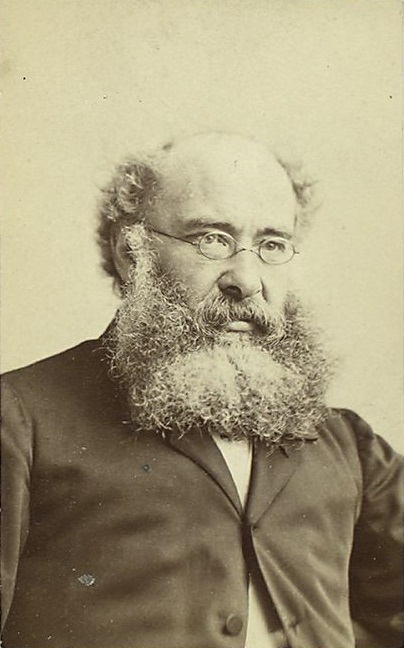
Anthony Trollope
English novelistWikipedia
161
MENTIONS
83
EPISODES
52
PODCASTS
Search complete. 161 mentions across 83 episodes found for "Anthony Trollope".
Sep 17, 2026

Dan GruzinskiNARRATOR
"I wish I could tell you," he replied, "but only odd bits change places, like looking in a kaleidoscope, yet all cluster around one center." One day, looking over his portfolios, I found an old temple bar, which he said he kept for this passage, which he read to me from T.A.
Dan GruzinskiNARRATOR
Trollope's Artist's Tragedy.
Dan GruzinskiNARRATOR
"The old walls and ceilings and floors must be saturated with the exhalations of human emotions.
Dan GruzinskiNARRATOR
These lintels, doorways, and stairs have become, by long use and homeliness, dear to human hearts, and have become so intimately blended a portion of the mental furniture of human lives that they have contributed their part to the formation of human characters.

Emily JonesGUEST
And to Disraeli, Whiggism, as it was kind of, you know, kind of re-energised by Burke as he saw it.
Emily JonesGUEST
was this kind of nefarious mixture of kind of landlordism, like the idea of like they're the, in Trollope, they're the Dukes of Omnium.
Emily JonesGUEST
So they're the big land owners who are very distant from tenants and things like that.
Emily JonesGUEST
War with France, so a kind of specific kind of like foreign policy.
6 MINS LATER
Emily JonesGUEST
I think that even in the 19th century, these clearly were intellectual outputs for Disraeli.
Emily JonesGUEST
There were also ways, there were also kind of vehicles of making money, for making money.
Emily JonesGUEST
And I think that, you know, even... you know, Sybil and the Young England trilogy of Coningsby and Tancred as well of the 1840s that does later get canonised as these really significant condition of England novels at the time were like kind of were kind of like laughed off as like, you know, insincere kind of contributions and, you know, And novelists like Trollope and figures who have already mentioned, you know, even later when Disraeli was pretty well known, you know, a kind of political celebrity, dismissed the novels as kind of like, you know, I think Lothair was described as by Trollope as having the flavour of hair oil.
Emily JonesGUEST
So, like, with a reference to the coils.

Larry WilsonNARRATOR
Moss of Water Street? Nor does this apply merely to Thackeray, but to all those Victorians who prided themselves on the realism or sobriety of their descriptions.
Larry WilsonNARRATOR
It applies to Anthony Trollope, and as much as anyone, to George Eliot.
Larry WilsonNARRATOR
For we have not only survived that present which Thackeray described, we have even survived that future to which George Eliot looked forward.
Larry WilsonNARRATOR
It is no longer adequate to say that Dickens did not understand that old world of gentility, of parliamentary politeness, and the balance of the constitution.
8 HRS 24 MINS LATER
Larry WilsonNARRATOR
And it must be remembered that nearly everybody else did yield to it, especially those writers who are commonly counted Dickens' superiors in art and exactitude and closeness to connected reality.
Larry WilsonNARRATOR
Thackeray wallowed in it.
Larry WilsonNARRATOR
Anthony Trollope lived on it.
Larry WilsonNARRATOR
Those modern artists who prided themselves most on the separation and unity of a work of art have indulged in it often.

Alan JuddGUEST
And every now and again I go back to the 19th century because in a way the great novels stem from there, so many of them.
Alan JuddGUEST
Trollope I like a lot.
Alan JuddGUEST
And I read the Cazalet novels by Elizabeth Jane Howard recently.
Alan JuddGUEST
Having been told by my wife for years that I wouldn't like them, I found them fascinating, partly because I come from the village she was writing about, and I know their house.

Rory StewartGUEST
... which was partly connected to the Industrial Revolution, which stretched from about 1780 to about 1950.
Michael GoveHOST
It seems to me that, uh, many of your role models are like, uh, Squire Thorn of Ulathorne in, um, Trollope's Barchester Chronicles or, uh, Mr. Knightley in Jane Austen's Emma, uh, or Christopher Tietjens, um, in Ford Madox Ford's, uh, tetralogy about the, uh, the First World War.
Rory StewartGUEST
Or, or, or, or Boot in Scoop.
Michael GoveHOST
Yes.

Rory StewartGUEST
... which was partly connected to the Industrial Revolution, which stretched from about 1780 to about 1950.
Michael GoveHOST
It seems to me that, uh, many of your role models are like, uh, Squire Thorn of Ullathorne in, um, Trollope's Barchester Chronicles, or, uh, Mr. Knightley in Jane Austen's Emma, uh, or Christopher Tietjens, um, in Ford Madox Ford's, uh, tetralogy about the, uh, the First World War.
Rory StewartGUEST
Or, or, or, or Boot in Scoop.
Michael GoveHOST
Yes.

Dan RocheGUEST
And it would be, you know, sort of looked at as what they called a fixed eye.
Dan RocheGUEST
And it became kind of a metaphor for some writers like Anthony Trollope and others for a character who is suspicious, perhaps evil, something bad going on.
Dan RocheGUEST
You know, you give them a fixed eye.
Dan RocheGUEST
and it kind of freaks people out and they don't know where they're looking.

Jonathan WilliamsGUEST
Well, I'd studied literature at university, and this was like reading a Victorian novel.
Jonathan WilliamsGUEST
You know, I wasn't saying it was at the standard of Trollope or Thackeray, but it was very, very good.
Jonathan WilliamsGUEST
And it was being told in the 1850s, but the author had the capacity to render, you know.
Fergus FinlayHOST
But you knew, to go

Gretel le MaîtreHOST
Right, and now with my little lamp resting on my shoulder.
Gretel le MaîtreHOST
Anthony Trollope, Chapter 33, Mrs. Proudy Victrix.
Gretel le MaîtreHOST
All right, so we've had the last paragraph was all about Mr. Slope wanting that position.
Gretel le MaîtreHOST
The next week passed over at Barchester, with much apparent tranquillity.

Nick WhitleyNARRATOR
All LibriVox recordings are in the public domain.
Nick WhitleyNARRATOR
For more information, or to volunteer, contact LibriVox.org. Phineas Finn by Anthony Trollope Chapter 60 Madame Goesler's Politics It may be remembered that when Lady Glencora Palliser was shown into Madame Goesler's room, Madame Goesler had just explained somewhat forcibly to the Duke of Omnium her reasons for refusing the loan of His Grace's villa at Como.
Nick WhitleyNARRATOR
She had told the Duke in so many words that she did not mean to give the world an opportunity of maligning her, and it would then have been left to the Duke to decide whether any other arrangements might have been made for taking Madame Goesler to Como, had he not been interrupted.
Nick WhitleyNARRATOR
That he was very anxious to take her was certain.
73 more episodes mention Anthony Trollope.
Create an account to see the whole feed, search across every transcript, and follow the entities you care about.