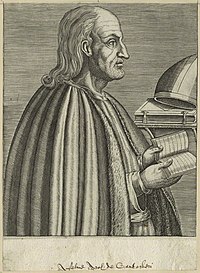
Anselm of Canterbury
AbbotWikipedia
308
MENTIONS
70
EPISODES
58
PODCASTS
Search complete. 308 mentions across 70 episodes found for "Anselm of Canterbury".
Sep 17, 2026

Dwight ZscheileHOST
But so another theologian that you talk about from that early period is Irenaeus.
Dwight ZscheileHOST
And I want to talk about him a bit because, you know, coming out of Augustine and his understanding of original sin, but really through the medieval period, we tend to have in the West, in Western theology, a sense of salvation through a kind of, you know, legal and penal framework, right? Going back to Anselm and all of that.
Dwight ZscheileHOST
that the Reformation was trying to solve for in a very different way than kind of the medieval practices were and medieval theology was.
Dwight ZscheileHOST
But that sense of sin and salvation as sort of somehow getting ourselves legally in right relationship with God who's punishing us, I think can often fall flat in modern culture.

Pamela NagamiNARRATOR
Thus in spite of the discontent of his people and the frequent petitions to him, one of which is peculiar, that the king would allow it to be enjoined that the people should pray that the king's heart might be changed, he continued obstinate until a dangerous illness brought on a temporary fit of remorse as violent as is usual in ill-balanced minds.
Pamela NagamiNARRATOR
Then at last, giving way to a long-expressed desire of his country, he appointed Anselm Archbishop of Canterbury in 1093.
Pamela NagamiNARRATOR
This great man was a Lombard like Lanfranc and of noble birth.
Pamela NagamiNARRATOR
He had been attracted to Beck by the fame of Lanfranc, and there in spite of their very different characters had become one of his dearest friends.
Pamela NagamiNARRATOR
To his predecessor he formed a complete contrast.
Pamela NagamiNARRATOR
Lanfranc was a man of the world, gifted with a practical, vigorous turn of mind.
Pamela NagamiNARRATOR
Anselm, on the contrary, deficient in worldly qualities, far surpassed his friend in originality of thought and subtlety of mind.
Pamela NagamiNARRATOR
He was the first great philosopher of Christian Europe, and in his works at once laid the basis of the future scholastic philosophy and went beyond it.

speaker_2NARRATOR
He no longer attempts, like a theologian of the previous period, to bear down his adversary with the dead weight of authority, but he answers dialectic with dialectic, and argues a point of theology upon the basis of pure reason.
speaker_2NARRATOR
What Lanfranc had done reluctantly, and as it were by accident, his disciple Anselm did with the whole soul of a philosopher, and from that time the scholastic philosophy took firm root in Europe.
speaker_2NARRATOR
The transformation which thus passed on the intellectual education of the Western world is one of which it is scarcely possible to exaggerate the magnitude.
speaker_2NARRATOR
It was an exchange of education by a dead literature for education by a living philosophy.
speaker_2NARRATOR
Therefore it became necessary that students, instead of being scattered among the numerous monastic and cathedral schools, should be assembled at a few great centers where the greatest possible number of pupils could have access to the lessons of the few men who had caught the ear of their day and could advance the science which they taught.
speaker_2NARRATOR
A corresponding necessity pressed upon the teachers themselves.
speaker_2NARRATOR
Anselm himself, at Beck, found it almost impossible to receive the numbers who came to him for instruction.
speaker_2NARRATOR
In the next generation, a teacher of Anselm's celebrity would have been driven perforce to the new university of Paris, where alone at that time accommodation could be found for the growing concourse of students.

Alex O'ConnorGUEST
So to take a philosophical approach to the question is to essentially analyze the nature of the beliefs that these people hold, that religious people hold, sometimes that you yourself hold.
Alex O'ConnorGUEST
That's why, you know, I said before, like religion for Anselm and for Augustine like him is faith seeking understanding.
Alex O'ConnorGUEST
It's like the belief that I have is based on faith.
Alex O'ConnorGUEST
I believe in God.

Ricky McCarlHOST
And this is not a Protestant thing.
Ricky McCarlHOST
This is St. Anselm.
Ricky McCarlHOST
St. Anselm writing in what, the 12-1300s.
Ricky McCarlHOST
He says that the debt that humanity has to God is so great that no human man could ever pay it back.
Ricky McCarlHOST
So purgatory is just not possible.

Matt FraddGUEST
But that clearly isn't true.
Matt FraddGUEST
The fact that he disagreed with the foremost argument for the existence of God at the time, right? Namely the ontological argument by Anselm.
Matt FraddGUEST
I would think that was probably the most preeminent argument.
Matt FraddGUEST
I mean, unless people are using a causal argument based on Aristotle.

Chris FirestoneHOST
So I think of Augustine in the City of God or his confessions.
Chris FirestoneHOST
I think of Anselm in Proslogion.
Chris FirestoneHOST
I think of John Locke, who was one of the Enlightenment thinkers that helped us to give rise to the US Constitution.
Chris FirestoneHOST
We have a vast array of resources that what I call the great books.

Marcellino D'AmbrosioHOST
Why do Christians adorn their churches, homes, and necks with a symbol of abasement, terror, and torture? The Feast of the Exaltation or Triumph of the Holy Cross provides the answer.
Marcellino D'AmbrosioHOST
St. Anselm in the twelfth century explained it this way.
Marcellino D'AmbrosioHOST
Our first parents' sin was all about pride, disobedience, and self-love.
Marcellino D'AmbrosioHOST
Deceived by the serpent, Adam and Eve ate the forbidden fruit in defiance of God because they wanted to exalt themselves as His equal.

Brandon CookHOST
Case in point.
Brandon CookHOST
In the 11th century, you get Saint Anselm, who rejects this crude idea that God literally owed the devil a ransom.
Brandon CookHOST
But he still frames up the problem in terms of honor and an honor debt that had to be paid.
Brandon CookHOST
Again, a transaction.

Chris WhiteHOST
uh a few different things i don't think that you can kind of pin them down exactly i think this is i think first of all i think atonement theory is probably one of the most complex topics in the bible and there's probably a good reason why no one in church history really expected everybody to have an atonement theory it's never a part of any of these creeds or anything jesus died for our sins was good enough for most of them and it should be good enough for us today but wrath satisfaction started really in the middle ages.
Chris WhiteHOST
A guy named Anselm really made the big shift.
Chris WhiteHOST
I didn't say what the early church believed.
Chris WhiteHOST
I should say that real quick.
Chris WhiteHOST
And then the modern church, if you ask them, why did Jesus need to die for our sins? They would say, well, God can't forgive sins, and not unless he punishes somebody.
Chris WhiteHOST
So our problem is God.
Chris WhiteHOST
And that's what Anselm did.
Chris WhiteHOST
So Anselm, right in the middle between the two worlds, He actually says it explicitly.
60 more episodes mention Anselm of Canterbury.
Create an account to see the whole feed, search across every transcript, and follow the entities you care about.