Anschluss
68
MENTIONS
44
EPISODES
37
PODCASTS
Search complete. 68 mentions across 44 episodes found for "Anschluss".
Sep 16, 2026

Johnny VaughanHOST
they thought they got...
Johnny VaughanHOST
No one is fooled, but successive invasions and no one calling their bluff on it, you know, from Anschluss through to the Sudetenland and then finally with Poland.
Johnny VaughanHOST
Yeah.
Johnny VaughanHOST
They're thinking, hey, no one knows what our real intention is.

Mike MartinHOST
The previous era where we saw that, I think, was in the foothills of the Second World War, where you started to see lots of regional conflicts.
Mike MartinHOST
So the Japanese in Manchuria, China or other bits of the Far East, you had Italy in Ethiopia, you had The Nazis taking over Czechoslovakia, the Anschluss moving into Europe.
Mike MartinHOST
And slowly these conflicts knitted together into one big conflict.
Mike MartinHOST
And you had Axis versus Allies.

Brayden ShawHOST
The other thing, though, you did you did mention how there isn't a ton of drama, but there is one point that we did mention earlier is the the thing that hangs over really, really the entire film.
Brayden ShawHOST
Like it's not just at the end when like the Anschluss comes in and like, you know, the Nazis are fully there when the war is really, you know, picking up.
Brayden ShawHOST
But it is so interesting.
Brayden ShawHOST
Obviously, there's the meme.

Jamarl ThomasHOST
But yeah, so now-
Ted RallHOST
And let's not forget, uh, there's that Anschluss problem they have to explain.
Jamarl ThomasHOST
Yes.
Jamarl ThomasHOST
Yes.

Catherine Grace KatzGUEST
But it's not enough to cry out with alarm that something terrible is going on, because compared to what he has been doing, things seem a little bit better.
Catherine Grace KatzGUEST
Of course, we know that the Sudetenkrisis and the Anschluss and Munich and all that are just around the corner.
Catherine Grace KatzGUEST
But in 1937, things look better and Hitler is seen as a legitimate international leader.
Ben SawyerHOST
I was really interested to see how the Zeppelins and these airships played a role in the story leading up to this.

Paul VanderKlayHOST
It has been called the most famous book on the Habsburg Empire.
Paul VanderKlayHOST
He started writing it in 1934 when anticipating the Anschluss and Nazi persecution.
Paul VanderKlayHOST
Of course, the Nazis were going to...
Paul VanderKlayHOST
We're going to take over a part of Austria and basically absorb it.

David DyzenhausGUEST
And it was in large part to bring that similarity to light that I wrote this book, because I think that if one looks for the real inspiration, and this is a clear theme of the book, for the political ideas, of the figures on whom I focus.
David DyzenhausGUEST
That inspiration does come from these 1930 figures, Carl Schmitt, and then someone who's less well known in the UK, but had tremendous influence on the right in the US, a fellow called Eric Ferguelin, of more or less the same vintage as Schmidt, also a German fascist who gets out of Austria in the late 1930s because of the Nazi Anschluss.
David DyzenhausGUEST
He's actually in disfavor with the Nazis because he was part of the Austrian fascist right who wanted to keep the Nazis at bay.
David DyzenhausGUEST
And he makes his way to the US where he's really influential in the founding of conservatism, then leaning towards right-wing thought in the 1950s in the US.

William HitchcockGUEST
And on it goes, this trail of tears.
William HitchcockGUEST
The Anschluss, 1938, gobbling up Austria.
William HitchcockGUEST
America says, we don't really have the tools to make a difference here.
William HitchcockGUEST
There's nothing we can do.

speaker_1NARRATOR
The German army had been rebuilt, an air force, the Luftwaffe, had emerged in violation of the Treaty of Versailles, and Hitler's rhetoric of reclaiming lands lost after the First World War and creating a greater Germany was being ramped up.
speaker_1NARRATOR
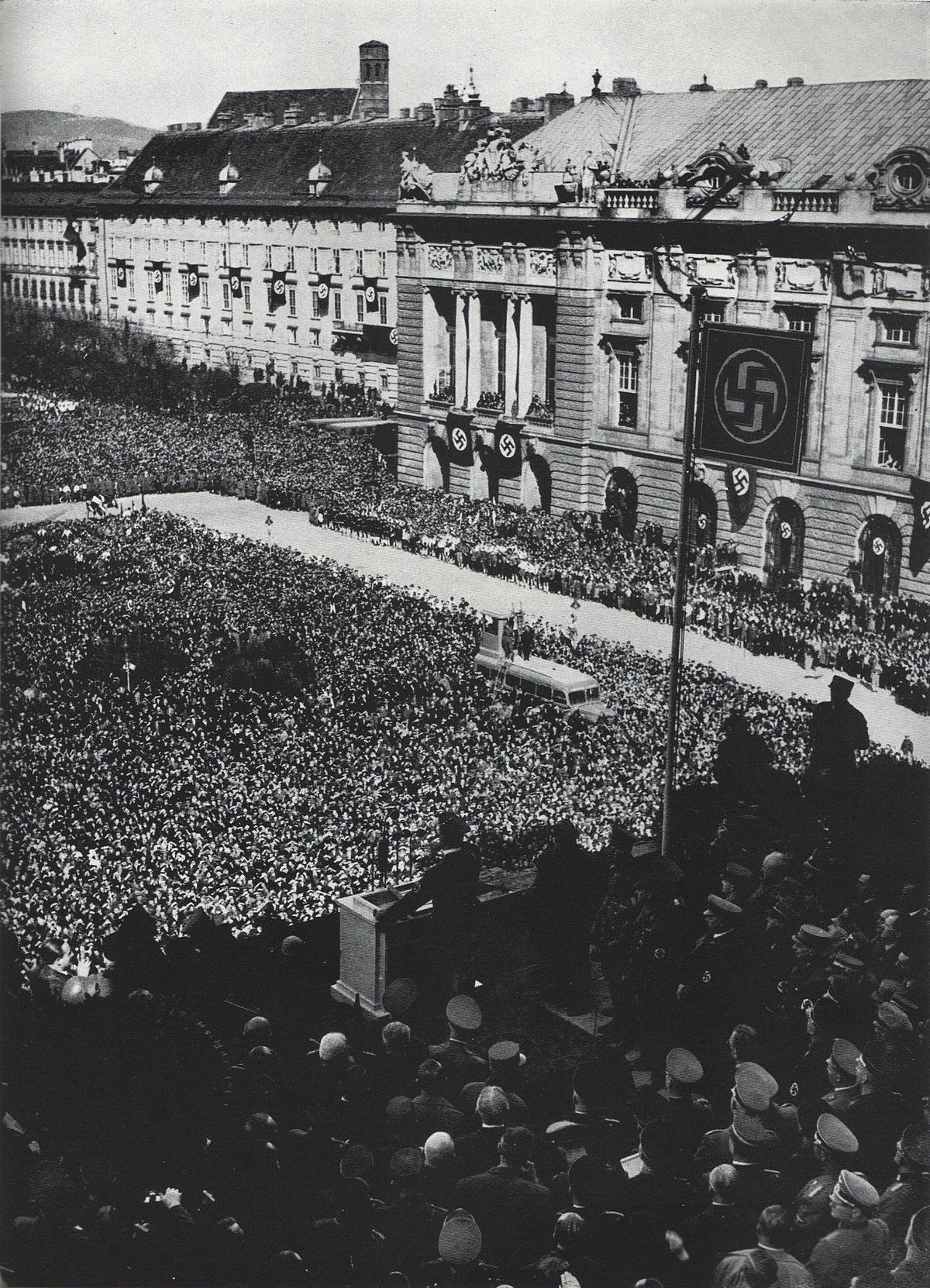
In March 1938, this resulted in the German annexation of Austria after years of political pressure for the Union or Anschluss.
speaker_1NARRATOR
Hoffmann was unexpectedly invited to go on a drive by Hitler in the midst of it.
speaker_1NARRATOR
He had no idea where they were going, only that Hitler ordered him to bring a change of clothes with him, stating that they might be away for several days.
speaker_1NARRATOR
Once there, Hitler told Hoffmann that he had a great desire to visit the town of Braunau am Inn in Austria, where Hitler hailed from.
speaker_1NARRATOR
When Hoffmann stated that that would mean crossing into Austria, with which Germany was embroiled in a diplomatic crisis, The Fuhrer smiled and told the driver to continue on.
speaker_1NARRATOR
As they proceeded, they passed soldiers along the way, with Hoffmann only then realizing that the Anschluss was underway and German troops were moving into Austria.
speaker_1NARRATOR
They then arrived at Braunau, where Hoffmann photographed Hitler with the spire of the town clock tower in the background.

ThomasGUEST
Nora, uh, Feternik were, uh, were, were ciphers.
ThomasGUEST
Uh, they both wielded tremendous power and clout, but I'm talking when I say figurehead, I mean, in terms of outward appearances, um, One of Hitler's challenges with balancing Italian demands on the Balkans, and specifically Croatia, in order to placate Mussolini over, among other things, the murder of Dolfus and the subsequent Anschluss and other things, Early on, he'd agreed to cede the Dalmatian coast to Italy, at least as a sphere of influence and an event of general war as a territorial imperative that they would be permitted to capture.
ThomasGUEST
This caused intense resentment in Zagreb, but Hitler realized it was a necessary evil.
ThomasGUEST
Now, Pavelic, having spent so many years in Italy and having courted, really, since 1932-33, alliance with the Italian fascists, he was kind of Mussolini.
20 MINS LATER
ThomasGUEST
And Italy is a stabilizing influence.
ThomasGUEST
So the Italians, for all of its...
ThomasGUEST
For all of its revolutionary aptitude in capturing power, the fascists in this epoch, and especially before the Anschluss and things, they were behaving very much like a national conservative party.
ThomasGUEST
And a lot of these guys in authority, they didn't want to openly support some radical right partisan, like Polish and the Ustasha.
34 more episodes mention Anschluss.
Create an account to see the whole feed, search across every transcript, and follow the entities you care about.