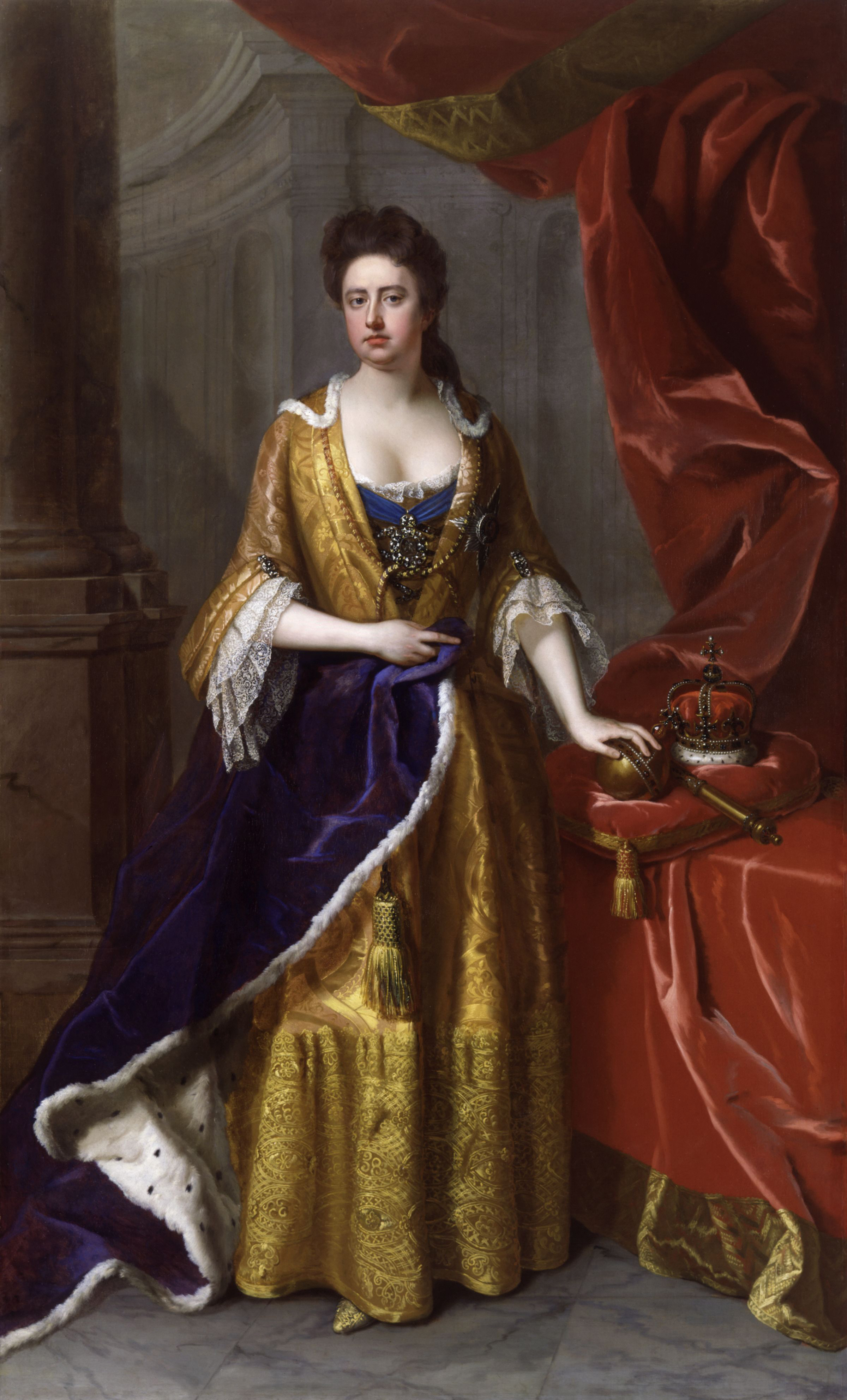
Anne, Queen of Great Britain
Former Queen of Great BritainWikipedia
288
MENTIONS
88
EPISODES
72
PODCASTS
Search complete. 288 mentions across 88 episodes found for "Anne, Queen of Great Britain".
Sep 23, 2026

Robert H. CherneyNARRATOR
The power of the king was derived from violence.
Robert H. CherneyNARRATOR
The monarch, before the act of succession in the reign of Queen Anne, claimed the throne in virtue of the conquest by William in ten sixty.
Robert H. CherneyNARRATOR
In America the institutions are the result of deliberate consultation, mutual concessions, and design.
Robert H. CherneyNARRATOR
In England the people may have gained by diminishing the power of the king, who first obtained it by force; but in America to assail the rightful authority of the Executive is attacking a system framed by the constituencies of the States, who are virtually the people, for their own benefit.

Lindsay HolidayHOST
Queens of the World.
Lindsay HolidayHOST
Anne, Queen of Great Britain and Ireland.
Lindsay HolidayHOST
Queen Anne was the younger sister of Mary II, half of England's only joint monarchy, William and Mary.
Lindsay HolidayHOST
When they died, Anne had no interest in sharing the throne with her own husband.

Kara SchallenbergNARRATOR
This made King William and the British people still more angry.
Kara SchallenbergNARRATOR
for with a french king on the throne of spain they thought it very likely that france and spain might one day be joined together and become too powerful so king william again declared war on france but before the war began he died Queen Mary's sister Anne now became queen.
Kara SchallenbergNARRATOR
She carried on the war already declared.
Kara SchallenbergNARRATOR
This war brought fighting in America as well as in Europe.

Fred AboodNARRATOR
Their theories made headway early in the century throughout Central Europe and England.
Fred AboodNARRATOR
Bolingbroke, Shaftesbury, and the elite amongst the statesmen and literary aristocracy of the reign of Queen Anne were infidels.
Fred AboodNARRATOR
Tindall, Collins, Wolston, Toland, and Chubbs were as advanced as Tom Paine was, later on, in the way of atheism.
Fred AboodNARRATOR
But however much England and Germany had advanced their Protestantism to what was called free thinking Both were soon destined to be eclipsed in that sad progress by Catholic and monarchical France.

Fred AboodNARRATOR
Their theories made headway early in the century throughout Central Europe and England.
Fred AboodNARRATOR
Bolingbroke, Shaftesbury, and the elite amongst the statesmen and literary aristocracy of the reign of Queen Anne were infidels.
Fred AboodNARRATOR
Tindall, Collins, Wolston, Toland, and Chubbs were as advanced as Tom Paine was, later on in the way of atheism.
Fred AboodNARRATOR
But however much England and Germany had advanced their Protestantism to what was called free thinking, both were soon destined to be eclipsed in that sad progress by Catholic and monarchical France.

Fred AboodNARRATOR
Their theories made headway early in the century throughout Central Europe and England.
Fred AboodNARRATOR
Bolingbroke, Shaftesbury, and the elite amongst the statesmen and literary aristocracy of the reign of Queen Anne were infidels.
Fred AboodNARRATOR
Tyndall, Collins, Wolston, Toland, and Chubbs were as advanced as Tom Paine was later on in the way of atheism.
Fred AboodNARRATOR
But however much England and Germany had advanced their Protestantism to what was called free thinking, both were soon destined to be eclipsed in that sad progress by Catholic and monarchical France.

Carrie Mae StrebNARRATOR
Mayfair, which has given its name to a locality now aristocratic, introduces us, in 1702, the year in which the fearful riot occurred in which a constable was killed there, to Thomas Simpson, an equestrian vaulter, described in a bill of Husband's Booth as the famous vaulting master of England.
Carrie Mae StrebNARRATOR
A few years later, a bill of the entertainments of Bartholomew Fair, preserved in Bagford's collection in the library of the British Museum, mentions tightrope dancing and some performing dogs, which had had the honour of appearing before Queen Anne and most of the quality.
Carrie Mae StrebNARRATOR
The vaulters and posturers and tightrope performers of this period were not all the vagabonds they were in the eye of the law.
Carrie Mae StrebNARRATOR
Fox, a posturer and juggler of the first half of the 18th century, started, in conjunction with a partner named Pinchbeck, a show which was for many years one of the chief attractions of the London fairs, and appears to have realised a considerable fortune.

Pamela NagamiNARRATOR
Moreover, a new power, the Turks, had by this time secured a place in Europe, much to the disgust of many who thought that no efforts would have been too great to keep them out of Christendom.
Pamela NagamiNARRATOR
End of Section 1 Section 2 of The Early Hanoverians by Edward Ellis Morris This LibriVox recording is in the public domain Recording by Pamela Nagami Book 1 Chapter 2 George I On the death of Queen Anne, on an eventful Sunday morning, August 1, 1714, both the Privy Council and the House of Commons met.
Pamela NagamiNARRATOR
Messengers were at once sent to convey the news to Hanover.
Pamela NagamiNARRATOR
Fast travelling brought them there in less than five days.
6 MINS LATER
Pamela NagamiNARRATOR
It was decided, therefore, that part of the Palatinate should be restored to Frederick, and an eighth Electorate created.
Pamela NagamiNARRATOR
Forty-four years later, a ninth Electorate was established in favour of his son-in-law, the Duke of Hanover.
Pamela NagamiNARRATOR
During almost the whole of Queen Anne's reign, the Electress Sophia was her legal heir.
Pamela NagamiNARRATOR
Naturally, she took the keenest interest in English politics, and is said to have declared that she would die happy if she could know that Queen of England would be engraven on her coffin.

Pamela NagamiNARRATOR
Louis was beaten on all sides and sued for peace, which was at first refused.
Pamela NagamiNARRATOR
in the second period seventeen o eight to seventeen ten the strife of parties at home is all-important wearied by the long war the nation refused to support marlborough as they had refused to support william the danger seemed over the influence of the duchess was undermined and queen anne ceased to take pleasure in the society of a brawling woman in a wide house a tory reaction occurred churchmen raised their voices against toleration and the foolish prosecution of one of them gave away the dignity of the government who their popularity being already gone could not long hope to retain office the struggle ended in a victory for the tories and thus incidentally for the principle of party government a tory ministry was soon appointed and in the third period seventeen ten to seventeen fourteen the revolution settlement trembled in the balance peace was made with france a peace perhaps necessary perhaps just yet in terms far less glorious than our victorious armies were considered to have earned the tory ministers plotted for a tory triumph perhaps for a stuart restoration the death of anne however found this ministry divided by a quarrel between its leaders and the whigs were able to obtain sufficient influence in the council to secure the succession of george i The war of the Spanish succession, 1702 to 1713, was waged mainly in three separate quarters, first on the eastern side of France, in the Netherlands, along the Rhine and the borders of Bavaria and Austria.
Pamela NagamiNARRATOR
Here Marlborough and his Dutch allies had to succour the emperor and to drive Louis from the Netherlands, which they had to regain foot by foot.
Pamela NagamiNARRATOR
secondly in italy where eugene a prince of the house of savoy faced the french armies sent into the milanese duchy and endeavoured to prevent them from reaching austria by the tyrolese passes thirdly in spain itself where the english with their spanish and portuguese allies endeavoured to drive philip v from his newly acquired throne and to place the archduke charles the candidate of the allies in his place this was the ostensible purpose for which the war was being waged though it turned into a struggle to keep france from attacking the empire and the netherlands as well as from obtaining a commanding position in north italy the spanish campaigns always remained of secondary importance as william had died when war was popular there was no delay in taking up the struggle marlborough took command of the allies in the netherlands and war was formally declared in may seventeen o two anne was still as much as ever under the influence of this great man and his wife the queen allowed her favourite to call her mrs morley and in the familiar intercourse between the friends the duchess was mrs freeman the ministry comprised both whigs and tories marlborough and godolphin to whom the former was related by marriage being the leading spirits soon however it became clear that the tories loved neither the war nor those who were conducting it and they gradually were eliminated from the administration nottingham left office in seventeen o four and the whigs sunderland and somers soon appeared in the ministry The elections in 1705 were in favour of the Whigs, and the gradual stiffening of the Whig element in the government reflected their gains in Parliament.
7 MINS LATER
Pamela NagamiNARRATOR
they had therefore now to choose between independence and free trade.
Pamela NagamiNARRATOR
A scheme proposed by one Paterson in the reign of William III, by which Scots were to secure a foremost place in the commercial world by colonizing the Isthmus of Darien and making it a depot for trade of East and West, had failed miserably.
Pamela NagamiNARRATOR
the spaniards whose rights they invaded and the climate which they thought much better than it proved to be combined to kill off the colonists this together with the jealousy shown towards the enterprise in england was enough to make a wider breach more probable than a closer union between the two nations but the scots took advantage of the coming succession problem to make englishmen think less of scottish commercial rivalry and more of scottish political union their parliament in edinburgh declared in seventeen o three that though they would have as sovereign after queen anne a descendant of the electress sophia yet their nominee should not be the same as england's unless their religion and trade were secured this act of security was indeed a skilful trick to bring the english to terms commissioners were named to discuss a union of the two realms as soon as the northern kingdom threatened to sever the union of the two crowns which had been a fact since sixteen o three the terms finally adopted were those we have suggested their religion was secured their commerce made free their legal system remained to bear witness if necessary to their ancient independence scottish members to the number of forty-five were to sit in the house of commons while sixteen peers were to be elected by the whole body of nobles to represent them in the house of lords thus ended one of the greatest difficulties of the seventeenth century We have seen how it baffled the wit of James I, brought Charles and Laud to war, and their system to overthrow.
Pamela NagamiNARRATOR
It had given occasion for the display of the cynical indifference of Charles II and the bigoted brutality of his brother.

Fred AboodNARRATOR
Their theories made headway early in the century throughout Central Europe and England.
Fred AboodNARRATOR
Bolingbroke, Shaftesbury, and the elite amongst the statesmen and literary aristocracy of the reign of Queen Anne were infidels.
Fred AboodNARRATOR
Tyndall, Collins, Wolston, Toland, and Chubbs were as advanced as Tom Paine was later on in the way of atheism.
Fred AboodNARRATOR
But however much England and Germany had advanced their Protestantism to what was called free thinking, both were soon destined to be eclipsed in that sad progress by Catholic and monarchical France.
78 more episodes mention Anne, Queen of Great Britain.
Create an account to see the whole feed, search across every transcript, and follow the entities you care about.