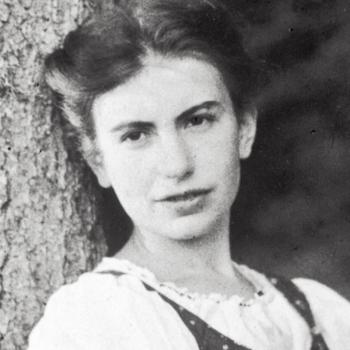
Anna Freud
British psychoanalystWikipedia
18
MENTIONS
14
EPISODES
12
PODCASTS
Search complete. 18 mentions across 14 episodes found for "Anna Freud".
Sep 13, 2026

Matt HeganHOST
And, like, he's talking a lot about existential...
Nick WilsonGUEST
Well, he was a colleague of Anna Freud.
Nick WilsonGUEST
Eric Erickson was a student of Anna Freud.
Nick WilsonGUEST
So, yeah, they... very psychodynamic at one level.
Nick WilsonGUEST
And I mean, Viktor Frankl had started to develop his beliefs around logotherapy before the Second World War.

Eric MetaxasHOST
And I think I was on a plane about two years ago and I thought, son of a gun, somebody made a film of Freud's last session.
Eric MetaxasHOST
Now, the film, unfortunately, makes Anna Freud out to be this big, brave lesbian.
Eric MetaxasHOST
And that that you know that Hollywood has to wreck things by going in that direction.
Eric MetaxasHOST
But the film is worth seeing.

David SpiegelGUEST
Tandis que la plupart des cabinets médicaux étaient sombres et austères.
David SpiegelGUEST
J'ai eu l'occasion, quand j'étais étudiant en médecine, de travailler quelques mois à Londres et je savais qu'Anna Freud était encore en vie et exerçait là-bas.
David SpiegelGUEST
Alors, je lui ai envoyé un petit mot en me présentant comme étudiant en médecine.
David SpiegelGUEST
À ma grande surprise, elle m'a donné un rendez-vous la semaine suivante.
David SpiegelGUEST
Whereas most physicians' offices were dark and bare.
David SpiegelGUEST
And I had the occasion when I was in medical school, I was working in London for a few months, and I knew that Anna Freud was still alive and practicing in London.
David SpiegelGUEST
So I sent her a little note and introduced myself as a medical student from Harvard.
David SpiegelGUEST
And to my amazement, she gave me an appointment the next week.

Chloe MadisonHOST
that I was avoiding myself so sometimes I think we look at other people's behavior with a microscope to avoid looking at our own or maybe what we're feeling so it's like maybe we need to ask ourselves instead of saying well why is he so emotionally avoidant or why can't he do all these things it's like why are you spending that much time chasing after somebody who's emotionally unavailable that's a good question we should figure out here that's something
Jemma SbegGUEST
we can control you know yeah no absolutely and it's like well we're so it's so much easier to put the spotlight on somebody else's behavior rather than as you said interrogating your attraction to that because surely that's not natural if our instinct as humans is to bond and is to find partnership for survival purposes and for belonging purposes it's somebody who does not care about you or does not show you signs that they do or who doesn't make you feel good that should not be something that you go towards and yet somewhere along the way that has been equated with love and purpose and achievement for you and so now you do and it's just a classic coping mechanism right if we have a look at any of like the Freudian well Anna Freud's like coping mechanisms or any of the others that have been established in psychology intellectualization is like often pretty top of the list for people who have a good sense of their feelings because it's so easy to think that you can out think a problem that sometimes you just need to feel and the feeling is this person makes me feel terrible this person makes me feel worthless this person makes me feel anxious But intellectualizing it feels more practical, feels more achievable and is a distraction from having to just like sit with the fact that maybe this just isn't right.
Jemma SbegGUEST
And there's a bunch of other coping mechanisms that we use.
Jemma SbegGUEST
Another big one is like busyness.

Christopher MillerGUEST
And I think that he was clearly laboring under sort of a misapprehension on his own part, but he was also somebody who was discovering this science and describing it within his own time.
Christopher MillerGUEST
There's a lot of criticism levied um towards something regarding what you were just mentioning but also about you know not really working with children you know making a lot of extrapolations and such so it kind of took some decades later on for you know even his daughter anna freud to you know maybe have a little bit more actual experience with children adolescents to expand his theories So I think you started something very good, but I do think that we needed to broaden its applications because I think it is incorrect to say that people can't benefit from psychotherapy because of age.
Christopher MillerGUEST
And I've seen it happen.
Christopher MillerGUEST
I've seen it make a big difference, even within short periods of time for patients who are later in life as well.

SeanHOST
The clean picture of a transparent consciousness making free choices looks less plausible in light of this research.
SeanHOST
Anna Freud's defense mechanisms, Jung's shadow, Kahneman's system one thinking, all of these are accounts of how much of what we do is determined by processes outside conscious awareness.
SeanHOST
Sartre's picture needs to be integrated with this research rather than held in isolation from it.
ClaireHOST
And yet, with all those criticisms in view, what survives in Sartre is still enormously important.

Georgie Wisen-VincentGUEST
I went to London.
Georgie Wisen-VincentGUEST
I studied at the University of Roehampton in child-centered play therapy, which is an approach that's derived from when we think about the original play therapist, we're going way back in time to, like, the 1930s and the 1940s and places like the Tavistock Clinic and that home that we think of as, like, associated with Sigmund Freud and his daughter Anna Freud, people like that.
Georgie Wisen-VincentGUEST
So rather than becoming really psychoanalytic about play therapy, we use those traditional roots of, like, understanding that kids express things through their play that they can't usually talk about.
Georgie Wisen-VincentGUEST
Maybe they haven't developed the language or the communication skills to do it yet, or maybe they're just too little.

Miriam SteeleGUEST
They missed out on a loving, sensitive, responsive, caring relationship in their childhoods, and that that was the link between that and their criminal, um, behavior.
Miriam SteeleGUEST
He also did an interesting study with somebody called Jimmy Robertson, who was somebody who was working, uh, with Anna Freud.
Miriam SteeleGUEST
It was, uh, during the war, and she set up something called the War Nurseries.
Miriam SteeleGUEST
Uh, children who were separated from their parents, um, because of the war, either fully, the parents were killed, or mothers were going off to help the war effort, and fathers were, um, in the military.
ClaireHOST
There is also a connection to the epistemological questions that have run through the whole show.
ClaireHOST
We have been arguing, from the first episode on Anna Freud's defense mechanisms through the cognitive bias episode to the Bayesian probability episode, that honest knowledge is hard, that our minds are designed to resist clear seeing, and that the examined life requires sustained effort to see past those resistances.
ClaireHOST
The philosophy of mathematics adds a dimension to that picture.
ClaireHOST
Even in the domain where we feel most certain, where the truths seem most necessary and most clear, the philosophical foundations are genuinely contested.
4 more episodes mention Anna Freud.
Create an account to see the whole feed, search across every transcript, and follow the entities you care about.