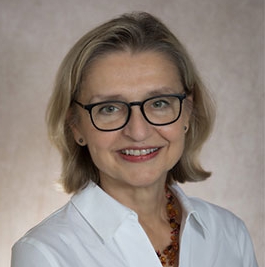
Anna D. Jaroszyńska-Kirchmann
Historian of Polish American immigration; Distinguished Professor Emerita of History at Eastern Connecticut State University and author of "Pierogi: An American Story of Polish Food" (Columbia UP, 2026).
6
APPEARANCES
6
PODCASTS
Sep 18, 2026

Miranda MelcherHOST
Can we talk a little bit about this time period? I mean, if we're tracing the popularity today of certain Polish food ways, can we see traces or legacies or continuities that far back? Yeah.

9:08
You know, it is sometimes challenging to figure out what the Polish cuisine is and what it isn't, especially when we talk about those early centuries.
9:18
Poland's borders changed a lot over time, and Polish lands included different regions and cultures.
9:25
For example, in the 16th century, the Polish-Lithuanian Commonwealth included a vast territory which stretched from the Baltic in the north, almost to the Crimea on the Black Sea in the south, and in the east reached deep into what is now Ukraine, Belarus, and Russia.
9:43
So naturally, the Polish lands included many ethnic, linguistic, and religious groups with their own food cultures.
9:51
At the same time, that situation opened possibilities of sharing and adopting various foodways, especially when trade routes connected various culinary trends.
speaker_8NARRATOR
So two rather different recipes speaking

speaker_4NARRATOR
following centuries,
13:50
in the 18th century, for example, more Polish cookbooks featured pierogi recipes.
13:56
And I need to mention that many of them, most of them, used twaróg, which is a kind of farmer's cheese.
14:03
And it's the main filling that can be prepared either savory or sweet.
14:11
And such pierogi were boiled in water and served topped with melted butter.
14:16
Doesn't start sounding familiar, right? And by the end of the 18th century, after potatoes were broadly adopted on the territories of Poland, Lithuania, and Ruthenia, pierogi were often filled with a mixture of cheese, the twaróg that I mentioned, and potatoes, which made them much more of a contemporary flavor.
14:39
But if I may, Miranda, let me step back and say a few words about Kirogi's origin story.
5 MINS LATER
Miranda MelcherHOST
Can you give us more examples of like, when is that just sort of a one-off? Do we start to see, when do we start to see pierogi showing up kind of more regularly? And is there still a lot of variation in those recipes? It's a good

speaker_4NARRATOR
Now, in
12:24
the following centuries, in the 18th century, for example, more Polish cookbooks featured pierogi recipes.
12:31
And I need to mention that many of them, most of them, used twaróg, which is a kind of farmer's cheese.
12:38
And it's the main filling that can be prepared either savory or sweet.
12:46
And such pierogi were boiled in water and served topped with melted butter.
12:51
Doesn't start sounding familiar, right? And by the end of the 18th century, after potatoes were broadly adopted on the territories of Poland, Lithuania, and Ruthenia, pierogi were often filled with a mixture of cheese, the twaróg that I mentioned, and potatoes, which made them much more of a contemporary flavor.
13:14
But if I may, Miranda, let me step back and say a few words about Kirogi's origin story.
21 MINS LATER
speaker_4NARRATOR
So the trends that affected the general American society

Miranda MelcherHOST
Can we talk a little bit about this time period? I mean, if we're tracing the popularity today of certain Polish food ways, can we see traces or legacies or continuities that far back? Yeah.
9:29
You know, it is sometimes challenging to figure out what the Polish cuisine is and what it isn't, especially when we talk about those early centuries.
9:39
Poland's borders changed a lot over time, and Polish lands included different regions and cultures.
9:46
For example, in the 16th century, the Polish-Lithuanian Commonwealth included a vast territory which stretched from the Baltic in the north almost to the Crimea on the Black Sea in the south, and in the east reached deep into what is now Ukraine, Belarus, and Russia.
10:04
So naturally, the Polish lands included many ethnic, linguistic, and religious groups with their own food cultures.
10:12
At the same time, that situation opened possibilities of sharing and adopting various foodways, especially when trade routes connected various culinary trends.
speaker_7NARRATOR
speaking

speaker_7NARRATOR
Now, in the following
13:44
centuries, in the 18th century, for example, more Polish cookbooks featured pierogi recipes.
13:51
And I need to mention that many of them, most of them, used twaróg, which is a kind of farmer's cheese.
13:59
And it's the main filling that can be prepared either savory or sweet.
14:06
And such pierogi were boiled in water and served topped with melted butter.
14:11
Doesn't start sounding familiar, right? And by the end of the 18th century, after potatoes were broadly adopted on the territories of Poland, Lithuania, and Ruthenia, pierogi were often filled with a mixture of cheese, the twaróg that I mentioned, and potatoes, which made them much more of a contemporary flavor.
14:34
But if I may, Miranda, let me step back and say a few words about Kirogi's origin story.
22 MINS LATER
speaker_7NARRATOR
So the trends that affected the general American society

Miranda MelcherHOST
and a much older history and examination of kind of immigrant experiences across the community more broadly so there's a whole bunch of things obviously for us to get into in more detail but i think the thing i'd like to pick up on first is you mentioned sort of how did this polish peasant food become so popular so can we go back into the early modern polish foodway i mean even in the book you go all the way back to the medieval can we talk a little bit about this time period i mean If we're tracing the popularity today of certain Polish foodways, can we see traces or legacies or continuities that far back?
8:09
You know, it is sometimes challenging to figure out what the Polish cuisine is and what it isn't, especially when we talk about those early centuries.
8:19
Poland's borders changed a lot over time, and Polish lands included different regions and cultures.
8:26
For example, in the 16th century, the Polish-Lithuanian Commonwealth included a vast territory which stretched from the Baltic in the north almost to the Crimea on the Black Sea in the south, and in the east reached deep into what is now Ukraine, Belarus, and Russia.
8:44
So naturally, the Polish lands included many ethnic, linguistic, and religious groups with their own food cultures.
8:52
At the same time, that situation opened possibilities of sharing and adopting various foodways, especially when trade routes connected various culinary trends.
7 MINS LATER
Miranda MelcherHOST
Can you give us more examples of like, when is that just sort of a one-off? Do we start to see, when do we start to see pierogi showing up kind of more regularly? And is there still a lot of variation in those recipes?