anhedonia
DisorderWikipedia
17
MENTIONS
13
EPISODES
13
PODCASTS
Search complete. 17 mentions across 13 episodes found for "anhedonia".
Nov 2, 2026

Arthur BrooksHOST
If you didn't have it, life would be horrible.
Arthur BrooksHOST
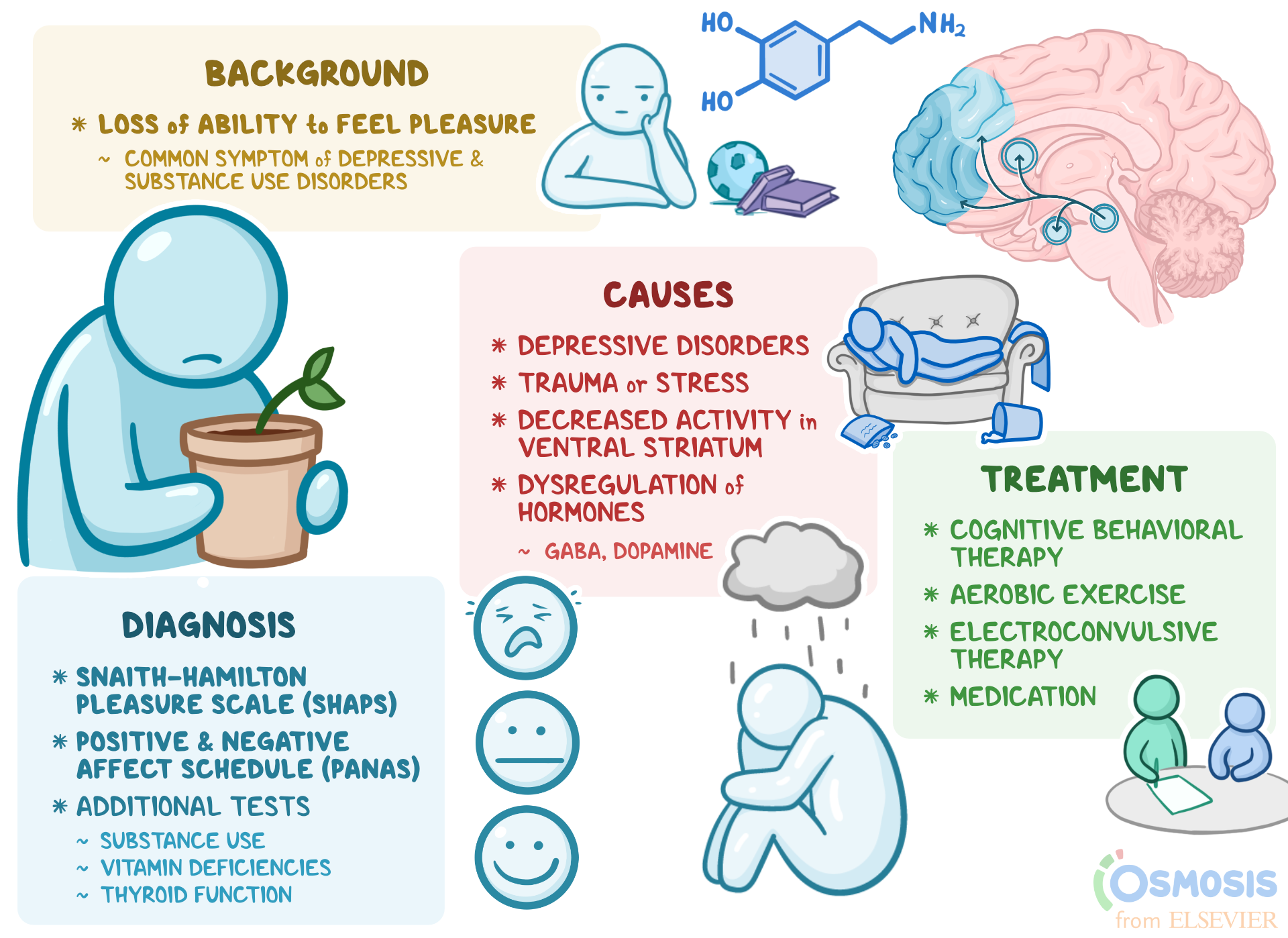
And people who don't have enough of it, they suffer from one of the most common aspects of clinical depression, which is known as anhedonia, the inability to feel pleasure.
Arthur BrooksHOST
Anhedonia, it's got its own word, of course.
Arthur BrooksHOST
You know, one of the characteristics is if you go to the doctor and you say, you know, everything I used to like, I don't like it anymore.
Arthur BrooksHOST
That anhedonia ordinarily means that you have a deficit of dopamine.

CarmenHOST
Maybe showering feels like an expedition, noise feels sharper, conversation costs more, and skills used to rely on are suddenly buffering like the world's saddest Wi-Fi connection.
CarmenHOST
So, what is happening here? ADHD motivation? Anhedonia? Autistic burnout? Depression? A deluxe combo platter that nobody ordered? Today, we're going to name the experience.
CarmenHOST
Look at the brain and body underneath it.
CarmenHOST
Remove the moral judgment.
CarmenHOST
because dopamine is involved in multiple processes, including learning, anticipation, effort, and salience.
CarmenHOST
The science is more complicated than the sad little dopamine tank with a leak.
CarmenHOST
Anhedonia is different.
CarmenHOST
It means a reduced ability to feel interest or pleasure.

Judith JosephGUEST
And it's not something to ignore.
Judith JosephGUEST
Anhedonia shows up across mental health conditions from substance abuse to dementia to schizophrenia to depression.
Judith JosephGUEST
It's something that we need to learn how to detect.
Allison AubreyHOST
So Genevieve goes into this long period after the restaurant closes where she's feeling depressed.

Henry CloudGUEST
You sink into a grief, and as you process all of that, you are, you're listening your grip to let go, and you're in a phase that grief has to do its work.
Henry CloudGUEST
And one of the things that happens in grief is we experience something called anhedonia, which is, you know, if you think about hedonism as loving life, doing all the things that make you happy, even shouldn't do the bad ones, but the good ones.
Henry CloudGUEST
Anhedonia is the inability to derive pleasure from just waking up and doing things.
Henry CloudGUEST
And so I would think that it, I would want to normalize for you that it's been hard in recent months probably to figure out what you want to do because want includes desire and it's hard to have that in a grief period.
Henry CloudGUEST
So first of all, I'd normalize it that it's okay where you are, that's pretty normal.

Scott AlexanderHOST
He describes flattening of affect, the loss of pleasure in things he used to enjoy, the slow strangulation of his relationship with his partner, who appears in earlier entries as a person and disappears by the latter entries into the background like a piece of furniture.
Scott AlexanderHOST
Anhedonia, withdrawal, sleep disturbance that is not just situational.
Scott AlexanderHOST
The diagnosis is forming on the page, and Kate does not quite have the framework to recognize it.
Scott AlexanderHOST
Then comes the climactic case, the laden straw that would give even the most long-suffering camel a prolapsed disc.

Ben FuchsHOST
A Parkinson's tremor is the inability to perform functions that we all take for granted that are driven, at least partially, by dopamine because of the pleasure link.
Ben FuchsHOST
And by the way, there's a condition called anhedonia.
Ben FuchsHOST
Anhedonia means without pleasure.
Ben FuchsHOST
Hedonism, hedonia means pleasure.
Ben FuchsHOST
An means without.
Ben FuchsHOST
Anhedonia, like hedonism.
Ben FuchsHOST
Anhedonia, it's a disease, a pathology, a symptom really, of Parkinson's.
Ben FuchsHOST
And Parkinson's is associated with depression.

Robin Carhart-HarrisGUEST
And then I'm hearing about some other domains that contribute as well to a diagnosis such as cognitive impairment, inability to think clearly, sleep problems, yeah, a general sort of slowing cognitively and motor, so movement, and often suicidal ideation as well being another sort of sub-factor here.
Robin Carhart-HarrisGUEST
But the core would be the low mood and the anhedonia.
Robin Carhart-HarrisGUEST
Anhedonia is the inability to feel pleasure.
Robin Carhart-HarrisGUEST
And then, you know, one from a cluster of other potential symptoms.
Robin Carhart-HarrisGUEST
Yeah, and so if doctor is hearing this, then they write out that prescription, you know, it might be major depressive disorder.

Steve KassemGUEST
different parts of your brain involved in memory learning and decision making but what's unique about this research study is it's the first one to be able to link it directly one to two between childhood stress slash trauma and anhedonia, which is what you're talking about, which is a form of depression, which is what all the researchers in this space have indicated as well.
Steve KassemGUEST
Severe childhood stress is indicative of depression.
Steve KassemGUEST
Anhedonia is a type of depression, meaning you don't
Tim WebsterHOST
actually experience
Steve KassemGUEST
joy anymore.

Early BrunnerHOST
That was why I felt nothing.
Early BrunnerHOST
And it's also called anhedonia.
Early BrunnerHOST
Anhedonia is our inability to feel pleasure.
Early BrunnerHOST
It's often connected with depression, but it can be something that continues on for like quite a while after you quit using substances because it takes a while for the body to re-regulate to learn that small levels of dopamine are what we're going to be expecting now.
Early BrunnerHOST
And for those things to actually feel good.

Ramani DurvasulaHOST
Having negative emotions, depression, anxiety, even anger or irritability.
Ramani DurvasulaHOST
Anhedonia, we've talked about this word before, not getting pleasure out of activities that have traditionally been joyful for you or happy for you.
Ramani DurvasulaHOST
Feeling more detached from other people and having difficulty experiencing any kind of positive emotion.
Ramani DurvasulaHOST
A person going through traumatic stress might find it hard to laugh or be joyful in a given moment.
3 more episodes mention anhedonia.
Create an account to see the whole feed, search across every transcript, and follow the entities you care about.