Angular momentum
71
MENTIONS
5
EPISODES
4
PODCASTS
Search complete. 71 mentions across 5 episodes found for "Angular momentum".
Oct 9, 2026

WolfmanHOST
Conservation laws.
WolfmanHOST
This states that the total energy, momentum, and angular momentum remain constant in an isolated system.
WolfmanHOST
We calculate the momentum of a system and we treat the system as one specific system, an isolated system.
WolfmanHOST
Force laws.
WolfmanHOST
And we are back.
WolfmanHOST
I wanted to get more into the subject here so we can look at this online course.
WolfmanHOST
This first course in the physics curriculum introduces classical mechanics, historically a set of core concepts, space, time, mass, force, momentum, torque, and and angular momentum were introduced in classical mechanics in order to solve the most famous physics problem, the motion of the planets.
WolfmanHOST
The principles of mechanics successfully described many other phenomena encountered in the world.

Ramamurti ShankarHOST
You remember in the world of rotation, we defined something called momentum, which is mass times velocity.
Ramamurti ShankarHOST
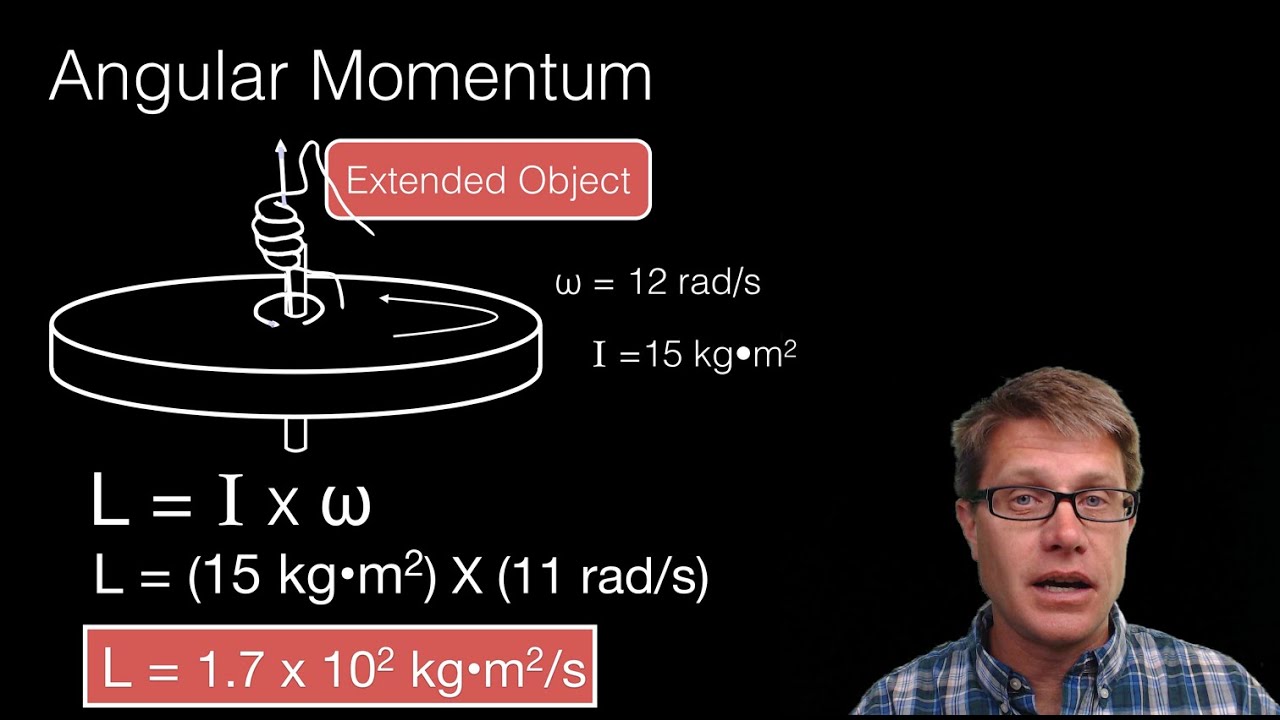
Here, we're going to call something called angular momentum.
Ramamurti ShankarHOST
It's going to be I times ω.
Ramamurti ShankarHOST
This I is called the angular So, one extremely important point that you guys should notice is that all the concepts I'm using, like mass and energy, they are the same old concepts that we learned earlier on.
Ramamurti ShankarHOST
The fact that it's a rotating body doesn't change anything, okay? Kinetic energy still means the same.
Ramamurti ShankarHOST
This k, though it looks so different, is in fact the ½ mv² of every part of the body So, this L is called angular momentum.
Ramamurti ShankarHOST
It'll take a while to get used to this, but right now, it's a product of the moment of inertia and the angular velocity.
Ramamurti ShankarHOST
So now, we are looking for the most important equation in that's going to be equal to some mystery object.
Ramamurti ShankarHOST
We're going to take a rather simpler version of the rigid body problem, basically the problem of torques and forces in 3-D, but apply it in a very limited context.
Ramamurti ShankarHOST
The limited context I've set for myself right now is to just What is the analog of τ equals iα when the mass is not moving in the xy plane but just running around all over three dimensions? How do we define torque? How do we define angular momentum in 3D? You'll find that it's not a straightforward extension.
Ramamurti ShankarHOST
You have to think a little harder.
Ramamurti ShankarHOST
Let me motivate the problem we have.
11 MINS LATER
Ramamurti ShankarHOST
I hope you know what that means.
Ramamurti ShankarHOST
If a force is acting at the point with vector r, measured from some origin, the torque due to that force is r x F.
Ramamurti ShankarHOST
Now, I'm going to introduce for a single point mass, somewhere here, an angular momentum, the angular momentum.
Ramamurti ShankarHOST
Previously, angular momentum, iω, is not a vector.

Andrew DunkleyHOST
Uh, Martin, one of our regular contributors, has a dark matter he wants to discuss.
Andrew DunkleyHOST
Uh, Peter in Sweden is talking angular momentum.
Andrew DunkleyHOST
Uh, that is the angular momentum of matter falling into a black hole.
Andrew DunkleyHOST
And a real bummer of a question.
Andrew DunkleyHOST
We'll tell you all about it on this episode of Space Nuts.
20 MINS LATER
Fred WatsonGUEST
Space Nuts.
Andrew DunkleyHOST
Our next question comes from Sweden.
Andrew DunkleyHOST
Uh, can matter that falls into a black hole keep its angular momentum and sort of add it to the black hole's angular momentum? Uh, or does matter fall into a black hole, um, or does matter falling into a black hole need to shed its angular momentum or part of it through, uh, radiating energy out into space before it can fall down the hole? If so, why can't a black hole that can retain light and, uh, spaghettify things, pull things in despite their angular momentum and just add the incoming momentum to itself? That comes from Peter in Sweden.

Andrew DunkleyHOST
Martin, one of our regular contributors, has a dark matter he wants to discuss.
Andrew DunkleyHOST
Peter in Sweden is talking angular momentum.
Andrew DunkleyHOST
That is the angular momentum of matter falling into a black hole.
Andrew DunkleyHOST
And a real bummer of a question.
Andrew DunkleyHOST
We'll tell you all about it on this episode of Space Nuts.
17 MINS LATER
speaker_2NARRATOR
Space Nuts.
Andrew DunkleyHOST
Our next question comes from Sweden.
Andrew DunkleyHOST
Can matter that falls into a black hole keep its angular momentum and sort of add it to the black hole's angular momentum? Or does matter fall into a black hole Or does matter falling into a black hole need to shed its angular momentum or part of it through radiating energy out into space before it can fall down the hole? If so, why can't a black hole that can retain light and spaghettify things pull things in despite their angular momentum and just add the incoming momentum to itself? That comes from Peter.